
November 11, 2011
Virtually every day, news from Europe affects the U.S. financial markets and economy. The European Union recently slashed its 2012 GDP growth forecast from 1.9% to 0.6%. Clearly, the difficulty European policy makers face in resolving budget and debt problems in Greece and Italy is undermining investment and consumer confidence. This situation impacts the U.S. through both the traditional trade channel, and the financial channel should either country default on its debt payments.
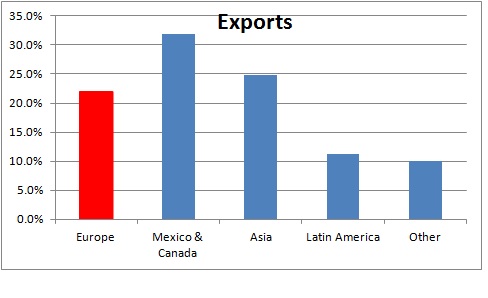
With respect the trade, it is important to remember that exports are only 10% of our economy. Furthermore, the bulk of that trade is done with our neighbors to the north and south. As shown below, exports to Canada and Mexico combined account for almost one-third of the total. Asia represents another 25% — led by exports to China and Japan. Exports to Europe are 22% of the pie. Thus, trade represents about 10% of our economy, and trade with Europe is 22% of the total. This means that exports to Europe account for only about 2% of GDP. Economic activity in the U.S. is not going to be significantly impacted if growth in Europe is reduced by 1.3%. That change should shave about 0.3% off U.S. GDP growth in 2012. Trade with Europe matters for the U.S., but there are more urgent matters.
The more important channel by which events in Europe can impact the U.S. is through the financial markets. A default by Greece would raise concerns about sovereign debt in Italy, Spain and elsewhere. Interest rates those countries pay to finance their budget deficits would rise, government expenditures climb, and budget deficits widen. As a result, even larger tax increases or cuts in government spending would be required to shrink the deficit, which weakens the economy further and exacerbates the problem. And on it goes.
Meanwhile, banks that hold this sovereign debt begin to have difficulties as that debt declines in value. When Europe’s leaders approved a 50% haircut on outstanding Greek debt, it means that owners of that debt – largely banks – are only going to get $0.50 on every dollar of Greek debt they own. As banks write down the value of their Greek debt, they incur losses. The stock market declines as bank stocks fall sharply. The markets begin to worry that the lower value of bank assets might create problems with solvency. Some banks could fail.
It is easy to envision a very dark scenario, not just for Europe, but for stock markets and economies around the globe. And, indeed, all of the events described above have already occurred to some extent as investor concern has been shaken. But how realistic are these fears?
In the short-term it is our sense that the fears are overblown. It is clear that the European Union is not going to let any country default on its debt as long as that country makes a good faith effort to reduce its budget deficit and implement measures to stimulate growth. The EU has reduced Greece’s debt burden by 50% and approved a renegotiated bailout package which enables Greece to borrow up to 100 billion Euros. Its new Prime Minister Lucas Papademos is a former vice president of the European Central Bank and a former governor of the Bank of Greece. His credibility should secure the necessary funding from the European Union to avoid a near term default. The resignation of Italian Prime Minister Berlusconi and the formation of a national unity government should please market participants and reduce long-term interest rates for Italy which have climbed to a 14-year high of 6.8%.
With the possibility of a default by Greece virtually eliminated for now, European commercial banks should weather the storm. As these banks act to boost capital, it is likely that bank stocks, which have fallen sharply in recent months, should rebound.
But make no mistake that in the longer term Greece and Italy must implement measures to boost growth in their economies and trim government spending sharply. The massive changes necessary will be difficult to achieve. The markets will gyrate wildly as the political situation changes from one day to the next but, hopefully, the worst is behind us.
Stephen Slifer
NumberNomics
Charleston, SC
Follow Me