
May 8, 2015
Everybody wants the economy to grow quickly to eliminate the “slack” that developed in the wake of the 2008-2009 Great Repression. However, that “slack” in the economy will disappear by yearend. If growth continues at a 3.0% pace in 2016 it will not be long before inflation becomes a problem. Once inflation begins to rise the Fed will be forced to raise rates more quickly. That, in turn, will begin the countdown towards the end of the expansion. It is far better for the Fed to start early and raise rates slowly then to fall behind and have to play catch-up later.
The economy has a longer-term speed limit which is generally believed to be about 2.0%. That growth rate is determined by the growth rates for the labor force and productivity.
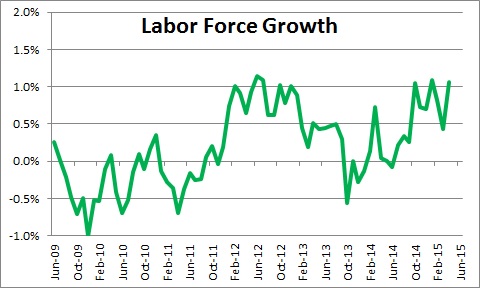
The economy needs to expand quickly enough to keep pace with growth in the labor force. If it does so, everyone who wants a job will have one and the unemployment rate will bounce along at its full employment threshold which is generally regarded as about 5.5%. Unfortunately, the labor force is highly volatile on a month-to-month so one needs a relatively long-run average to determine the trend. Since the end of the recession the labor force has grown at about a 0.5% rate so perhaps that is a reasonable guesstimate for the first part of the equation.
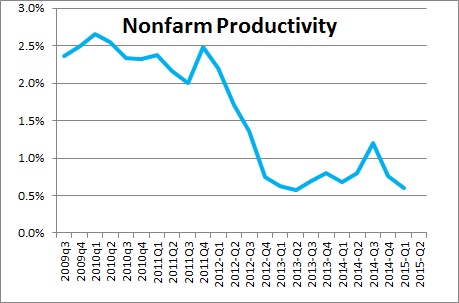
If employers provide their workers with the latest technology then productivity will grow and more goods can be produced. But productivity growth is also volatile. Since the end of the recession it has grown by about 1.5% so perhaps this is a decent guess for the second part of the equation.
If the labor force grows by 0.5% and productivity by 1.5%, then the economy’s speed limit – known as “potential growth” — is about 2.0%. From that growth rate we can calculate the level of GDP that is necessary if everyone in the country who wants a job has one and if our factories are running at full speed. That potential GDP path should be regarded as the Fed’s wish list.
But occasionally the economy hits a speed bump and slips into recession (the shaded areas in the chart below). Consumers panic and reduce their purchases of cars, houses, and lots of other items. Businesses slow their rate of production. Workers get laid off and the unemployment rate climbs. As a result, actual GDP slips below its potential growth path. The gap between the two reflects the degree of “slack” in the economy and is a visual representation of the deepness of the recession. The 2008-2009 experience was the worst downturn since the Great Depression in the 1930’s.
At its peak in 2009 the unemployment rate was 10.0% (versus full employment of about 5.5%). The factory utilization rate dipped to 64% (versus its long-term average of about 78%. There was lots of “slack” in the economy.
Once the recession ends the economy grows fairly quickly for a while. If it grows at 3.0% and potential growth is 2.0%, then the slack in the economy begins to shrink. If that continues for a long enough period of time that slack will eventually disappear. That is about where the economy is now. By yearend the economy will have returned to its potential growth path.

For the past six years the Fed believed that the economy needed considerable stimulus because so much “slack” existed and it wanted to do everything in its power to boost growth and eliminate the gap between actual and potential GDP as quickly as possible. But by the end of this year that slack will disappear. If the economy continues to grow at a 3.0% pace in 2016 actual GDP will rise above potential. Shortages will develop. Firms will be unable to find the workers they need. Wages will begin to climb. Factories will run at full throttle. Manufacturers will take advantage of that opportunity to raise prices. Inflation will accelerate. Actual GDP above potential is not a good thing.
It is time for the Fed to adopt a different policy stance. The economy no longer needs 0% interest rates. If the Fed lets actual GDP rise too far above potential and inflation begins to accelerate, the Fed will be forced to raise rates more quickly. The faster rates rise the sooner the expansion will end. The Fed needs to start early and stay ahead of the game. Have courage. Just do it.
Stephen Slifer
NumberNomics
Charleston, SC
Follow Me