
April 22, 2016
Contrary to expectations interest rates have not risen this year and the dollar has not increased in value. Convention wisdom was that the Fed would raise the funds rate four times this year. Faster GDP growth and higher interest rates in the U.S. combined with falling rates elsewhere would cause the dollar to strengthen. Neither of those things happened.
The catalyst for this unanticipated outcome was the Fed’s announcement in March that it only intended to raise the funds rate twice this year rather than four times. This means that the yearend funds rate is now likely to be 1.0% rather than 1.5% as the Fed expected previously. Fed officials were reacting to the flow of information on the economy in the first quarter which was weaker than expected. On Thursday we should learn that first quarter growth was about 1.0% rather than the 2.5% that economists had projected at yearend. At the same time the inflation data have remained subdued. Against this backdrop the Fed felt comfortable shifting to a slower path of rate increases. Whether the Fed will stick with this revised schedule will depend upon the flow of data in the months ahead.

The markets reacted sharply to the Fed’s announcement and all interest rates from short rates to bond yields have fallen by about the same amount. As a result, mortgage rates at 3.5% are within a whisker of the record low of 3.35% set in December 2012 which was the lowest level in almost 50 years!
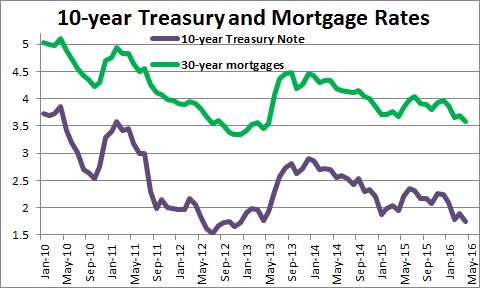
Corporate borrowing rates have done the same thing. They, too, are approaching their lowest level in decades. If corporations want to borrow to finance a new project, or re-finance outstanding debt, this is an unexpected opportunity.

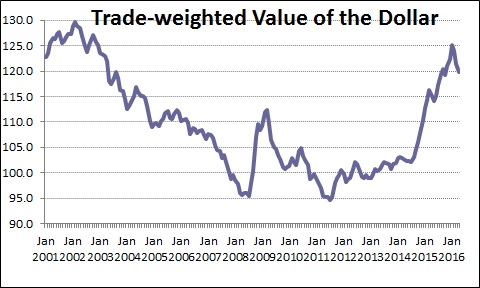
The drop in interest rates has also affected the dollar. The dollar began a steady 18-month upswing in August 2014 as oil prices began to collapse. Market participants around the globe concluded that lower oil prices would not only provide considerable economic stimulus, they would keep inflation in check and prevent the Fed from raising interest rates for a protracted period of time. That dollar surged 22% between August 2014 and January 2016. But it reversed direction after the Fed’s March announcement and has now declined about 4% in the past three months. For the U.S. that is a good thing. As the dollar climbed U.S. goods became more expensive for foreigners to purchase. As a result, exports declined and the trade component subtracted 0.6% from GDP growth last year. If the dollar levels off, that relentless drag on economic activity will disappear.
Clearly, lower interest rates will re-invigorate the pace of economic activity. The economy has been supported by consumer spending and housing throughout 2015. Lower rates will keep consumers happy and willing to spend for some time to come. At the same time a lower level of the dollar should boost exports and eliminate the trade drag on growth. Thus, most economists expect growth of 2.5% in the final three quarters of the year. Do not be too disappointed with the first quarter GDP data when they are released. The press will undoubtedly highlight the fact that GDP rose only 1.0% in the first quarter after having risen 1.4% in the fourth quarter. Analysts will suggest that the economy is on the brink of collapse. Nothing could be farther from the truth. Faster growth lies ahead as lower interest rates and a lower level for the dollar work their magic. Because the stock market is currently within 1% of a record high level investors certainly do not think that the economy is on the verge of collapse.

One might argue that this slower path of rate hikes might encourage the Fed to abandon its plan to gradually push rates higher. Not a chance. A neutral level for the funds rate is about 3.25% not 0.25%. The Fed must steadily push rates higher. Even after its announcement in March the Fed still anticipates two rate hikes this year and, at the moment it is willing to proceed at a more leisurely pace than expected just a few months ago. As long as inflationary expectations remain in check it can afford to do so. However, faster GDP growth and an increase in oil prices could boost inflation in the months ahead and alter this rosy scenario.
Stephen Slifer
NumberNomics
Charleston, SC
Follow Me