
January 6, 2012
For the past several years the economy has been held back by an inability to create a significant number of new jobs. As the economy moves into a new year the labor market is vigorously turning around, which creates hope that 2012 may be a far better year than most economists expected just a few months ago.
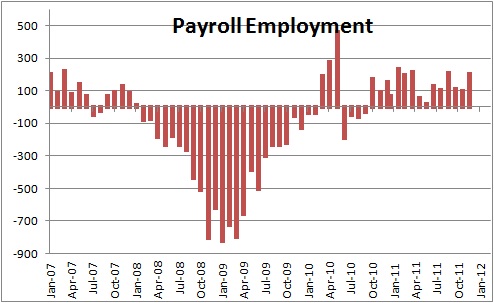
Payroll employment rose 200 thousand in December which, while acceptable, is nothing to write home about. However, the labor market is far more robust than the headline increase suggests. An often over-looked part of the monthly employment report is the change in the workweek.
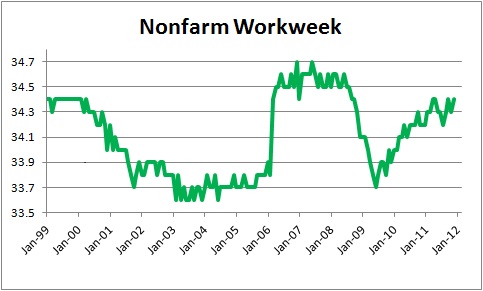
If firms need to boost production they can do it in two ways. They might choose to hire additional workers. Or they could decide to work their current employees longer hours. In December they did both. They added 200 thousand workers to their payrolls. But they also lengthened the workweek by 0.1 hour. Neither change seems very impressive. However, if firms had chosen to boost December output exclusively through new hiring, payroll employment would have risen by an eye-popping 584 thousand. That would have gotten our attention! A seemingly modest 0.1 hour advance in the workweek is powerful!
At its current level of 34.4 hours, the workweek is approaching the 34.6 level that existed prior to the recession. This means that employers have little ability to expand production by working people longer hours.
While private sector employment is currently rising by about 160 thousand per month, there can be little doubt that bigger gains lie ahead. We know, for example, that the pace of economic activity is accelerating. GDP rose 2.0% in the third quarter, and we will learn at the end January that fourth quarter growth quickened to almost a 4.0% pace. To satisfy that increased appetite for goods and services, firms have been laying off fewer workers, hiring more bodies, and working their existing labor force longer hours.
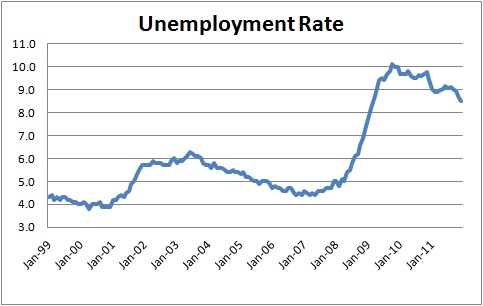
As they boost the pace of hiring the unemployment rate has begun to fall, and the rate of descent is accelerating. The unemployment rate peaked at 10.1% in October 2009 and began a painfully slow descent for the next two years. However, the rate of decline has picked up. The unemployment rate has fallen steadily from 9.1% in August to 8.5% by the end of the year – that is a 0.6% drop in just four months.
While the employment gains in recent months have been relatively widespread, two sectors of the labor market are noteworthy.
Construction. As the housing sector contracted during the recession, construction jobs were routinely falling by 100-150 thousand per month. Those job losses have been reduced to a trickle. With virtually every housing sector indicator pointing upwards – new and existing home sales, pending sales, housing affordability, record low inventory levels, housing starts, building permits, and construction spending – there can be little doubt that construction employment is going to climb quickly in the months ahead. In December employment in the industry rose 17 thousand which may well be the beginning of a new trend.
State and local governments. Municipalities have been laying off thousands of workers for the past two years. As the economy contracted, tax receipts plunged. To produce balanced budgets government entities were forced to fire teachers, police and firefighters. In the middle of last year state and local government jobs were disappearing at the rate of about 50 thousand per month. But as the economy accelerates and tax receipts rebound, the pressure to lay off workers will subside. In December government job losses contracted by just 14 thousand and they should soon stop falling entirely.
Thus, two sectors of the labor market which have been steadily losing jobs are turning around. There can be little doubt that more impressive jobs gains will emerge in the months ahead. As the pace of hiring gathers momentum, the unemployment rate should begin a steady decline. As more unemployed workers find jobs, income will grow more quickly. A virtuous cycle of faster spending leading to more jobs and faster growth in income, will produce second and third rounds characterized by more of the same.
Stephen Slifer
NumberNomics
Charleston, SC
Follow Me