
June 16, 2019
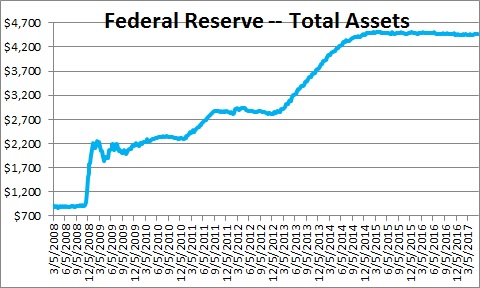
The Federal Reserve’s Open Market Committee met this week and, as expected, raised the funds rate to the 1.0% mark. It continues to expect a slow but steady pace of additional rate hikes over the next several years, eventually pushing the funds rate to 3.0% sometime in the first half of 2020. That part of the Fed’s “normalization” process has not changed. But there is a necessary second step. Following the Fed’s bond buying binge between October 2008 and October 2014, its balance sheet skyrocketed from $900 billion to its current level of $4.4 trillion. It needs to shrink its portfolio dramatically and, at its meeting earlier this month, it laid out a game plan for how it intends to proceed. It will be a very gradual, lengthy process which will drag on well into the 2020’s. The Fed is not going to trigger a recession by shrinking its balance sheet too quickly.
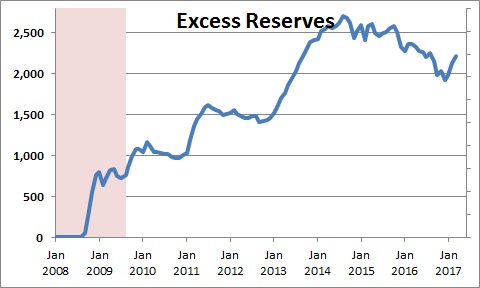
As the Fed purchased its combination of U.S. Treasury and mortgage-backed securities, it flooded the banking system with surplus reserves which skyrocketed from about $0.1 billion in late 2008 to $2.25 trillion currently. Because those funds represent the ability of the banking system to lend to consumers and businesses, they need to be eliminated to prevent a potentially inflationary spending spree at some point down the road. The Fed will accomplish that objective by shrinking its balance sheet. But how will it go about that?
Basically, the Fed has two options. First, it could go into the market and sell some of its current holdings of securities. Doing so would shrink its balance sheet quickly. But the Fed is concerned that such action would be disruptive to the bond market and could push long-term interest rates sharply higher which would pose a risk to the ongoing expansion. That is not the desired outcome.
Second, it could accomplish the same objective by running off some of its holdings of U.S. Treasury and mortgage-backed securities by simply not replacing them when they mature. But given that the Fed’s portfolio has an average duration of almost ten years, this will be a very slow process.
Once this program begins later this year (presumably at its early November meeting) it will initially run off $6 billion of U.S. Treasury securities per month for the first three months. At the same time it will run off $4 billion of its holdings of U.S. agency and mortgage-backed securities. Thus, at the beginning it will allow a total of $10 billion of its security holdings to run off for the first three months. It then plans to increase that total amount by $10 billion every three months until it reaches a cap of $50 billion per month. It would reach that limit at the end of its first year of implementation. Doing the math, it means that the Fed’s portfolio will have shrunk to the desired level by the end of 2022.
Keep in mind that the Fed does not need to shrink its balance sheet back to the $900 billion level that existed prior to the recession. It wants its portfolio to grow roughly in line with growth in nominal GDP, or about 4.0% annually. That means that the desired balance sheet level at the end of this year will be about $1.3 trillion and it will grow at roughly a 4.0% pace every year thereafter to $1.6 trillion by the end of 2022.
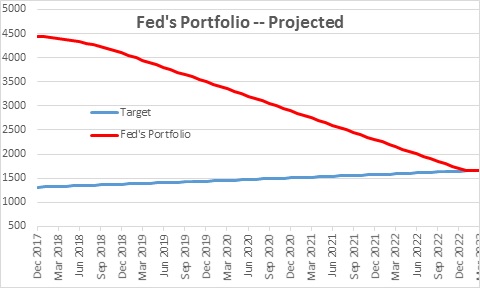
If the Fed does what it is suggesting, the Fed’s balance sheet will have shrink by $2.8 trillion from $4.4 trillion currently to the $1.6 trillion target level during the next five years. But that is not going to happen.
According to data reported by the Fed, it has only $1.5 trillion of securities maturing within the next five years, and an additional $0.4 trillion maturing between 5-10 years. All the rest of its security holdings have a maturity date in excess of ten years. Thus, more realistically, Fed holdings will not return to their target level until 2031.
The point is that the Fed will have a two-pronged approach towards “neutralizing” monetary policy. First, it intends to use the funds rate as its primary policy tool. The funds rate should reach its so-called “neutral” level by early 2020. Second, it will gradually return its balance sheet to a desired level. The Fed says that should happen within five years. But given the maturity schedule of the securities held in its portfolio that process may not be complete until 14 years from now. Thus, the Fed has made it abundantly clear that it is unwilling to let its policy become the catalyst for the next recession – at least not in the near term. If inflation heats up and the Fed needs to cool the economy, its policy approach will change, but that is not going to happen any time soon.
Stephen Slifer
NumberNomics
Charleston, S.C.
Follow Me