
September 22, 2017
At its FOMC gathering this week the Fed left the federal funds rate at its current level of 1.0-1.25%. That was not a surprise. The important takeaway from this meeting is that the Fed intends to continue on a path of slowly returning monetary policy to a neutral stance. That implies two things. First, FOMC members intend to gradually raise the funds rate to an estimated equilibrium rate of 2.9% by early 2020. Second, beginning in October the Fed will gradually reduce the size of its portfolio and thereby shrink the volume of excess reserves in the system. It did not specify exactly what the ultimate size of its portfolio should be, but it is clear that getting there will be a multi-year process and unlikely to be completed until mid-2023. All of us need to understand that the days of ultra-easy monetary policy have come to a halt. It is equally important to understand that with the snail-like pace of normalization, the risk that the Fed will raise rates too quickly and inadvertently push the economy into recession is minimal for the next several years.
With respect to the funds rate, the projected glide path is little different from what the Fed has described previously. The biggest difference is that, for the first time, they provide a glimpse of their expectations for GDP growth, the unemployment rate, inflation, and the level of the federal funds rate for 2020. The Fed anticipates one final rate hike in 2020 which would bring the funds rate to 2.9%, which happens to be its estimate of the long-term equilibrium rate. At that point short rates would no longer be “stimulative”. For the first time in more than a decade they would be “neutral”.

For the Fed to follow that trajectory for the federal funds rate several things must happen. First, the Fed expects GDP growth to be essentially 2.0% in in 2018, 2019, and 2020. It believes that the economy’s “potential growth rate is 1.8%. With the economy at full employment and growing at a pace only marginally faster than potential, the unemployment rate will decline very slowly. It is at 4.4% currently. The Fed expects it to fall only 0.2% in the next three years to 4.2% by the end of 2020. Similarly, with GDP growth only slightly exceeding its potential growth path, the Fed expects the inflation rate (as measured by its preferred measure which is the personal consumption expenditures deflator) to climb from 1.4% currently to 2.0% throughout the entire 2018-2020 period.
If all of that transpires the Fed would achieve its two stated goals of full employment and a 2.0% inflation rate.
The other important part of the Fed’s formal announcement this week is that it intends to gradually reduce its holdings of U.S. Treasury and mortgage-backed securities beginning next month. Initially it will reduce its holdings by $6 billion per month. The monthly reduction in its security holdings will increase in steps of $6 billion at three month internals until it reaches $50 billion per month. At that pace it will take until mid-2023 for its portfolio to shrink to the level the Fed believes is the minimum necessary to effectively implement monetary policy.
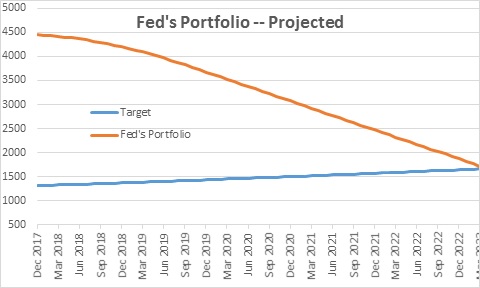
But nothing about this forecast is cast in stone. The Fed believes that potential GDP growth will be steady at 1.8% between now and 2020. Our sense is that individual and corporate income tax rates will be cut, and that Trump will continue to eliminate unnecessary and duplicative Federal regulations. That combination of policy changes will significantly boost corporate spending on technology, new plants, and equipment. The additional investment spending, in turn, will boost productivity growth. As a result, we believe that between now and 2020 potential GDP growth will accelerate from 1.8% to perhaps 2.8%. If actual GDP growth is roughly in line with this faster potential growth pace, then the inflation rate should not exceed the Fed’s 2.0% target. However, faster nominal GDP growth will imply higher interest rates, in particular a higher equilibrium level for the funds rate (perhaps 3.5%).
But nobody – neither the Fed nor us – knows what the president and Congress will be able to achieve. But if we are right and some of the previously described policy changes are implemented, the Fed’s current forecasts of GDP growth, the inflation rate, and the equilibrium funds rate will change. But make no mistake. Regardless of which set of forecasts might be more accurate, the Fed has told us as explicitly as it can, that it intends to very gradually, but steadily, return its monetary policy to a more neutral stance. They key word, in our view, is “gradual”. The gradual nature of the described rate hikes, and the gradual shrinkage of its balance sheet, will allow the economy to remain on a steady growth path through 2020. If that occurs the expansion will break the current record of 120 consecutive months (or exactly 10 years) established during the decade of the 1990’s and become the longest expansion on record. That would be an impressive outcome.
Gradual is good.
Stephen Slifer
NumberNomics
Charleston, S.C.
Follow Me