
April 10, 2015
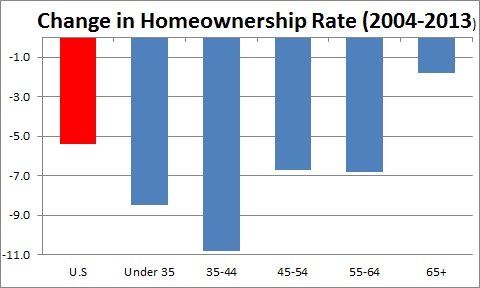
Home ownership has been falling steadily for a decade. Several factors are at work. First, the housing bubble made home ownership affordable for a large number of lower income Americans as down payments fell to 0% and income verification ceased to be a requirement. Unfortunately, many of those people should never have become home owners. When the Fed raised short-term interest rates in 2005 and 2006, adjustable rate mortgages re-priced upward and monthly payments increased dramatically. Many people fell behind on their payments and eventually lost their homes to foreclosure and were forced to rent. Thus, a large part of the drop in home ownership reflects the bursting of the housing bubble.

While home ownership has declined for every age group it has been concentrated amongst younger Americans, specifically the under 35- and 35-44 year old age brackets. In the wake of the Great Recession these younger people faced a high unemployment rate and slow wage growth. Many were saddled with student debt. As a result, they lived in their parent’s homes for a much longer period of time than in the past and were forced to take whatever low-paying jobs they could find. Their lack of interest in home ownership may also reflect a desire not to be tied down by home ownership. Whether by choice or simply because they are unable to qualify for a mortgage, many of these young folks have chosen to rent. What has not been clear is whether this reflects a cyclical adjustment or a more long-lasting change in behavior.
As the economy completes its sixth year of expansion younger adults are finding jobs more readily. They also appear to believe that mortgage rates will remain low for some time even as the Fed begins to raise short-term interest rates. As a result, they are beginning to leave their parents’ home and venture out on their own. The Census Bureau recently reported a sharp increase in household formation. In fact, it is now rising at the fastest rate in a decade.

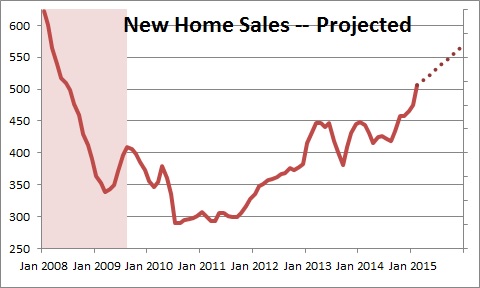
This has enormous implications for the housing sector. First time home buyers account for 40% of all home purchases. Thus, a pickup in the pace of household formation should stimulate sales of both new and existing homes, particularly for lower-priced homes. Indeed, new home sales unexpectedly surged in December, January, and February. They climbed at an astonishing 80% annual rate during that period of time. Now we know why. Looking ahead it is easy to envision a selling rate of 560 thousand by the end of this year which would be the fastest pace in eight years.
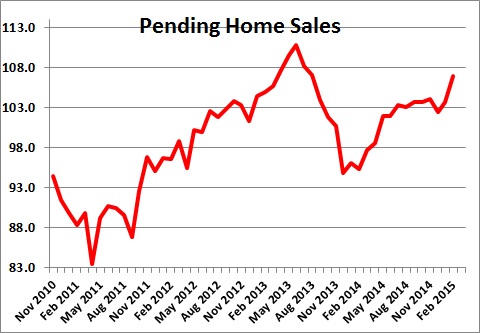
Existing home sales have not yet demonstrated a similar pickup, but pending home sales surged in February which implies that existing sales will climb in the months ahead.
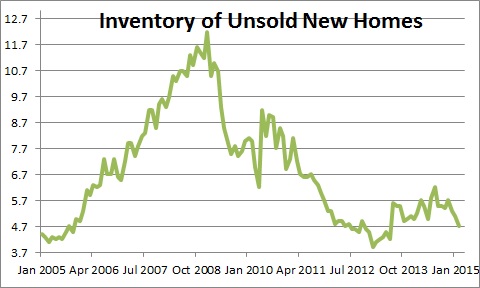
Given the pickup in the pace of new home sales, the available inventory of unsold homes fell to a 4.7 month supply in February which is far below the 6.0 month supply that is generally regarded as the point at which the demand for and supply of new homes are roughly in balance. Thus, the pressure is on builders to step up the pace.
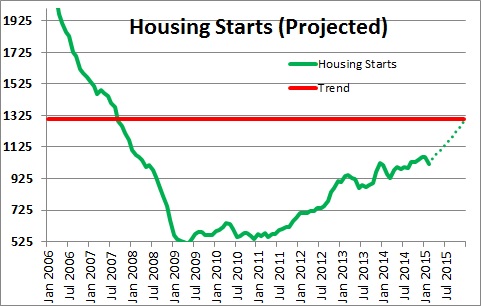
The problem is that builders are having difficulties finding an adequate supply of labor. Many immigrant workers once relied upon by builders left the country once the housing bubble burst. Many builders are also reporting challenges in finding available lots for development. And credit remains tight for speculative projects. That said, we expect single-family starts to climb 15% this year to 800 thousand while multi-family units jump 38% to 500 thousand. If housing starts reach the 1,300 thousand mark by the end of this year that would be the fastest pace of sales since August 2007.
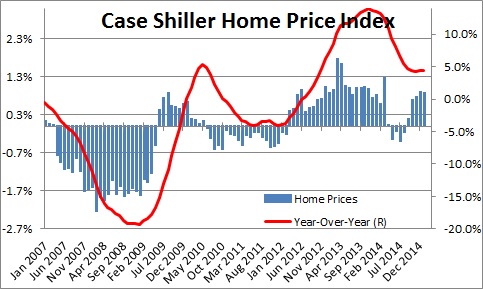
The robust demand for new homes should boost home prices considerably. Right now the Case-Shiller Index has risen 4.4% in the past year. However, in the most recent 3-month period prices have been climbing at a steamy 10.3% pace. If builders are unable to keep pace with the ambitious construction schedule described above, home prices could increase at a double-digit pace this year which would negatively impact sales later this year. As it stands we expect home prices to rise about 8.0% in 2015.
The important point is that first time home buyers have resurfaced. This will boost the pace of home sales, housing starts, and home prices more sharply than we anticipated at the beginning of this year.
Stephen Slifer
NumberNomics
Charleston, SC
Follow Me