
November 28, 2014
As we move into the final days of 2014 it is time to think about some important developments that will impact the economic outlook for next year. Think about the following:
1. How close is the economy to full employment? With the current unemployment rate at 5.8% and full employment (the level at which everyone who wants a job has one) presumed to be about 5.5% it would appear that the economy is close to the desired level. But what if the full employment level is lower, say, 5.0%? If that is the case the Fed would postpone any tightening move for some period of time. We think that we are already seeing some upward pressure on labor costs being reported by businesses. The employment cost index has risen more rapidly in the past two quarters. If labor costs are beginning to rise we contend that the economy is approaching full employment. But could the full employment level be lower? Maybe.

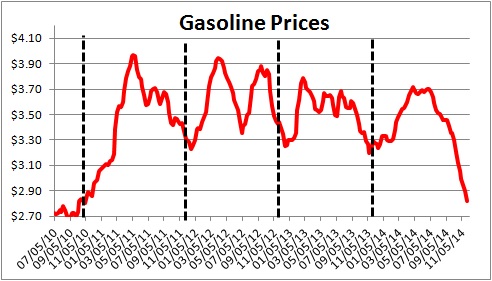
2. What is the new equilibrium price of crude oil and/or gasoline? How does OPEC respond? The increased supply of oil from shale producers in the United States has dramatically increased the supply of oil which has lowered crude oil prices from $107 in June to $70 currently and gasoline prices from $3.70 to $2.75. But gasoline prices are highly seasonal and always fall sharply between July and mid-November and then reverse direction and head higher between December and June. This year should be no exception. But as shown in the chart below, the midyear peak in gasoline prices each year seems to be getting steadily lower. We are guessing that by June 2015 they will be about $3.50. Could it be lower? Maybe. What about crude oil? We have gotten used to seeing an average price of almost $100 per barrel. We believe it will average about $90 during the course of next year. If OPEC is unable to reach an agreement to cut production, could it be lower? Maybe.
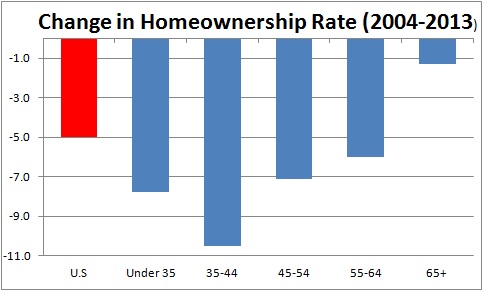
3. When do millennials decide to buy a house? Homeownership rates have fallen sharply for a decade. While homeownership has fallen for all age brackets, the decline has been most acute in the under 35 and 35-44 year age brackets. Higher home prices combined with slightly higher mortgage rates have raised the required down payment and boosted monthly mortgage payments. As a result, many younger borrowers – particularly those saddled with a considerable amount of student debt – have chosen to rent rather than buy and home sales have risen less rapidly than many expected. But as the millennials age and begin to raise families, do they change their mind and decide to buy rather than rent? Maybe.
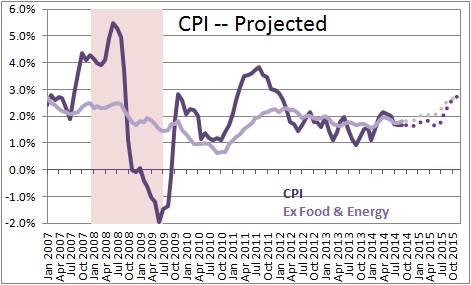
4. When will inflation begin to rise? How quickly will it accelerate? Everybody is aware of the impressive drop in gasoline prices. But, as noted above, gas prices are likely to very soon begin to reverse direction and start to climb. At the same time the shortage of available housing is pushing up rental rates. Because “shelter” is one-third of the CPI there is clearly an upward bias to inflation from this important component. Then, also as noted above, there is the potential for tightness in the labor market to boost labor costs. Because wags are such an important part of a firm’s overall costs, higher labor costs could also push inflation higher. We think the CPI could climb 2.8% next year compared to just 1.8% this year. Could inflation surprise to the upside? Maybe.
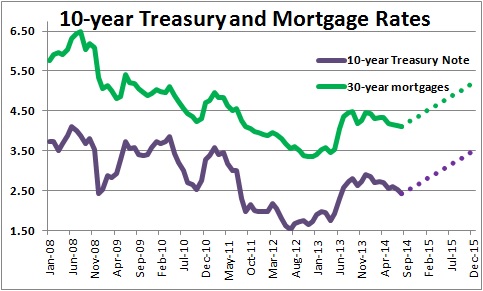
5. When will interest rates begin to rise? How quickly? We expect the Fed to begin raising short-term interest rates by the middle of next year which will lift the funds rate from about 0.0% currently to 1.3% by the end of 2015. This increase in short rates will boost long-term interest rates like the mortgage rate. We believe that mortgage rates will climb from about 4.0% currently to 4.75% by the end of next year. Can home sales withstand such an increase in mortgage rates? Maybe.
As usual, we have an opinion about all of these matters. But whether that outlook is accurate is an entirely different matter. Our goal is not to persuade you that our view is correct. There are many smart economists that have different viewpoints. Instead, we want you to understand why we believe what we do, and then you can decide what makes sense. If we can provide you with a few things to think about that you have not heard from others, we have done our job.
Stephen Slifer
NumberNomics
Charleston, SC
Follow Me