
August 15, 2012
( This article was written for and published by the Daniel Island News on August 15, 2012.)
Many people are disappointed that GDP growth is not more vibrant, that the economy is not creating enough new jobs, and that the unemployment rate is too high. Why is that happening? And what can we do about it?
You will recall that GDP fell 4.7% in the 2008-09 period which made it the deepest economic slump since the Great Depression. Nearly nine million jobs were lost. The unemployment rate peaked at 10.0%. The stock market plunged. Consumers, bankers, and corporate leaders saw things they had never seen before. Confidence was shattered. Once broken, it is not easily repaired.
Housing. People investing in real estate since the early 1970’s never lost money. Buy a map of your neighborhood, throw a dart, pick a house completely at random, and still make money. But suddenly that changed. People were losing money. Their equity was wiped out. Many owed more than their house was worth. Housing is typically one of the first sectors to recover when the economy turns upward. But given the 2008-09 experience who had the courage (or the ability) to jump back in? Even those who were so inclined could not find a banker willing to approve their mortgage request. Only now is the housing sector beginning to right itself. Sharply lower prices, record low levels of mortgage rates, and modest employment gains that boost income have made housing extremely affordable. But why are we surprised that it took time for that to happen?
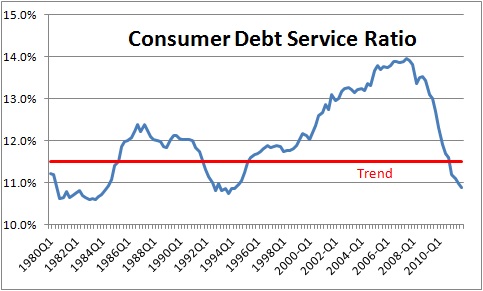
Consumer debt. During the good times consumers leveraged themselves to the hilt. And why not? Times were good. If there was going to be a recession it would almost certainly be short and shallow –like all of the others. But suddenly that changed as well. People couldn’t sell their house. If they owed more than it was worth they were locked in. Millions of people lost their jobs. If they had a job, they were worried that they might not be so lucky six months down the road. What to do? Answer – pay down debt! And they did. With a vengeance. Every month for almost two years consumers paid down debt, expensive credit card debt in particular. But because they were so highly leveraged at the beginning, that process has taken time. Now that debt is much more in line with income, consumers are beginning to spend a bit more rapidly and contemplating additional debt. But given the extent to which they got into trouble in the 1990’s they remain timid.
Banks. Bankers also thought that the good times were here to stay. A measure of bank leverage, like total loans to cash, shows how highly leveraged banks were in 2008. When the recession hit they were in trouble. Many of the loans they made in the 1990’s – mortgage loans in particular – became worthless. Banks were not only becoming illiquid, many failed. Regulators were pressuring all banks to raise capital. Against this background, the banking sector was not looking to make a loan to you or me, or to any business for that matter. It takes a while to clean up a balance sheet given the extent to which it was overleveraged.

Corporate America. Having seen the economy go south in a hurry, and having just laid off eight million workers, corporate leaders were not in a big hurry to hire them back. Besides, they found that they could produce just as many goods and services with fewer workers by spending a few bucks on technology. And in many cases temp workers were able to fill the void.
Confidence is improving. Today the economy is on the mend. GDP is growing, jobs are being created, and the unemployment rate is gradually falling. But, understandably, all of the players noted above are proceeding cautiously. How might we get the economy on a faster growth track?
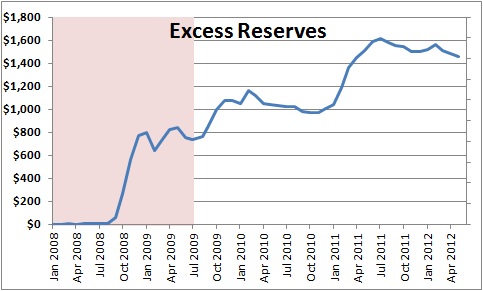
Can the Fed help? The Fed is debating whether it should buy more Treasury securities in an effort to increase liquidity and/or to push long-term interest rates lower. But liquidity today is not an issue. The banking system currently has $1.5 trillion more reserves than it needs. Banks have the ability to make as many loans as we are likely to need for years to come.
Furthermore, it is hard to imagine that lower mortgage rates are going to help. They are already at a record low level of 3.5%. High mortgage rates are not a problem.
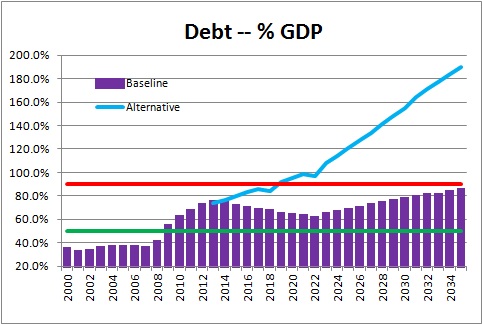
What about more fiscal stimulus? Nobel prize-winning economist Paul Krugman – thinks that is the answer. But with all due respect, that does not seem like such a good idea. Any additional stimulus will increase debt outstanding. But we cannot afford the amount of debt we already have. The Congressional Budget Office’s projected budget deficits ensure we will have a dangerously high debt burden by 2030, and if things do not go as well as planned the problem could occur within a decade.
What might help? At the end of this year the so-called “fiscal cliff” could push the economy over the edge – hence its name. Cuts in individual tax rates adopted in the Bush era will expire. The alternative minimum tax will impact more people. A 2% cut in payroll taxes adopted in 2011 and 2012 will end which will reduce workers’ paychecks. Estate and gift taxes will climb. Extended unemployment benefits will end. Across-the-board Federal spending cuts are set to begin in 2013 with one-half of the burden falling on defense. The CBO estimates that this will reduce GDP growth by $607 billion or 3.7% of GDP, most of which will occur in the first half of next year. Given the tepid pace of current expansion, this would almost certainly push the economy back into recession.
No one expects Congress to let the “fiscal cliff” take effect in full. But the uncertainty of how and when lawmakers will resolve the issue is hurting business confidence and weighing heavily on companies investment and hiring decisions.
Fortunately, a solution is in front of their noses if our policy makers have the political courage to adopt it. In February 2010 President Obama appointed a bipartisan commission headed by Erskine Bowles the White House Chief of Staff under Clinton, and former Wyoming Senator Alan Simpson, to find ways to reduce the country’s budget deficit. Surprisingly the committee reached an agreement, the results of which were released on December 1 of that year and encompassed a wide range of topics that have been hot buttons in American politics for years – cuts in Social Security, Medicare/Medicaid, discretionary spending, and defense. While controversial, the commission came up with a comprehensive, bi-partisan plan of action.
Unfortunately, the commission’s recommendations were not supported by President Obama and partisan political bickering sank any chance of its adoption. But times may change. The November election may well narrow each party’s majority in Congress and make compromise even more difficult in 2013. But we can no longer afford to “kick the can down the road” and postpone decisive action. Thus, the “lame duck” session between the November 6 election and mid-January when the newly elected officials take office provides a perfect opportunity to adopt compromises on revenue enhancements and entitlement cuts. The debt reduction recommendations of the bi-partisan Simpson Bowles commission may well be resurrected as a blueprint for that legislation.
Passing it would go a long ways towards fixing what ails us.
Stephen Slifer
NumberNomics
Charleston, SC
Follow Me