
June 18, 2010
The focus of attention this coming week will be on the Fed’s meeting on Tuesday on Wednesday. It is a certainly that the Fed will leave the funds rate rate target unchanged at between 0-0.25%. It is also likely that the Fed will continue the wording in its directive that “economic conditions, including low rates of resource utilization, subdued inflation trends, and stable inflation expectations, are likely to warrant exceptionally low levels of the federal funds rate for an extended period.” At some point that language will change, but not at this meeting.
At the last meeting on April 27-28 the Fed upgraded its economic outlook slightly. Based on stronger-than-anticipated economics statistics the Fed boosted its 2010 GDP outlook by about 0.25% to 3.2-3.7%. However, in the interim the stock market has fallen farther, and is now off by about 10% from its early year level.

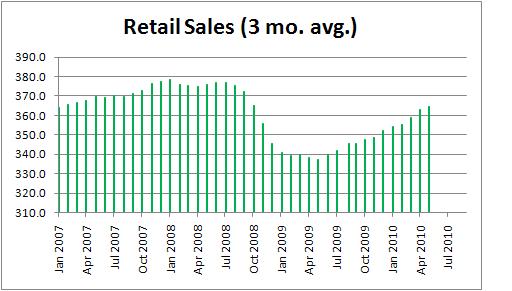
We have also seen consistently weaker than expected economic data. You will recall that private sector employment rose just 40 thousand in May. Retail sales unexpectedly declined 1.2% in that month. But just keep in mind that these are volatile series and a single month of weak (or strong) data does not necessarily indicate a change in trend. Indeed, in the case of retail sales, a 3-month average growth rate does not appear to have weakened at all.
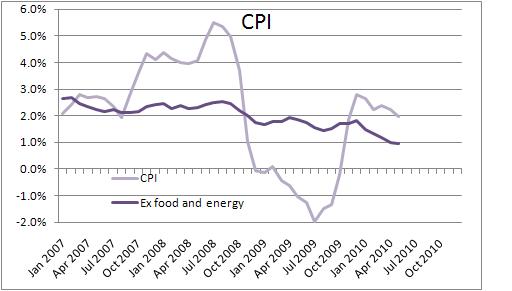
And the inflation statistics have consistently come in lower than expected. Indeed, the core CPI has now risen just 0.9% in the past 12 months, and for the last seven months it has been essentially unchanged. Some economists are beginning to worry about the possibility of deflation. That outcome seems unlikely, but the very fact that people are talking about it is noteworthy.
About the only good news released during June is the fact that the unemployment rate declined 0.2% to 9.7% as the labor force declined.

If you are in the hot seat at the Fed you are probably more worried about the likelihood of a double dip in the economy now than you were six weeks ago. Against that background, this would not be the time to change the wording of the directive and hint at the possibility of higher rates by the end of the year. The results of the FOMC meeting will be released on Wednesday at 2:15 PM Eastern time.
In other news this week we should expect new home sales to fall sharply as the tax incentives come to a close. Having said that, the low level of mortgage rates and the decline in home prices should provide some support to the housing sector. What is disappointing is that these two factors are not providing more of a lift to housing than they are.
Finally, industrial production is likely to have risen 0.8% this month as the factory sector continues to support the economy. In the summer and fall of last year the increase in production was largely attributable to a re-stocking of inventories. That is no longer the case. When first quarter GDP is released at the end of July, it should register a GDP growth rate of 3.0-3.5%, but with growth in final sales of roughly that same magnitude. What this means is that, for the first time since the turnaround in the economy in the third quarter of last year, the primary driving force behind growth is the consumer and not inventory rebuilding.
All-in-all this should be a relatively quiet week.
Stephen Slifer
NumberNomics
Charleston, SC
Follow Me