
August 22, 2014
The U.S. economy is zipping along at a fairly impressive pace. We see it in virtually every sector of the economy. Housing has shaken off its slump and is once again on a roll. The economy is producing 225 thousand new jobs a month. The unemployment rate is close to its full employment threshold and continues to drop. The stock market reversed its recent angst and climbed to a record high level.
While our primary focus is on the United States it is important to note that this economic euphoria is global. Global confidence and stock markets everywhere suggest that is the case.
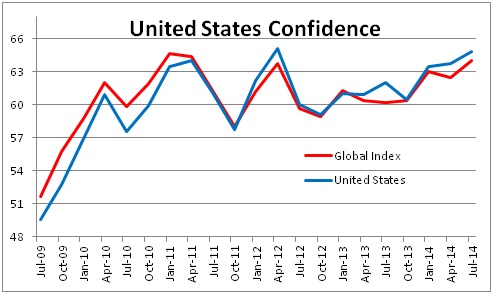
The Young Presidents’ Organization consists of more than 20,000 CEO’s under the age of 40 in more than 125 countries. It does a quarterly survey of confidence. Both their global and U.S. confidence indexes for the second quarter climbed to levels that approach their peak for the business cycle. Confidence charts for Canada, Europe, Asia, China, the Middle East and North Africa look similar. Check out their website at http://www.ypo.org/globalpulse/ and have fun playing with the graphics!
Most economists formulate a view of the economy by looking at consumer spending, business investment, government expenditures, exports, and imports in the aggregate. It is generally a “top down” or macro approach. But micro matters. Over the years I have found that conversations with corporate leaders and industry analysts frequently provide useful insights that help me to refine my forecasts. On more than one occasion these corporate execs saw things in their individual businesses that were simply inconsistent with the macroeconomic story I was telling – and I altered my forecast accordingly. I like to think that their input made me a better economist. While the factors they point out will eventually be reflected in the broader economic indicators, that process could take months.
Thus, surveys such as the one offered by the YPO are useful. There have 20,000 corporate leaders around the globe looking at their own sales expectations, investment spending plans, and hiring intentions six and twelve months into the future. That is useful input. If their observations do not square with our forecast, perhaps it is time for a re-think.
Stock market indices are another good barometer of the economic temperature. Changes in stock prices reflect changes in earnings expectations for a very large, diverse group of investors. The U.S. economy has never dipped into recession without first having experienced a sharp drop in the stock market. That is why it is one of a group of leading economic indicators. It is not the whole story but it is an important part. Unfortunately, the market is volatile and can emit false signals. If the stock market begins to dip, one needs to look elsewhere for confirmation that the economy could be at a turning point. In this case it is an easy read. The S&P 500 index for the U.S. shrugged off some recent nervousness and is once again at a record high level. It has climbed almost 20% in the course of the past year.
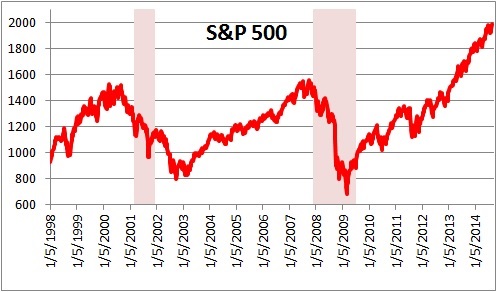
It is not just the U.S. stock market that is on a roll. Europe’s Euro Stoxx 50 index has risen 10%. The German stock market, the DAX, is up 12%. The Hang Seng (in Hong Kong) is up 14%. China has climbed 17%. The Japanese Nikkei index is up 14%.
If business leaders around the globe are optimistic and investors around the globe are optimistic, why is it that economists generally continue to see doom and gloom around every corner?
At the risk of oversimplifying a rather complex world, the reason why this global euphoria exists is because every major central bank has the pedal to the metal. They are all trying as hard as they can to stimulate economic activity. The Fed has had the funds rate at 0% for the past six years and has no intention of altering that stance for some time to come. Ditto for Europe. Ditto for Japan. The game will change when the central banks change. And we are not talking about the first move by the Fed (or any of these other central banks) from 0% to ¼%, ½%, or 1%. We are talking about a cumulative movement from 0% to 3.5-4.0%. Then we can start to think about the party coming to end. It is hard to imagine closing time arriving sooner than 2018.
Stephen Slifer
NumberNomics
Charleston, SC


It is easy to make generalities on surveys. The economic confidence is at 64% now but is actually lower than it was Jan to Apr 2011 and about the same as in 2012. Since Jan 2010 there seems to be random rises and falls along a baseline of about 60. Is a rise from 60 to 64 really significant or is it within the margin of error of the study. There could be built in bias in the study. For example, are the results of individuals made public (or within the company itself). If so, there could be a bias to appear optimistic for your shareholders. If 36% of young CEOs don’t have confidence in the economy is this a good thing. Thank you for the article but I don’t buy it.
Hi Blake,
Thanks for sending me your comments. There is plenty of room for differing opinions in the world of economics and you certainly would not be the first to disagree with my conclusions. Fair enough.
Certainly I talked a lot about the survey. You are right that it has been about this high a couple of times in the past. But, in my view, that is just one piece of the story. Confidence surveys (any of them) are a part of the story, but they must be corroborated by other bits of information. I do believe that recent behavior of the global stock markets re-enforce the survey results. Stock market movements are not the be-all and end-all either, but are another piece of information that seems relevant. And then there are the central banks. As long as they — not just the Federal Reserve but all of the major central banks around the world — pledge to keep rates low for a protracted period of time, it is hard to see where the global economy is going to stumble.
Just FYI the survey results are not made public in this survey or any other survey. But given that the Young Presidents’ Organization is a non-profit they have no incentive to bias their results favorably. And re: the individual reporting companies some may be publicly held, but most are private. In either case, there is no incentive to bias the results in either direction.
Thanks for taking the time to comment.
Steve
I couldn’t agree with you more. It takes courage to predict that far ahead about about monetary policy rates especially with all the pressure from the budget hawks and austerity crowd.The work of Larry Summers on secular stagnation and that of Thomas Piketty on a return to a protracted slow growth environment both support the idea of protracted low rates. Beware however of the Minsky moments, as bubbles are bound to occur.
PS: Minsky also pointed out that the first and biggest bubble in his boom to bust cycle is always in cash.