
March 10, 2017
Since the election in early November the economy has shifted in a fundamental way. Consumers, businesses and investors are the most optimistic they have been in years. The stock market is on a roll and reaches a new record high level every few days. Consumer confidence has surged. Business spirits are soaring. That newfound optimism is translating into jobs. Given the timing of these dramatic changes it is evident that the source of this newfound enthusiasm is the election of Donald Trump. Given that legislation cutting individual and corporate income taxes has not yet been introduced, and that the regulatory burden remains largely unchanged, it may be that the current degree of optimism is overstated. Setbacks will undoubtedly occur as the year progresses, but there can be little doubt that the economy is gathering momentum, inflation is on the rise, and the Fed’s near-0% interest rate policy is a thing of the past. What has yet to be determined is the extent of that improvement. We believe the acceleration in GDP growth this year will be moderate, the core inflation rate will climb and rise a bit above the Fed’s 2.0% target, and the Fed will adhere to the 3-rate-hike plan it has previously suggested.
The stock market continues its ascent.
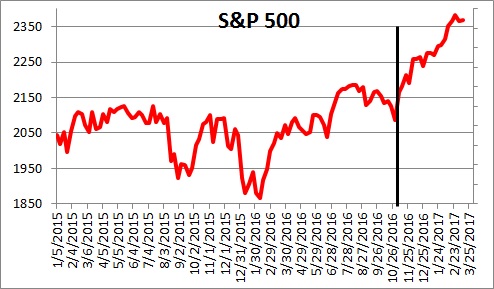
That increase in the stock market is important because it is boosting consumer net worth. During the course of the past year net worth climbed 6.3%, but in the two most recent quarters the stock market gain has boosted growth in net worth to a 9.2% pace.

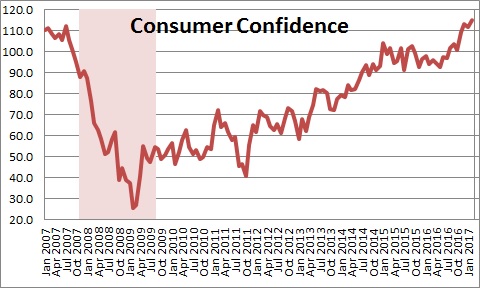
Given the increase in net worth and the prospect of cuts in individual income tax rates later this year it is no wonder consumer confidence has risen to its highest level in a decade.
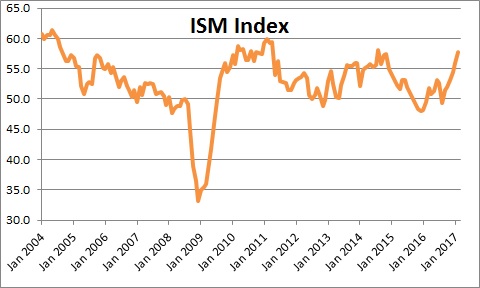
Business confidence amongst manufacturing firms has risen almost 10 points in the past year. In December 2015 this index stood at 48.0. The manufacturing sector was in a slump and contracted for five consecutive months. In February of this year the index stood at 57.7 with 17 of 18 manufacturing industries reporting growth in that month. Orders are surging. Production is picking up. Employment is rising. The turnaround is being fueled by the likelihood of reductions in the corporate tax rate later this year, and relief from the currently punishing regulatory environment. The Institute for Supply Management believes the February level of the index is consistent with GDP growth of 4.5%. While GDP will not rise that rapidly this year, there is no doubt that the manufacturing sector is on the mend.
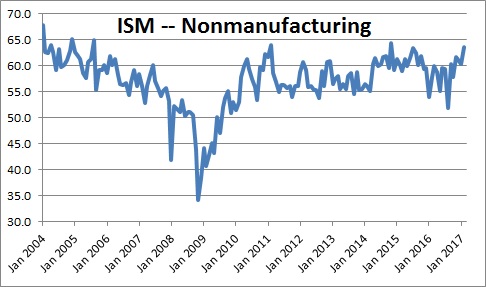
Firms in the service sector are experiencing similar improvement and the ISM service-sector index has reached its highest level in more than two years.
As business sentiment has rebounded, so has hiring. Private sector employment rose 224 thousand per month in the first two months of the year. That compares to an average monthly gain of 170 thousand in 2016. Employment in the service sector has been rising steadily for the past couple of years while the production sector – manufacturing, construction, and mining – was steadily contracting. But now employment in those industries has begun to turn upwards.
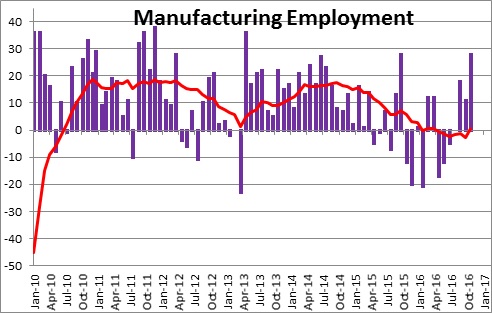
Factory employment was hit by the 20% increase in the value of the dollar from mid-2014 through the early part of last year which caused adversely impacted growth in U.S. exports.

As a result, factory employment fell for more than a year. But in the past three months jobs in the manufacturing sector have risen by 19 thousand per month.
Employment in mining was clobbered by the decline in oil prices. But oil prices have rebounded and mining employment has climbed back into positive territory.

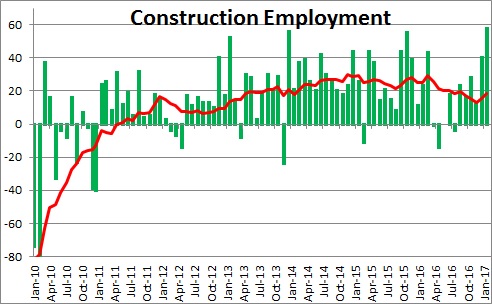
In the construction industry an extreme shortage of both single-family and residential housing and strength in commercial real estate have generated strong demand for construction workers. However, builders have been constrained in their ability to hire because they have been unable to find an adequate supply of qualified workers. Even so, construction employment has averaged about 25 thousand per month for a while. The pickup in construction employment in January and February largely reflects the unusually mild winter weather and undoubtedly overstates the case, but employment gains in the industry appear to be on the rise.
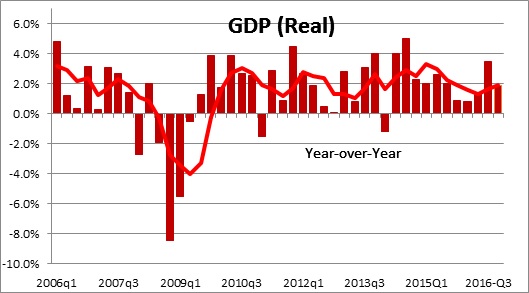
After several years of disappointing GDP growth it is encouraging to see so many leading economic indicators showing signs of life. The exact dimensions of the upturn may be unclear, but the direction is not. Look for the Fed to raise the federal funds rate to 0.75% at its meeting next week.
Stephen Slifer
NumberNomics
Charleston, S.C.
Follow Me