
March 30, 2011
So much has transpired since the beginning of the year that we need to step back for a moment and review the economic landscape. Little did we know on January 1 that in the next 90 days we would have to contend with the worst January weather in decades, civil unrest in numerous countries in the Mideast, the unseating of two heads of state in that region, a record breaking earthquake and tsunami in Japan, the potential for a major nuclear disaster as the result of tsunami-inflicted damage to several nuclear power plants in that country and, more recently, the probable bailout of yet another European country — Portugal.
All of these events should serve to reduce GDP growth and boost inflation, but yet growth prospects for the first quarter and the year have not changed all that much. On March 4 we lowered our first quarter GDP forecast from 5.0% to 4.0%, but that was primarily because of the abnormally bad weather conditions throughout much of the country in January.
We continue to expect GDP growth of about 4.0% in each of the final three quarters of the year. One might legitimately ask why we have not lowered our forecasts for these subsequent quarters, given reports of supply constraints from manufacturers who are unable to get critical parts from Japan. The primary reason we are reluctant to change is that economy currently seems to have some very positive underpinnings and appears to be steadily gathering momentum. So, yes, recent events will serve to reduce GDP somewhat, but the question is the starting point. Ours was 4.3% GDP growth for the year as a whole; we currently expect GDP growth of 4.0%. While we could fall somewhat short of that mark, we will still be left with a very respectable pace of expansion particular despite the extraordinary set of events described earlier.
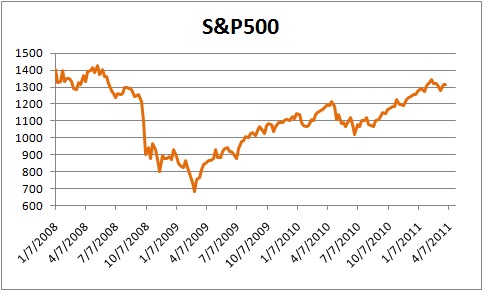
Last year in response to the debt problems in Greece and elsewhere in Europe, the stock market fell 16% from 1,217 to 1,022. That was sufficient to reduce consumer confidence and slow the pace of economic activity for a quarter. But this time the S&P is only 2% lower than its peak in response to this entire set of events. You can hardly see the drop. We hear all sorts of concern from people about the apparent inability of automobile manufacturers to get parts, or consumer electronic firms to get chips, for their U.S.-made products because of the problems in Japan. But if that is such a big problem, why isn’t the stock market lower? We acknowledge the argument, but think the concern is overdone. Firms have some inventory of these parts. U.S. firms can perhaps attain the necessary parts elsewhere. And Japanese firms may be able to shift production from Japan to the U.S. until power is fully restored in their own country. There are alternatives that can soften the extent of the difficulty.
Another thing to keep in mind is that at this time last year the economy was just beginning to create jobs. Indeed, the first increase in private sector employment following the recession occurred in March 2010. Now the economy is routinely generating almost 200 thousand jobs a month. All of these additional jobs provide income which boosts consumer spending.

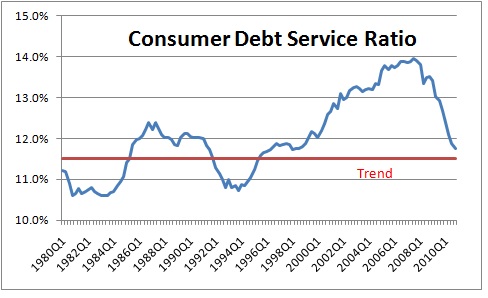
And, finally, the consumer has paid down considerable debt during the course of the past year. After peaking at 14.0% of income in 2007, the consumer’s debt service relative to income stood at 12.7% in the fourth quarter of 2009. Today it is 11.75%. Now consider that over the past 30 years that ratio has averaged 11.5%. It seems to us that the consumer is rapidly approaching a “comfortable” debt burden, which means that he or she should now have more money to spend instead of using a significant portion of income to pay down debt.
Yes, recent events have been particularly scary, but the factor most people miss is that the economy is going into this with a full head of steam. It is going to take more than sharply rising oil prices, nuclear fallout, and debt problems in Portugal to significantly dent GDP growth in 2011.
Stephen Slifer
NumberNomics
Charleston, SC
Follow Me