
January 27, 2017
Fourth quarter GDP growth turned out to be 1.9%. While slightly less than the 2.2% pace that had been expected these early estimates tend to be revised upwards. But that is history. There is a new guy in town who is changing the rules and market participants expect faster GDP growth this year and next, a moderate pickup in the inflation rate, and somewhat higher interest rates. In short, economists believe that the U.S. economy is emerging from the doldrums, inflation is edging upwards, and the Fed will be able to take the economy off the life support it has provided in the form of 0% short-term interest rates for the past eight years. At long last the U.S. economy is on the cusp of returning to a more sustainable economic environment.
There can be little doubt that Trump’s proposed cuts in individual and corporate income tax rates, relief from a stifling regulatory environment, and allowing U.S. corporations to repatriate some of their overseas earnings to the U.S. at a favorable tax rate has everybody excited.
Consumer confidence has climbed to its highest level since July 2007. And why not?
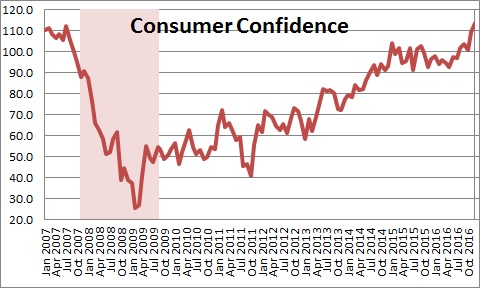
The stock market has surged to a record high level. The economy is cranking out jobs that are creating income. Interest rates will remain low for the foreseeable future. The likelihood of tax cuts is exhilarating. Confidence is soaring!

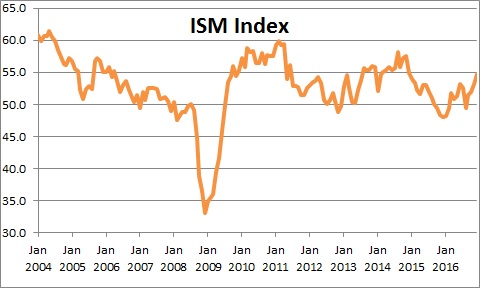
Confidence amongst manufacturing and non-manufacturing firms has climbed to a 2-year high.
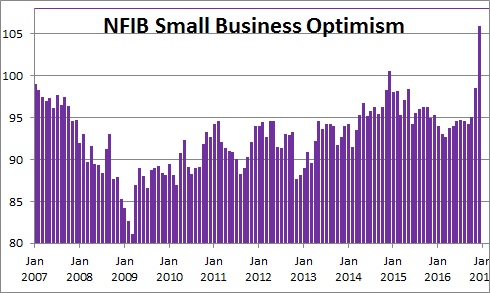
Small business optimism has surged to its highest level since 2004. Small business owners have been complaining about the punishing regulatory environment for years. Big firms can hire an army of attorneys to determine whether they are in compliance. Small business firms cannot afford that luxury and thereby operate at a competitive disadvantage to their larger counterparts. For the first time in years small business owners are genuinely excited.
To be sure these impressive gains in confidence are based on an expectation of policy changes that have yet to be enacted. But with a Republican president and Republican control of both houses of Congress all of the policy changes described above are certain to be implemented to some extent. However, the enacted legislation is likely to fall short of the current lofty expectations and thereby disappoint both consumers and business people. But even with a moderate setback in confidence the economy is poised to shift onto a faster growth track.
President Trump’s domestic agenda with respect to the economy is welcome news. His trade policy is not. He continues to talk about building a wall between the U.S. and Mexico, imposing tariffs on goods coming in from Mexico and China, taxing U.S. companies who want to shift their operations overseas, and re-negotiating NAFTA. These are protectionist policies which will put the U.S. out of sync with the rest of the world and, ultimately, will hurt the very people who elected him in the form of significantly higher prices on imported products.
Trump believes that trade is costing the United States jobs as firms shift production to China and Mexico. We contend that most of those manufacturing jobs have been zapped because of improvements in technology, not as the result of trade agreements. However, we concede that some U.S. jobs have been lost through this mechanism. But rather than worry about re-negotiating trade deals and imposing higher import duties and taxes, we would suggest that there is a better way to keep factory jobs in the United States.
Trump should focus on creating a much more business friendly environment. How? Through corporate tax cuts, eliminating much of the unnecessary regulatory burden, and allowing firms to repatriate their overseas earnings to the U.S. at a favorable tax rate. All of those policy changes will presumably be forthcoming later this year. Once enacted U.S. firms will have little incentive to shift operations and jobs to faraway places in the first place. At the same time foreign firms should find the U.S. business climate much more conducive and look favorably on investments in this country which will create still more jobs.
Some members of Trump’s cabinet are supportive of this “better way” approach to trade but thus far their voices have not carried the day. Trump’s early moves to kill the Trans-Pacific Partnership, begin construction of the wall between the U.S. and Mexico and impose a 20% tariff on goods imported from Mexico to pay for it are clearly discouraging. But Trump is a skilled negotiator. Furthermore, he has quickly become notorious about saying one thing one day and something entirely different a few days later (like his comments about the CIA and, more recently, about NATO). Given that he has only been in office one week it remains to be seen exactly how his new trade policy will fall out. Having said all that, his initial actions have been disquieting.
Stephen Slifer
NumberNomics
Charleston, S.C.
Follow Me