
September 4, 2015
The moment of truth is arriving. The FOMC meets September 16-17th. The Fed should end the agony by raising rates 0.25% at that meeting. Fed officials have become talking about this move for a year. If they persist in postponing the inevitable first rate hike they are going to completely lose credibility. The markets will have an initial negative reaction whenever the Fed chooses to raise rates, whether that is September, December, or sometime next year. But if the verbiage that accompanies the announcement highlights the fact that the Fed intends to proceed slowly and cautiously, the initial negative reaction will be short-lived. For an economy that needs a 3.5% funds rate for “neutrality”, an increase from 0% to 0.25% will have no discernable impact.
While the stock market has been shaky for the past month, the economy still appears solid if not spectacular. After a rough start it seems likely that GDP growth this year will be about 2.5%. That sounds unimpressive. But for an economy whose potential growth rate currently is about 1.8%, a 2.5% rate of expansion is fast enough to keep the unemployment rate falling. And since the unemployment rate at 5.1% is already at its full employment threshold, that will translate into upward pressure on wages and, ultimately, on inflation.

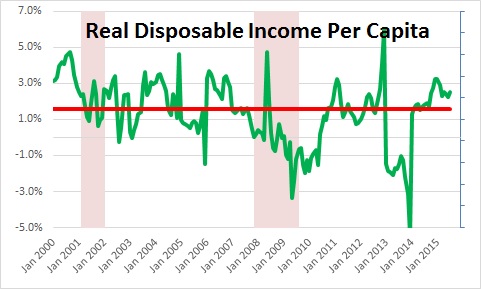
Furthermore, real GDP per capita, which is a measure of our standard of living, is currently rising at a 2.5% rate. Over the past 25 years GDP per capita has risen at a 1.5% pace. People think that GDP should be rising more rapidly, but the reality is that its current pace is perfectly acceptable.
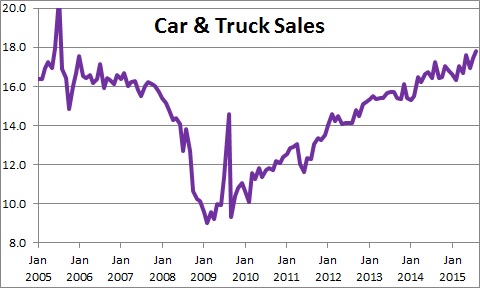
We frequently talk about car sales and home sales because they are the two biggest ticket items in any consumer’s budget. If we get nervous these are the first two sectors that turn down. But that is not happening. Car sales in August climbed to a 17.8 million pace – the fastest pace thus far in the business cycle.
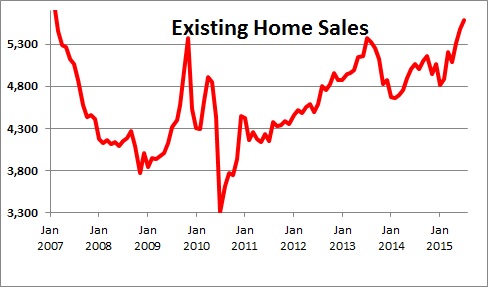
The housing sector is perhaps even hotter. Existing home sales have climbed 10% in the past year, but in the last six months the pace has skyrocketed to 32%! Why? Partly because younger adults who have been living at home are at last venturing out on their own. As they do so they need a place to live. Hence, the demand for housing has surged. And while builders are trying to boost production they are unable to find an adequate supply of skilled labor. As a result, they cannot keep up with the increase in demand. Given that car and home sales are both accelerating, it is hard to argue that the recent stock market selloff has had any significant economic impact.
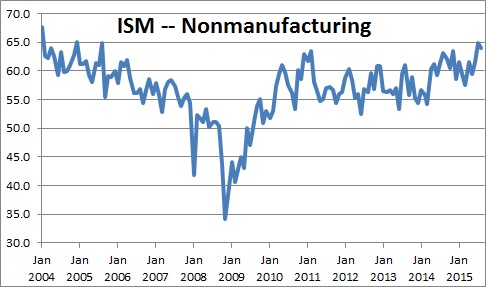
The service sector also seems to be on a roll. The Institute for Supply Management has a non-manufacturing index (think services). Its August level essentially replicated the level of the previous month – which happened to be the high for the cycle.
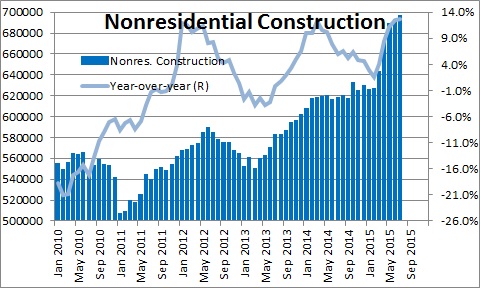
Even the beleaguered nonresidential investment category seems to have turned itself around. It was very soft in the fourth quarter of last year and the first quarter of 2015 as the shutdown of more than 50% of the oil rigs in operation acted as a significant brake on growth.
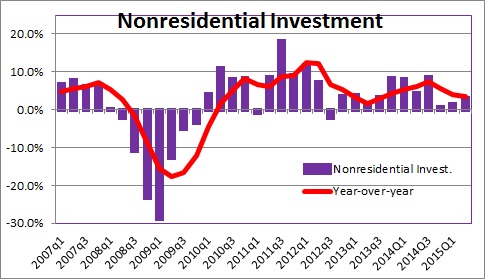
But something different is happening. Beginning in March such spending began to take off as the number of oil rigs in operation stopped falling. While nonresidential spending quickened to a 3.2% growth rate in the second quarter, it is poised to double that pace in the third quarter.
The Fed, however, keeps finding reasons to worry. Stock markets around the globe are weak and higher interest rates in the U.S. could make them worse. China’s growth is slowing down and this is the wrong time to raise rates. Other central banks are trying to stimulate their economies by lowering rates. If the Fed goes the opposite direction that will strengthen dollar and further slow the rate of growth of U.S. exports.
While all of those factors are certainly valid, the Fed should be focused on what is happening in the U.S. economy for a couple of reasons. First, after having talked about a rate hike this year for so long the Fed will jeopardize its credibility if it dithers much longer. Second, everybody (including the Fed) believes that the inflation rate will gradually increase going forward. The Fed cannot wait until that happens before they begin to get rates closer to “neutral”. Finally, if something bad should negatively impact the U.S. economy the Fed has little ability to respond. For an economy where a “neutral” funds rate is somewhere around 3.5%, an increase in the funds rate from 0% to 0.25% is simply not going to be a problem. The time has come.
Stephen Slifer
NumberNomics
Charleston, SC
Follow Me