
January 17, 2014
We talk a lot about the U.S. economy but it is sometimes important to look outside our borders. This is one of those times. An expected acceleration in GDP growth in Europe and Japan will augment U.S. GDP growth in 2014. Because the trade component is only about 10% of our economy we do not talk much about it. However, in 2014 trade should contribute about 0.25% to U.S. GDP growth as economies around the globe –specifically Europe and Japan — gather momentum.
Europe has been in recession for the past two years. In both 2012 and 2013 the European economy declined by about 0.5% each year. But this year the IMF expects GDP to change direction and expand by 1.0%. While this is not an overly impressive growth rate, a 1.5% swing for an economy that is larger than the United States is impressive.

That same sense of optimism noted by economists can be observed from CEO confidence. The red line below represents CEO confidence globally while the blue line represents confidence reported by CEO’s in Europe. From early 2010 through the middle of last year confidence in Europe was consistently 6-8 points lower than elsewhere around the globe. And for good reason. A steady series of financial difficulties which started in Greece and flowed on to Ireland, Portugal, Spain, and Cyprus triggered fear of a domino effect that could spread around the globe. As a consequence Europe experienced a two year long recession.
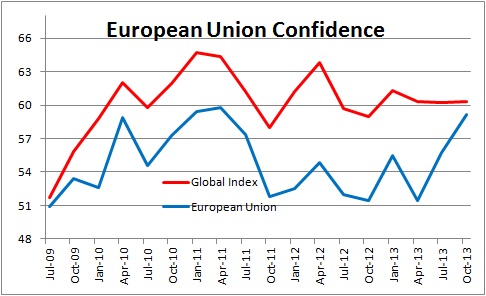
In late 2012, European Central Bank President Draghi pledged to do “whatever it takes to save the Euro” which was followed by the ECB’s commitment to buy unlimited quantities of sovereign debt if the issuing nation would agree to a strict set of conditions to get their finances in order. That action effectively took off the table any chance of global contagion in the event of any other financial problem. As a result, confidence in Europe climbed sharply in the second half of last year and is now virtually in sync with other regions around the globe.
As confidence has climbed the European stock market has gained an impressive 15% in the past year.
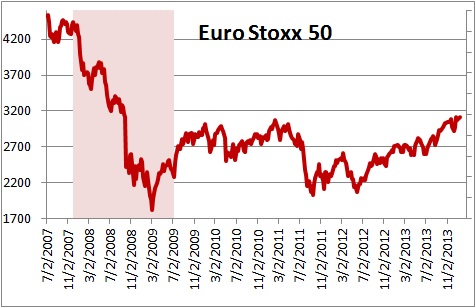
The rise in confidence in Europe coupled with an impressive stock market gain gives reason to hope that this year will mark the beginning of a meaningful economic recovery in Europe.
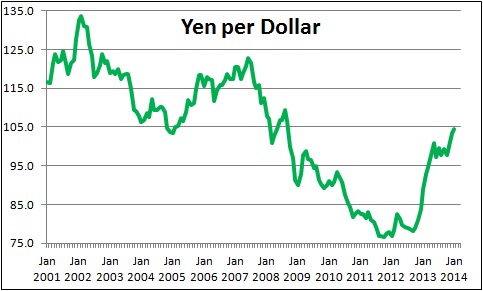
The same type of phenomenon is taking place in Japan. Japan has been in a growth recession since the early 1990’s. In the past 20 years GDP growth has averaged just 0.8%. However, in late 2012 the central bank adopted a quantitative easing strategy similar to what the Federal Reserve has pursued for the past several years. The idea was to inject huge quantities of reserves into the banking system, weaken the yen, and produce a 2-3% inflation rate. A weaker yen would reduce the price of yen-denominated goods, make Japanese goods more attractive to consumers elsewhere, and simultaneously boost the pace of economic activity. Thus far the strategy seems to be working.
The yen has fallen about 32% against the dollar from 79 in October 2012 to its current level of about 104 and has declined a roughly comparable amount against the Euro. As Japanese goods become cheaper for Americans and Europeans to buy, ultimately this should boost Japanese exports and strengthen the economy. For the first time Japan seems to have a credible plan for re-igniting its economy which has been languishing for years.
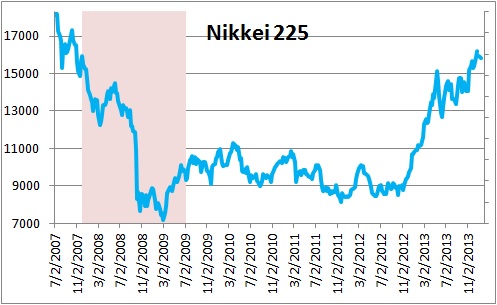
These developments have caused the Japanese stock market to surge. Indeed, it has risen 75% from where it was in October 2012 and is now where it was prior to the recession. A growth pickup in Japan is important because it is the world’s third biggest economy, surpassed only by the United States and China.
It is sometimes easy for U.S. residents to ignore what is happening elsewhere around the globe because our own economy is so large and, unlike most other countries, trade is a relatively small component of the overall pie. But Europe and Japan combined account for 30% of global GDP. If we are unaware of meaningful developments in those two regions we do so at our peril. There are lots of reasons to expect U.S. GDP growth to accelerate in 2014. This is one of them.
Stephen Slifer
NumberNomics
Charleston, SC
Follow Me