
October 13, 2017
While hurricanes will dampen third quarter GDP growth in the U.S, the pace of expansion elsewhere has been accelerating. Undaunted by slower near-term growth, U.S. investors are convinced that growth will rebound in the quarters ahead and that economic activity elsewhere around the globe is on the upswing. If non-U.S. growth accelerates, U.S. growth will get a lift as exports climb. And if President Trump can deliver on tax reform – particularly for corporate taxes – the investment portion of GDP will accelerate as well.
In the United States, the S&P 500 climbs to a new record-high level every few days. Indeed, it has risen 20% since this time last year. And this is not just statistical noise. There are solid reasons why corporate profits and the S&P should continue to climb.
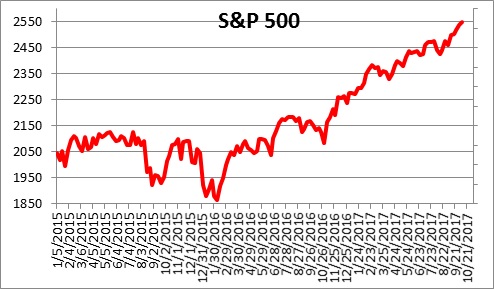
Some of that upswing reflects an expectation that President Trump will be able to deliver on his campaign promise of tax reform. The corporate world is getting particularly excited about a possible cut in the corporate tax rate from 35% to 20%, the immediate expensing of expenditures on equipment, and the re-patriation of overseas earnings at a favorable 10% tax rate. Nobody knows what the final legislation might look like. Our expectation is that a modest package will pass, and that it will stimulate GDP growth from 2.3% or so this year to 2.8% in 2018, and boost our economic speed limit from 2.0% today to 2.8% by the end of this decade.
Elsewhere around the globe growth is accelerating. The IMF, for example, just raised its global GDP growth rates for 2017 and 2018 by 0.1% apiece to 3.6% and 3.7%, respectively. The upward revisions may not seem impressive, but just keep in mind that these are the fastest global GDP growth rates since 2011.
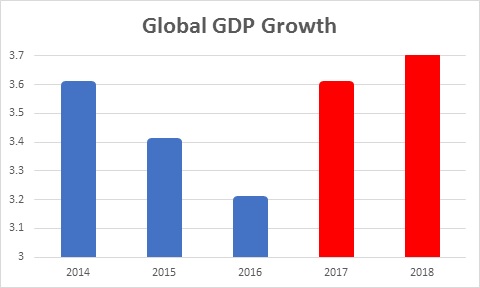
The IMF lowered its projected rate of expansion for the U.S. by 0.1% and 0.2% for 2017 and 2018. It had projected a considerable amount of fiscal stimulus coming from Trump’s tax cuts but, given the Administration’s current difficulty in passing legislation, they have lowered their growth expectations accordingly. We never expected a lot of stimulus so we have not trimmed our forecasts. Given that the IMF has trimmed its projected U.S. growth rates but raised global growth, growth elsewhere in the world must be looking better. So where might that be?
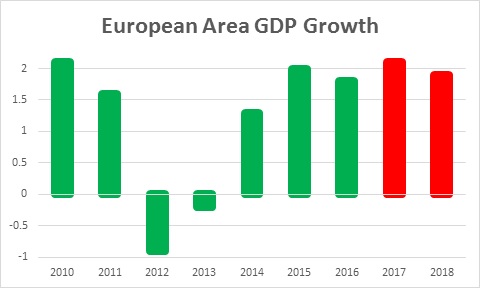
Europe. The IMF raised its projected GDP growth rates for Europe for 2017 and 2018 by 0.4% and 0.3%, respectively. Its forecasts for Germany, Italy, Spain, and France were all revised higher. European growth in 2017 is expected to be 2.1% which is the fastest growth rate since 2010 with roughly comparable growth likely for next year. That may seem like relatively subdued growth, but potential GDP growth in Europe is only about 1.5%. With that in mind, a couple of years of 2.0% growth is impressive. Remember, this is a region that weathered the financial crises in Greece, Ireland, Portugal and Spain in the early part of this decade. It survived elections earlier this year this where populist movements, particularly in France but also in the Netherlands and Germany, threatened to turn the political scene topsy-turvy and reduce the future pace of economic expansion.
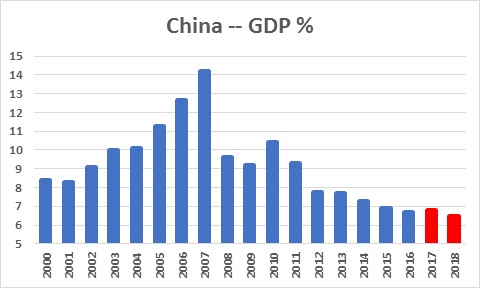
China. The IMF raised the 2017-18 forecasts for China, the world’s second largest economy, by 0.2% and 0.3%, respectively, to 6.8% and 6.5%. GDP growth in China had been growing at a double-digit pace for years and peaked in 2007 at 14.2%. Then government leaders decided to transform the industrial-based economy to a more consumer driven model, growth slowed to about 6.5%, and threatened to continue its slide to the 6.0% mark. But growth in recent quarters squashed those earlier 6.0% forecasts and now GDP growth seems to be stabilizing at about 6.5%.
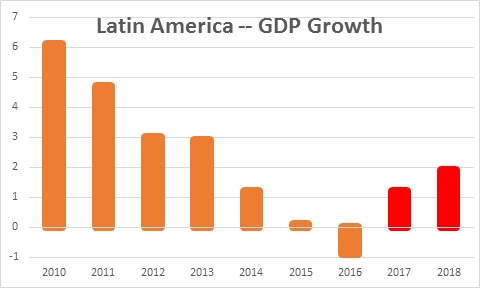
Latin America. The October revisions to the IMF’s forecasts for Latin America for 2017 and 2018 were negligible with significant upward revisions to Brazil and Mexico largely offset by a darker outlook for Venezuela where growth is projected to fall 12.0% his year. But look at the projected growth rates for the region of 1.2% and 1.9% for 2017 and 2018. Those growth rates are not impressive, but they are in sharp contrast to 0.1% growth in 2015 and negative growth of 0.9% in 2016. Growth in those years reflect the two-year-long economic recession in Brazil, as the Petrobras corruption scandal brought down President Dilma Rousseff, created a political vacuum, and snared dozens of high-level business people. Reforms designed to ensure fiscal stability appear to have restored confidence and, hopefully, allow the country to achieve modest growth of 0.7% growth in 2017 and 1.5% next year.
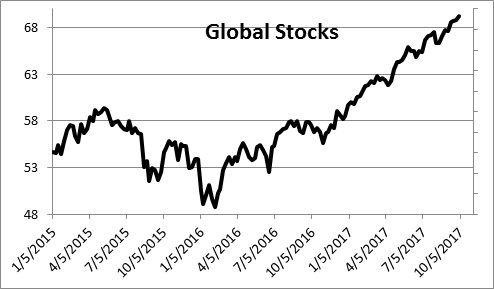
The point is that GDP growth around the globe is on the rise and likely to produce the fastest global rate of expansion since 2011. The reasons for the improvement vary by region. In the U.S. it appears to be reflect an expectation that individual and corporate tax cuts will boost growth in the years ahead. In Europe it is the cessation of a series of financial crises and a continuation of ultra-easy monetary policy by the European Central Bank. In China it seems to reflect the fact that expected GDP growth of 6.0% in 2017 and 2018 was too pessimistic. And in Latin America the two-year-long recession in Brazil appears to have finally come to an end. While the reasons vary, the reality is that GDP growth in countries around the world is in sync and re-accelerating. No wonder that global investor confidence is so high. The MSCI All World Index has risen 20% in the past 12 months. GDP growth seems to be picking up almost everywhere around the globe. It is not just U.S.
Stephen Slifer
NumberNomics
Charleston, S.C.
Follow Me