
August 23, 2013
GDP growth in the first half of the year was sluggish at 1.4% but it is widely expected to accelerate in the second half. The growth pickup is largely attributable to improvement in the housing sector and a faster pace of jobs creation. But a reduction in fiscal drag and faster growth overseas bolster the case.
The housing sector has shifted from the recovery phase to expansion during the course of the past year. During the recession home prices fell more than 30% and 30-year mortgage rates declined to a record low of 3.5% thereby setting the stage for a turnaround. However, nobody wanted to purchase a home when prices were falling. But about the middle of last year home prices hit bottom.
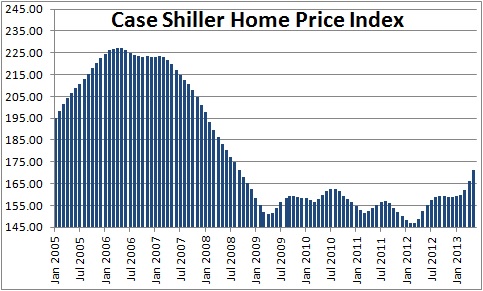
Once potential home buyers were confident that home prices would not fall further, home sales began to climb and they have marched steadily upwards since.
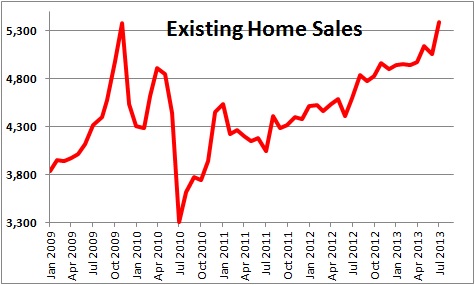
Builders have boosted the pace of new home construction to about 900 thousand. But the economy requires roughly 1.3 million new homes every year to keep pace with population growth. That has not happened in any year since 2007. Thus, demand for new homes has been rising faster than supply for six years. This cumulative shortfall has created shortages of available housing which, in turn, has caused prices to rise 12% during the past year. Even though prices have risen and mortgage rates have climbed from 3.5% to 4.5% in recent months, homes remain affordable and potential buyers are racing to beat further increases in interest rates. Furthermore, in July and August traffic through builders’ model homes surged to the fastest pace in seven years. Home buyers do not seem particularly bothered by the recent increase in mortgage rates.
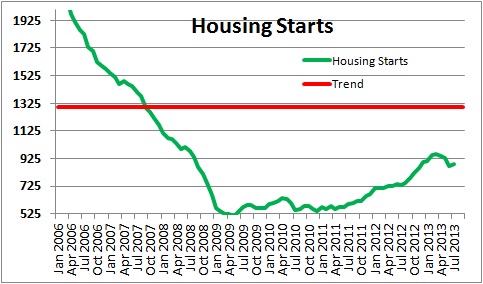
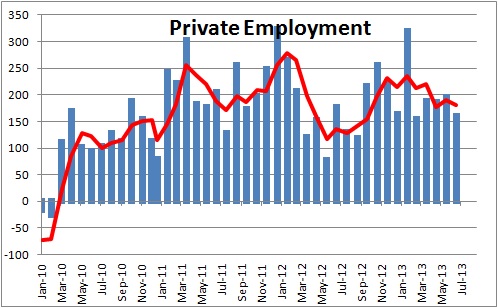
The jobs picture has brightened considerably in the past six months, and the unemployment rate continues to decline at a faster-than-expected pace. Currently, nearly 200 thousand jobs are being created each month which compares to 120 thousand at this time last year. While many of those jobs are part time, the reality is that new jobs are being created and the unemployment rate is steadily declining. A year ago the unemployment rate was 8.2%. Today it is 7.4%. More than a million people are no longer amongst the ranks of the unemployed. If the economy gathers momentum in the second half as is widely expected, the pace of hiring should accelerate.
Less widely discussed is the sharp drop in the budget deficit during the course of fiscal 2013. A year ago the U.S. had a budget deficit of $1.1 trillion. It is expected to shrink to about $0.6 billion this year. This contraction has been caused almost exclusively by higher tax revenues which have blossomed as the economy has gathered momentum. Thanks in part to the government sequester of funds at the end of March, expenditures in 2013 are roughly the same as they were last year. As funds flow from the private sector to the government, consumers and businesses have less disposable income which acts as a brake on GDP growth and slowed it by about 0.5% in 2013.
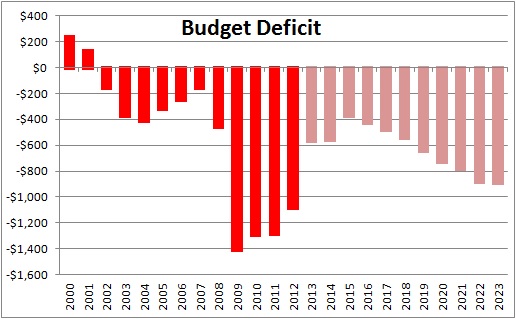
In 2014 tax revenues should continue to climb but at a slightly slower pace. Government expenditures will increase next year as more and more retirees become eligible for Social Security and Medicare benefits. Discretionary spending will continue to shrink, but not enough to offset the increase in entitlements. As a result, the budget deficit next year should be roughly the same as in 2013. If so, then instead of subtracting 0.5% from GDP growth in 2013, the budget deficit should subtract nothing in 2014.
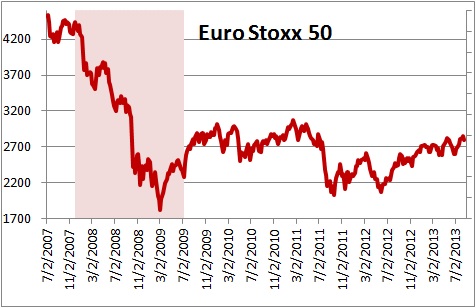
Growth overseas seems to be picking up as well. Europe has been mired in recession for more than two years. Recent economic indicators suggest that the recession will end in the second half of 2013 and then grow modestly in 2014. The European stock market seems to reflect that renewed enthusiasm. After a modest decline from mid-May to mid-June as investors worried about slower growth in China and that a Fed tightening initiative would adversely impact growth in Europe, the market has rebounded and is at a 2-year high. At long last, better times may lie ahead for the European continent. If that happens, U.S. exports to Europe which declined 4.0% in the first half of 2013 could stop falling or even squeeze out a small gain in 2014.
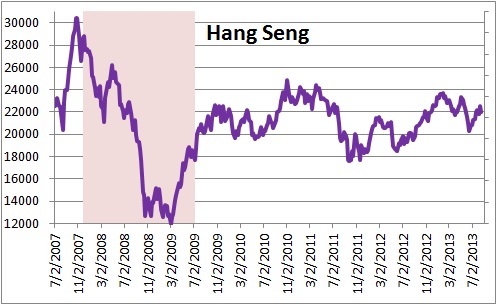
At the same time growth in China seems to be quickening. In the first half of this year the Hang Seng index fell sharply as investors feared slower growth in China and the prospect of an imminent interest rate increase in the U.S. But upon reflection, investors seem to believe that Chinese GDP growth will shrug off these impediments and accelerate from the expected pace of 7.5% this year to the 8.0% mark in 2014. As a result, the Hang Seng has regained much of the lost ground. As was the case for Europe, faster growth in China could modestly bolster exports growth in the U.S.
There are many reasons why GDP growth in the U.S. is on the cusp of quickening. Certainly improvement in housing and a faster pace of jobs growth are the primary engines of growth. But reduced fiscal drag and the prospect of faster growth in Europe and Asia could stimulate exports.
Stephen Slifer
NumberNomics
Charleston, SC


Steve,
I’m having some cognitive dissonance over your observation that deficits are a drag on the economy, when the Keynesian view that deficit spending is stimulative seems to be fairly well proven. A recent NYT article stated that most economists are “horrified” that the sequester is doing exactly the opposite from what needs to be done by a central government during a downtown. That’s not to dispute that tax increases take away spendable dollars from consumers, such as when the payroll tax cut was ended. That was a big one, both in magnitude and because it fell heavily on middle and lower income workers. But still, the basic principle that deficit spending is stimulative rather than an inhibitor of economic growth seems well established.
Bill
Hi Bill,
We do not have any disagreement at all. When we passed the big fiscal stimulus bill in 2009 and government spending skyrocketed, it did stimulate the economy. At that time the budget deficit went from $300 billion to $1.4 trillion. I contend that it helped a lot. I would hate to guess where the economy would have been had we not chosen to pass that bill. Others argue that given the subsequent modest recovery that it didn’t work. It is true that the recovery was anemic in comparison to any other that you or I have every experienced. But I would contend that consumer and business confidence was shattered by something the likes of which we had never seen before. I think we were all scared to death and, hence, both unwilling and unable to resume spending like we typically might in a recovery.
But since the beginning of this year with the increase in the payroll tax in January and the sequester in March the budget deficit is shrinking. Last year it was $1.1 trillion. This year it will be about $600 billion. So in fiscal 2013 the combo of higher taxes and reduced spending is acting as a brake on the economy. The NYT article that the sequester is doing the exact opposite from what needs to be done is true from a GDP standpoint. Indeed, I think the economy did relatively well to overcome all of that drag and still manage to grow. But next year the deficit will remain close to the $600 billion mark. So if a wider deficit subtracted 0.5% or so from GDP growth in 2013, it won’t do the same thing next year.
The good part of a smaller deficit is that it does help the fiscal outlook. The deficit for this year and, to a lesser extent, next year are considerably smaller than the CBO expected. But we still have a budget problem emerging by the end of the decade. The longer-term outlook does not change much. We can’t stop the baby-boomers from getting older, collecting Social Security, and becoming eligible for Medicare.
Does that make sense?
Steve