
November 21, 2014
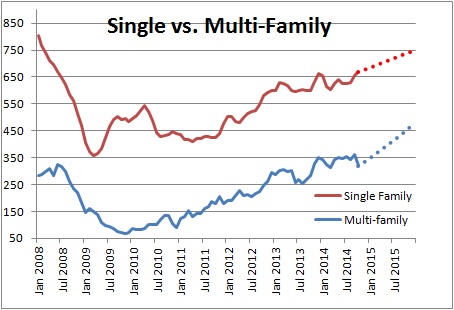
The housing sector will continue to do well for the foreseeable future because the demand for housing continues to outpace supply. However, there has been a distinct shift since the end of the recession towards renting rather than buying. So while the sector as a whole should continue to expand at a robust 25% rate over the next year, growth will be most dramatic in the multi-family sector.
The overall outlook for housing is easy to anticipate because demand continues to outpace supply. The Census Bureau tells us that 1.3 million new households are formed every year. Those families need a place to live — a single-family home or an apartment. But builders are constructing new housing at a 1.0 million pace which continues to fall short of demand.

While starts have been steadily rising for the past four years, some builders are currently reporting difficulty in getting adequate financing to get some projects underway. Others indicate an inability to get the skilled workers they require. If the pace of economic activity accelerates in the year ahead banks should become more willing to extend credit to builders. However, the lack of skilled workers may prove to be a more long-lasting challenge. Thus, we expect starts to continue to climb in the year ahead, but less rapidly than one might think given the imbalance between demand and supply. By the end of next year we anticipate that starts will have reached the 1.3 million pace required to satisfy demand, and then continue to climb in 2016 and beyond. But that is not the end of the story.
Since the recession end there has been a profound drop in homeownership in the United States. Owning a home has always been an American dream. In 1992 Congress passed legislation which encouraged banks to lend to low and moderate income borrowers. Down payments fell from 20% to 2%. No income verification was necessary. Banks offered teaser rates to attract buyers. As a result homeownership climbed sharply from the mid-1990’s through 2004. Unfortunately, the housing bubble burst in 2008 and homeownership began a rapid descent.

The decline in homeownership has been spread across all age brackets, but the drop has been most evident in younger adults in the under 35 and 35-44 age brackets. Two factors seem important.
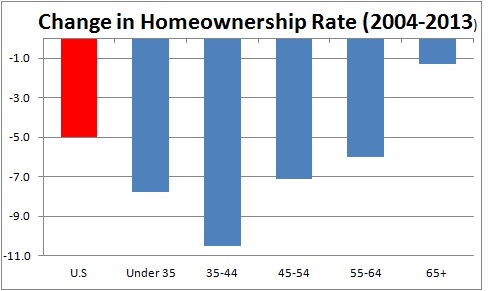
First, prior to the most recent recession home prices rose steadily for decades. Potential buyers could count on their home appreciating with near 100% certainty. But during The Great Recession suddenly people found that home prices could, in fact, decline sharply and they were no longer a sure bet. As the housing bubble burst, the desire for homeownership waned.
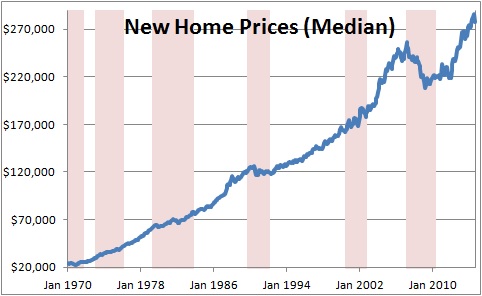
Second, since early 2013 mortgage rates have risen while home prices have climbed steadily. As a result, the required down payment for a median-priced home has climbed from $34,000 to $42,000. The monthly payment has climbed from $600 to $825. For younger adults, particularly for those coming out of school with a considerable amount of student debt, these increases have put homeownership out of reach for many.
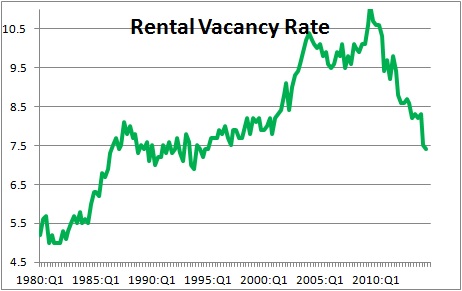
For both of these reasons, there has been a distinct preference on the part of younger adults for renting as opposed to buying. This dramatic increase in demand has lowered the rental vacancy rate to 7.4% which is the lowest it has been in 20 years.
As a result, builders have been scrambling to boost the construction of apartment units which are in such short supply. In the 12-month period ending in September single-family starts have risen 17% while multi-family units have grown at double that pace or 34%. This has lifted multi-family construction to almost 35% of the total number of starts, a share not seen since the mid-1980’s when the last wave of baby bombers was leaving school.
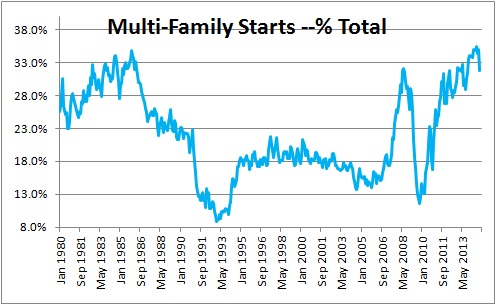
As we look ahead into the final few months of this year and into 2015, housing starts overall are expected to climb at a 25% pace from 1.0 million currently to 1.3 million. But given the acute shortage of available rental properties construction of multi-family units is projected to grow at a 50% rate compared to a 16% pace for the construction of single-family homes. The housing outlook is bright any way one slices it, but brightest for the multi-family sector.
Stephen Slifer
NumberNomics
Charleston, SC
Follow Me