
November 29, 2013
The Federal Reserve is on the cusp of slowing the pace of its bond purchases. It may start in December or wait until March. Either way it will happen soon. Once the Fed initiates that process long-term interest rates will tend to climb. But mortgage rates should rise only slightly next year and the housing sector will remain robust for three reasons.
First, there continues to be a shortfall of available housing. As the population grows every year roughly 1.3 million new households are formed. That means that housing starts must rise by 1.3 million to keep pace with demand. But currently builders are on a 900 thousand pace. They are having difficulty finding an adequate supply of skilled labor and/or an inability to find a bank willing to extend credit.
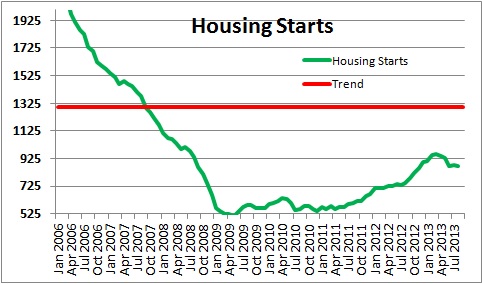
Realtors suggest that a 6-month supply of inventory is the point at which supply and demand are roughly in balance. Currently the supply of available housing is 5.0 months.
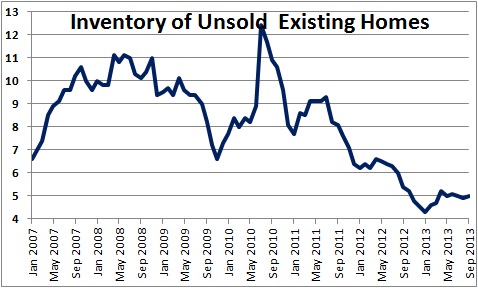
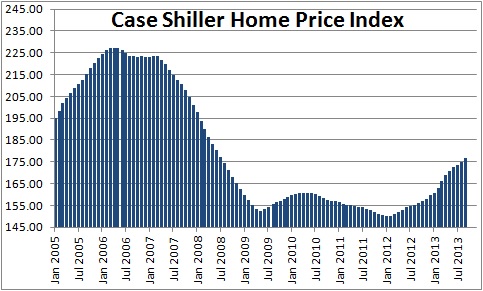
This shortage of available housing has caused home prices to rise 13.3% during the past year. The housing shortage will persist in 2014 which means that home prices will continue to rise but probably at a somewhat slower pace. As potential buyers worry about rising prices and the possibility of higher mortgage rates they will rush to buy before they get priced out of the market. That attitude will keep the housing sector on a sound footing for some time to come.
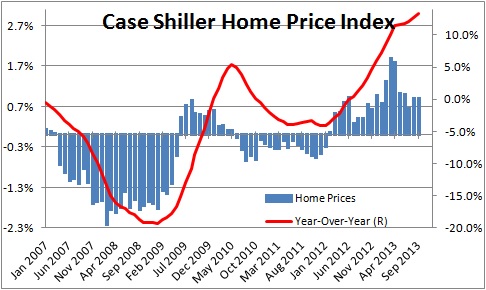
Second, housing remains affordable despite rising prices and higher mortgage rates. The National Association of Realtors constructs a monthly index of housing affordability. Housing is not as affordable as it was at the beginning of the year. However, the September index was 164.3 which means that potential buyers have 64% more income than is necessary to buy a median-priced home.
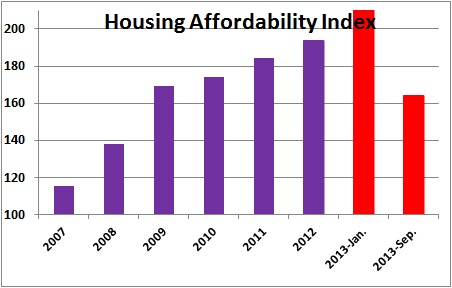
Keep in mind that while prices have risen 13.3% in the past year, they remain 22% below the peak price that was reached in April 2006.
Third, mortgage rates will climb only slightly in 2014. Some fear that as the Fed reduces its pace of bond purchases mortgage rates will rise sharply. We disagree. The primary reason is that the Fed will not allow that to happen. It has gone out of its way to point out that a slower pace of bond purchases does not represent a move towards “tightening”. Rather, reduced bond purchases should be regarded as a somewhat slower pace of easing. By purchasing $85 of bonds and mortgages every month currently the Fed is steadily easing. If it cuts those purchases to $50 billion per month it is still easing, but at a somewhat slower pace. If mortgage rates should rise sharply the Fed will counter by not reducing its bond purchases as quickly.
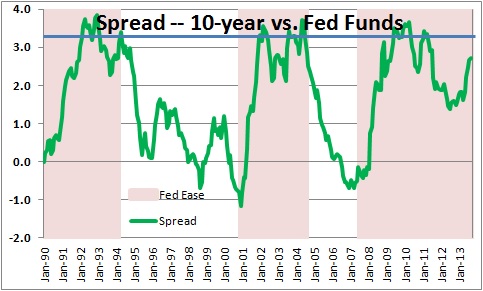
Another reason that mortgage rates will not rise sharply is because of the shape of the yield curve which is simply the difference between long-term and short-term interest rates. The spread between those two rates rarely exceeds 3.5 percentage points. Our forecast for the yield on the 10-year note at the end of next year is 3.25% versus 2.75% currently. With the funds rate expected to remain at 0% that implies that the yield curve would be 3.25% by the end of that year. That is about as steep as it ever gets. Long rates will not rise sharply until such time as the Fed unlocks the funds rate.
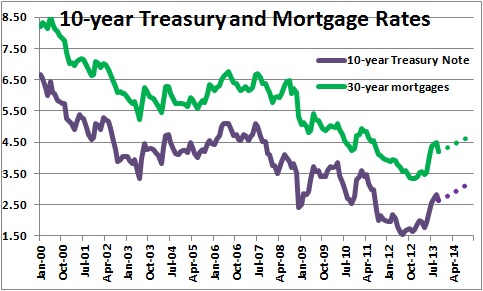
If the yield on the 10-year Treasury is projected to rise 0.5% in 2014, then the 30-year mortgage rate should climb by a reasonably comparable amount. Thus, we expect mortgage rates to rise from 4.25% currently to 4.75% by this time next year. Given that mortgage rates were at 4.5% just a few months ago a further increase to 4.75% is unlikely to have much impact.
As we see it, the housing sector will continue to do well in 2014 although the rate of improvement will be less rapid than it was year. A sharp increase in mortgage rates will not choke off home sales because the Fed will not let that happen. Meanwhile, housing will remain quite affordable. The recent rapid increase in home prices will slow in 2014 as builders step up the pace of construction which should alleviate the shortage of available housing and mitigate further price increases. Furthermore, as the pace of economy activity quickens more jobs will be created which will generate income. A combination of a modest increase in mortgage rates, prices that rise more slowly, and faster growth in income should keep the housing sector cruising for some time to come.
Stephen Slifer
NumberNomics
Charleston, SC
Follow Me