
June 17, 2016
Economists are always searching for bubbles. Could housing be next? The housing market today is hot. Demand far exceeds supply which suggests that home prices and rents will accelerate. That, in turn, should cause inflation to climb which will clearly capture the attention of policy makers at the Federal Reserve. As a result, rates are likely to rise more quickly than the Fed is suggesting at the moment and the markets are expecting. But even if the Fed steps up the pace, the funds rate is unlikely to be higher than the 3.0% mark (which is generally regarded as a “neutral” rate) by the end 2018. So while the housing sector is cruising along today, it does not appear to be flashing any sort of danger signal.
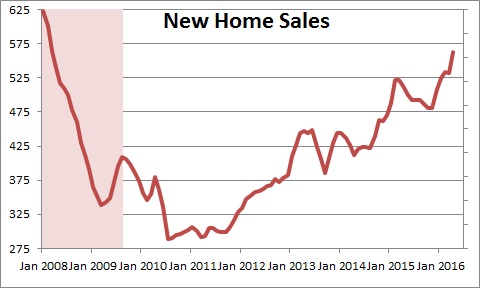
In the past couple of months we have seen home sales suddenly take off. The pickup in sales has created a shortage of available homes for sale. The inventory of homes on the market is well below the 6.0 month supply at which point demand and supply are in roughly balance.
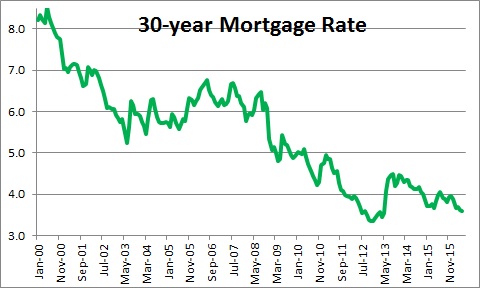
What is boosting the demand for housing? Probably the combo of falling mortgage rates and rising income. Mortgage rates have declined to 3.6% which is approaching the 3.35% low point reached in December 2012. Given that the U.S. is likely to grow steadily at about a 2.0% pace for the foreseeable future while interest rates rise at a snail’s pace, funds are flowing in from around the globe. As a result, long-term interest rates have declined and the U.S. stock market is approaching a record high level.
At the same time monthly job gains of nearly 200 thousand per month are boosting consumer income. Real disposable income (what is left after inflation and taxes) is growing at a respectable 3.3% pace.

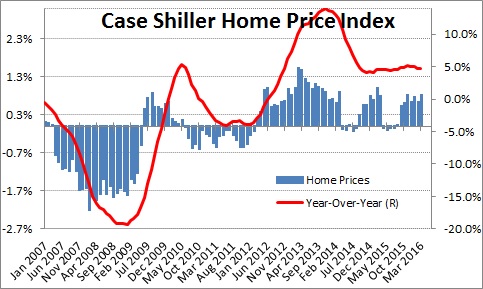
Whenever demand exceeds supply prices begin to rise. The Case Shiller Index of home prices has risen 4.7% in the past year which seems innocuous. But in the past six months prices have been rising at a somewhat more disturbing 8.5% pace.
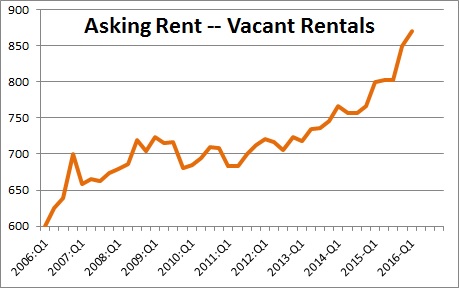
If one chooses to rent rather than buy there is still a problem. Rents have risen 9.0% in the past year. Any way you slice it the cost of housing is going up.
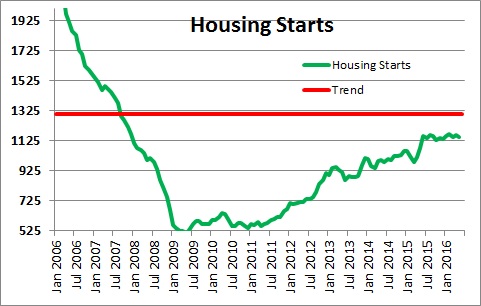
While builders could step up the pace of production to eliminate the shortfall, the reality is that housing starts have been essentially flat for the past year. The problem seems to be a shortage of skilled construction workers. After rising 25 thousand per month last year, construction employment actually declined slightly in both April and May. Builders have a hard time ramping up production if they cannot find enough bodies to hire.
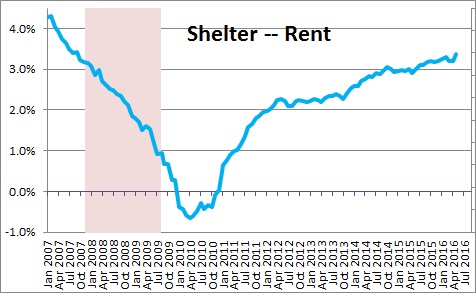
This increase in home prices and rents is an important ingredient in the outlook for inflation. In fact, housing represents one-third of the entire CPI index of inflation. The “Shelter” component has been gradually rising and in the past year has climbed 3.4%. But given the discussion above it is clear that this category of inflation will accelerate.
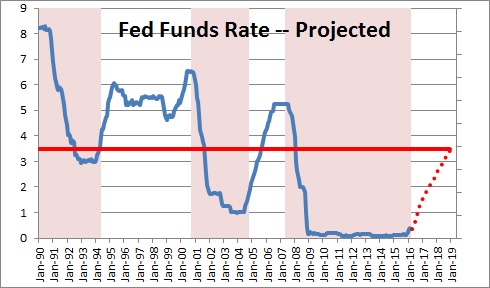
Presumably in response to the soft employment report for May the Fed recently ratcheted downwards the trajectory of rate hikes in coming years. It still expects the funds rate to be 0.9% at yearend, but by the end of 2018 it now expects the funds rate to be 2.4%. In March it thought the funds rate would be 3.0% at that time. But expectations can change. As oil prices and commodity prices level off, the steady acceleration in the shelter component discussed above should boost the core CPI to 2.5% by the end of this year and 3.0% by the end of next year.
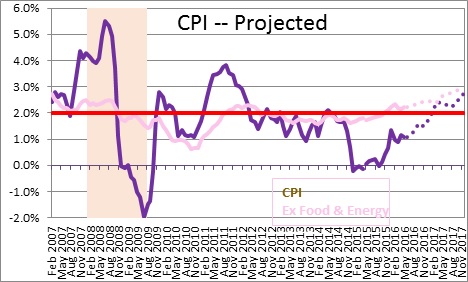
Given that these likely inflation rates are above the Fed’s 2.0% inflation target, we are likely to see the Fed’s pace of tightening gather momentum in coming months. We look for two more rate hikes between now and yearend, but by the end of 2018 we anticipate the funds to be close to the 3.0% mark versus the Fed’s current expectation of 2.4%. However, 3.0% is generally regarded as a “neutral” rate. Short rates at that level should not derail the economy. So while housing is hot for now, it is unlikely to create a problem.
Stephen Slifer
NumberNomics
Charleston, SC
Follow Me