
March 15, 2013
Sometimes we get so caught up in our economy we ignore developments elsewhere. Recently we have been thrilled watching the Dow Jones Industrial average climb to a record high level. But stock market gains are not confined to the United States.
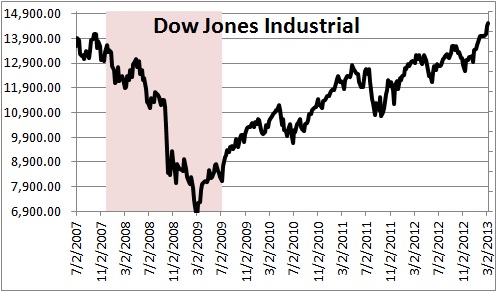
Since the beginning of October stock markets around the globe have climbed between 5-10%. Here in the U.S. both the Dow Jones Industrial average and the S&P have risen about 7%. In London stocks have climbed by almost 11%. On the continent they have gained 7.5%. Stocks in Hong Kong have climbed by 10%. Keep in mind that a 10% increase in a year is impressive.
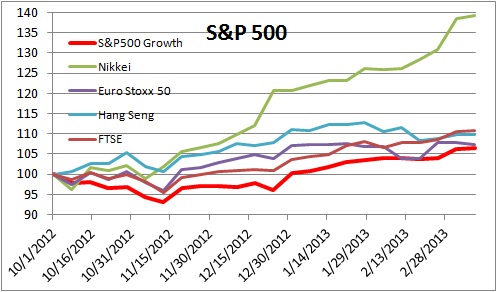
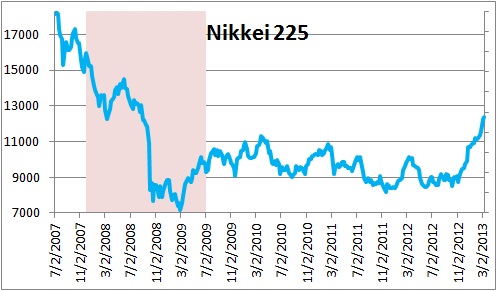
But one stock market stands out from the crowd. In the past six months the Japanese stock market, known as the Nikkei, has risen an astonishing 40%! To put that in more familiar terms, it is equivalent to the Dow Jones Industrial average climbing from 13,600 in early October to 19,000! What in the world is going on?
Japan’s newly elected Prime Minister Abe is trying to re-invigorate the Japanese economy which has been in a slump since the early 1990’s. To accomplish that objective he has demanded that the Bank of Japan pursue a quantitative easing program much like that being employed by the Fed. The idea would be for the BOJ to pump huge quantities of reserves into the banking system in an attempt to weaken the yen and produce a 2-3% inflation rate. At the same time a weaker yen would reduce the price of yen-denominated goods, make Japanese goods more attractive, and boost the pace of economic activity.
This means that the world’s two largest economies – the U.S. and Japan – have not only pushed short-term interest rates to 0%, they are trying to reduce long-term rates as well. Traditionally central banks carry out monetary policy by changing short-term interest rates. When they lower short-term interest rates that is known as “monetary easing”. But when short rates are already at 0% and cannot go lower and central banks want to further stimulate their economy, they engage in “quantitative easing”. That means that they buy bonds in an attempt to also reduce long-term interest rates. Such policies tend to boost the stock market, raise consumer and business confidence and, hopefully, lead to faster GDP growth.
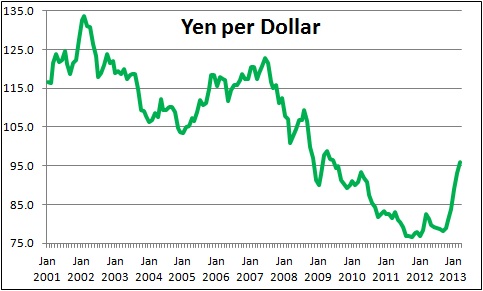
Thus far, the Japanese strategy has worked well. In the past six months the dollar has strengthened from 78 yen to the dollar six months ago to 96 yen to the dollar today – an increase of 23%. That means that the yen has weakened by an equivalent amount. The yen has also weakened by almost 30% versus the Euro. Thus, Japanese goods are roughly 25% cheaper to Americans and Europeans today than they were six months ago. With a price cut of that magnitude there is a good chance that Japan’s exports will surge and ignite GDP growth in 2013. No wonder the Japanese stock market has risen 40% in the past six months.
However, if those central banks do not eventually reverse course and eliminate those surplus reserves from the banking system, those same policies can lead to a higher inflation rate down the road. In the case of Japan, that is the whole idea. The inflation rate in Japan has been falling steadily since 1999. Japan needs to produce an inflation rate of 2-3% to help lift their economy out of the doldrums. If prices steadily decline, why should anyone buy today knowing that they can purchase the same product cheaper tomorrow? But the Fed needs to be more cautious. The inflation rate in the U.S. is slightly below the Fed’s 2.0% target, but not by a lot.
The 25% drop in the value of the yen is good for Japan because Japanese goods are now 25% cheaper to Americans and Europeans. But the flip side is that U.S. and European goods are 25% more expensive for Japanese purchasers. Indeed, the Japanese were accused of initiating a trade war at the G-20 meeting last month by intentionally devaluing their currency to gain a competitive advantage. After some apparently heated discussion it was agreed that developed countries should continue their monetary stimulus to encourage growth in their own economy because that is important for global growth. Thus, it is presumably OK if your currency falls because you are trying to stimulate your economy, but it is not OK if your currency falls because you seek a competitive advantage. It is not clear how one can tell which is which.
All-in-all, central bank action in both the U.S. and in Japan is going to stimulate stock markets around the globe and, hopefully, result in a faster pace of economic activity this year. It is becoming increasingly likely that 2013 may be the year of transition from the sluggish pace of GDP growth in recent years to a more robust rate of expansion. That would be a welcome development. But by the end of next year we should be watching carefully for any sign of a pickup in inflation.
Stephen Slifer
NumberNomics
Charleston, SC
Follow Me