
December 2, 2016
The inflation rate is poised to rise. Prior to the election we feared that it could accelerate rapidly. Post-election we still expect the inflation rate to quicken, but we are less concerned about it spiking upwards. Why? Because we expect productivity gains to counter most of the upward pressure on wages caused by the tight labor market.
President-elect Trump is going to create a more business-friendly environment. He plans to cut the corporate tax rate from 35% to 20%. He will allow companies to repatriate overseas earnings to the United States at a very low 10% tax rate. He wants to provide significant relief from the currently onerous regulatory environment. If these things come to pass, investment spending in the United States will accelerate. In the past three years investment spending has been essentially unchanged. In 2017 and 2018 we expect investment to gradually climb to about 5.0%.

The lack of investment spending in recent year has had a lot to do with the disappearance of productivity growth. The more money a firm spends on adopting the latest technology or refurbishing the factory floor with labor-saving equipment, the more likely it is that productivity will accelerate. Given the likely jump in investment spending during the next couple of years, we believe productivity growth will climb gradually from 0% today to about 2.0%. An increase in productivity is an extremely important development.

Faster growth in wages can cause employers to raise prices. For example, if a firm pays its workers 3.0% higher wages but they are no more productive, the firm’s labor costs have risen 3.0%. To prevent profit margins from shrinking firms may choose to raise prices. Thus, high labor costs frequently cause the inflation rate to accelerate.
But what happens if workers are more productive? If the firm pays its workers 3% higher wages and at the same time they are 3% more productive, the firm really does not care. It is getting 3% more output from its workers. Their employees have earned the wage hike. In this situation the firm has no reason to boost prices. Thus, the most accurate way of determining the impact of higher wages on the inflation rate is to adjust for the change in productivity. Economists have a name for this — unit labor costs.
In the past year worker compensation has risen 2.3%. In that same period of time productivity has been unchanged. As a result, unit labor costs have risen 2.3%.
In 2017 we expect compensation to increase 3.8% (versus 2.3% in the past year) because the labor market is at full employment. Firms will need to offer higher wages and/or more attractive benefits to get the workers that they need. But given the expected increase in investment spending, productivity should climb to 1.3%. This means unit labor costs will increase 2.5% — which is little different from the 2.3% increase we have seen in the past year. So even if wages pressures intensify, the largely offsetting increase in productivity means that employers will have little incentive to raise prices.
Apart from labor costs there are still reasons for the inflation rate to accelerate. There is an acute shortage of available rental properties which is putting upward pressure on rents. In the past year they have risen 3.5%. This is important because shelter represents one-third of the entire CPI. At the same time rising health care insurance premiums are boosting the cost of medical care. As a result, we expect the core CPI to increase from 2.2% this year to 2.7% in 2017.
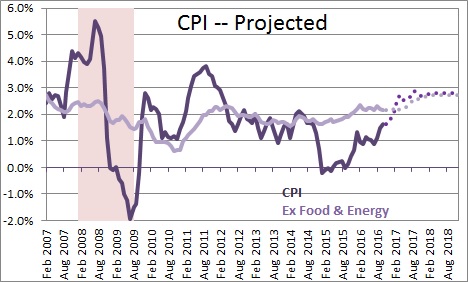
That represents a moderate pickup in the inflation rate which should not derail the Fed from the moderate path of rate hikes it has described previously. We think that by the end of next year the funds rate will have climbed from 0.5% to 1.0%.
If productivity gains counter most of the expected significant pickup in wages in 2017, there will be little upward pressure on inflation caused by the very tight labor market. If we can take labor costs off the table as a source of higher inflation, there will be little chance of it spiking upwards. That is a good thing.
Stephen Slifer
NumberNomics
Charleston, S.C.


Steve,
Are there any surveys that give visibility into a firm’s likelihood of making capital investments? I saw Meg Whitman recently talking about the possibility of repatriated cash and how they could use it for investment. Or they could use it for dividends or share buyback.
I can imagine CEOs succumbing to short term thinking and using repatriated cash to boost stock prices more than on capital investments.
Interested to hear your thoughts.
Thanks
-Pat