
May 22, 2015
The inflation rate is showing clear signs of accelerating which will eventually force the Fed into action. However, the doves on the FOMC are in control at the moment which means that the first rate hike will probably be postponed until September. By that time signs of the economic rebound following the first quarter slump will be more widespread, and evidence of a notable acceleration in the inflation rate should be more evident.
At its meeting on April 28-29 the Fed indicated that “Many participants thought it unlikely that the data available in June would provide sufficient confirmation that the conditions for raising the target range for the federal funds rate had been satisfied, although they generally did not rule out this possibility.” That statement essentially takes a June rate hike off the table. The Fed is trying very hard to send us a message.
The Fed has made it abundantly clear that it does not intend to raise rates until such time as the labor market achieves full employment and the inflation rate shows signs of climbing back towards the Fed’s 2.0% target. Both pieces are happening.
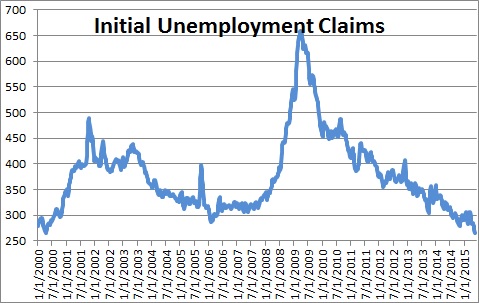
With respect to the labor market, the weekly data on initial unemployment claims (a measure of layoffs) have fallen in recent weeks to the lowest level in 15 years — April 2000 to be exact.
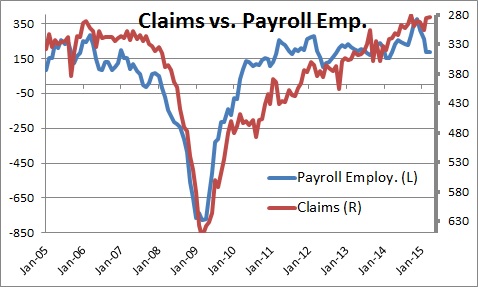
Not surprisingly, there is a reasonably close correlation between what happens to layoffs and the monthly increase in payroll employment. With claims at their current level the increase in payroll employment for May is likely to be in a range from 275-300 thousand. That figure will be released on Friday, June 5.
Similarly, the number of people receiving unemployment insurance benefits has also fallen to a 15-year low. We expect the unemployment rate to fall another 0.1% to 5.3%. Will an outsized increase in employment and another drop in the unemployment rate be enough to convince Fed officials that the time has come to boost the funds rate? Probably not.
What about inflation? Since the FOMC meeting on April 28-29 the Fed received the CPI data for April. It was somewhat disturbing. The overall index was acceptable as a drop in energy prices kept the monthly increase in check at just 0.1%. But the core rate, which excludes the volatile food and energy components, rose 0.3% which is the biggest increase in two years – since January 2013 to be precise. It was not statistical noise. The increase was broad-based – shelter, medical care, used cars and trucks, and new vehicles all contributed to the increase.
Of particular note was the increase in the shelter component. It rose 0.3% in both March and April. It has risen 3.0% in the past year but has climbed at a 3.2% pace in the past three months. It seems to be accelerating. At steady pickup in this particular component is important because shelter represents one-third of the entire CPI.
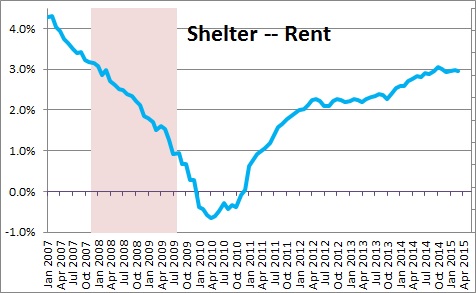
It is no surprise that rents are on the rise because the rental vacancy rate is at a 20-year low. There is an extreme shortage of rental properties available.

Landlords have taken advantage of the situation to raise rents quickly. The asking rent for vacant rentals has risen 4.3% in the past year, but it has been rising at double-digit past in the most recent two quarters. The situation is getting worse. The Fed should take note. Unfortunately, the May CPI report, which is also likely to be unfriendly, will not be released until the day after the June FOMC meeting.
One other piece of information that could influence the Fed’s decision at the June meeting is the increase in retail sales for May which will be released on June 11. You will recall that retail sales for April were unchanged. Economists had expected an increase of 0.4%. We suggest that the lack of increase in April was caused by the huge individual tax payments to the Treasury in that month. Absent this factor retail sales are likely to rise by 0.5% or so in May.
Will any of this evidence be enough to spur the Fed into action at its meeting on June 16-17? Probably not. The Fed has essentially told us that a June rate hike is off the table. The data released between now and then is unlikely to convince the majority of FOMC members to raise rates at that time. Our fear is that the Fed is falling behind which could imply a faster pace of tightening at some point down the road. While the economy responds primarily to the level of rates it is also sensitive to the pace of tightening. Consumers and business people are far more likely to get nervous – and slow their pace of spending — if the Fed starts raising rates by 0.25% at every FOMC meeting versus 0.25% at every other meeting because rates will get to a point where they begin to bite much more quickly.
Stephen Slifer
NumberNomics
Charleston, SC


Stephen,
Interesting information. At what point do the rates hikes move us dangerously close to the next recession? Does take 6% or more? Or, will a lesser percentage push the economy over the edge?
Just wondering.
…Darrel