
January 31, 2014
Inflation has been a forgotten word for the past six years. It is not a problem at the moment, but the Fed is keeping a watchful eye for signs of its re-emergence, and if that happens the Fed could be forced to raise the funds rate sooner than the middle of 2015. So what should we watch to give us an early indication of whether that might happen? The unemployment rate.
In 2013 the core CPI (excluding the volatile food and energy components) rose 1.7% which is close to the Fed’s 2.0% target. The inflation rate today is not a problem, but what is it going to be tomorrow?
Inflation can be influenced by many factors – commodity prices and the value of the dollar, but the most important factor is labor compensation. Why? Because labor costs represent about two-thirds of a firm’s overall cost. If compensation begins to climb firms are likely to pass the higher cost through to their customers in the form of higher prices, which translates into a faster inflation rate. In the past year compensation – wages plus benefits – has risen 2.0% and it has been steady at about that same pace for the past couple of years. What could cause compensation to rise more quickly? A further drop in the unemployment rate.

The unemployment rate today stands at 6.7%. Many economists believe that if everyone in this country who wanted a job had one the unemployment rate would be 5.5%. The Fed still seems to believe that is the case. If they are right we should not even be having this discussion about potential upward pressure on wages and a pickup in inflation for some time to come. But what if the Fed is wrong?
Our concern is that many currently unemployed workers have been without a job for a very long period time. Indeed, the average duration of unemployment today is currently 37 weeks — 8.5 months. While some workers are finding jobs, the hires are largely coming either from new entrants to the labor force or workers who have been unemployed for a relatively short period of time. Long-term unemployed workers are encountering serious challenges. It is likely that many of them simply do not have the education or the job skills required by today’s employers. If that is the case many of these people will become permanently unemployed and the so-called full-employment threshold could be much higher. Our guess is that it is at least 6.0%.
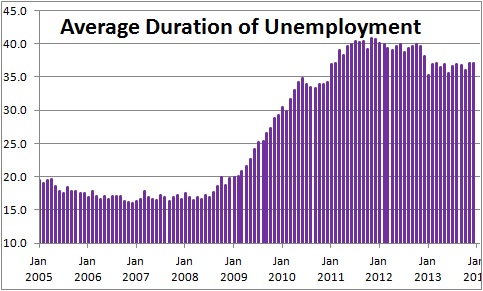
With the unemployment rate currently at 6.7% it should decline to 6.0% by the fall, particularly with a little help from demographics and the retiring baby boomers. At that time we could see upward pressure on compensation as firms bid more aggressively to get the skilled workers that they require. It may be that in today’s hyper-competitive environment with corporate profits continuing to rise, firms may eat the higher costs internally and not pass them through to their clients. But if the economy continues to expand and the unemployment rate falls farther, higher inflation will not be far behind.

At this point nobody knows what that full-employment threshold is — 5.5%, 6.0%, or higher. But the signal that we have reached that point will be when we see firms offering higher wages and/or more attractive benefits packages. That will be a signal to the Federal Reserve that it needs to get rates back to “neutral” fairly quickly. “Neutral” implies a funds rate that is about 4.25% (versus near 0.0% currently), and the yield on the Treasury’s 10-year note of about 6.0% (compared to 2.7% today). Obviously today’s rates are not even close to what might constitute a neutral rate environment.
There is no cause for alarm yet but vigilance is required. The reality is that the unemployment rate has declined far more rapidly than anyone expected. If it continues to do so and the full-employment threshold has risen to 6.0% or higher, the Fed may need to accelerate its pace of rate adjustment. We do not think that will happen and anticipate the first funds rate hike to occur in the middle of next year. But, like the Fed, we are paying attention.
Stephen Slifer
NumberNomics
Charleston, S.C.


Steve,
My partner, Peter Gambee and I very much enjoy your work!!!
One comment about the potential pressure on wages relating to the longer term underemployed…….it seems corporate america will continue to substitue capital.. for labor particularly with the increasing cost of benefits, ie. health care .
Have you read Dan Alpert’s “The Age of Oversupply”?…..the first half is interesting.
Please let us know the next time you are in NYC!
Hi Jerry,
Nice to hear from you! I trust all is well on your end. I have semi-retired and am now living in and operating out of Charleston, S.C. Great place to hang out! I have not read Dan Alpert’s book, but will check it out. I am always looking for fresh ideas.
I think you are right, firms want to take advantage of technology rather than hire more bodies and/or hire more part timers so they can eliminate the cost of benefits. But, unfortunately, it is not always a perfect substitute. Thus, I think we will see them put some of their cash to work and boost spending on technology and give a boost to GDP growth. But I also think they will need to bite the bullet and hire more bodies — some of our youth where help is readily available and perhaps convert some of those part-time slots to full time positions. Unfortunately, the long-term unemployed will probably be at the bottom of the list of new hires.
Nice to hear from you. I will find you the next time I am in NYC. But if you end up in Charleston, perhaps on your way to Kiawah, give me a shout.
Steve