
December 30, 2011
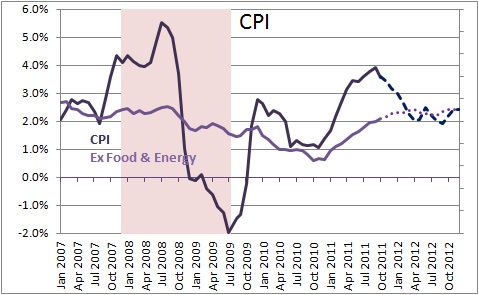
The inflation rate has not gotten a lot of attention lately primarily because it has been relatively subdued. When oil prices pushed inflation higher early in 2011, GDP growth slowed to a snail’s pace. Once oil prices retreated in the second half of the year the economy rebounded. What might inflation do in 2012 as the economy gathers momentum? Barring a political development, such as Iran closing the Strait of Hormuz which would push oil prices sharply higher, the odds are that inflation will behave relatively well in 2012. We expect both the overall CPI and the so-called “core” rate of inflation (the CPI excluding the volatile food and energy components) to rise by 2.4%; the Fed would like to see the inflation rate rise by about 2.0%. This is not sufficiently far above the target rate for the Fed to become worried. Indeed, the Fed’s preferred inflation measure – the index for personal consumption expenditures excluding food and energy – is currently expanding at an acceptable 1.8% pace.
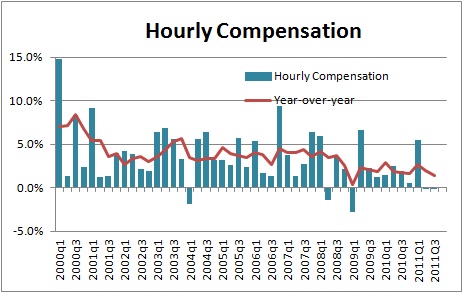
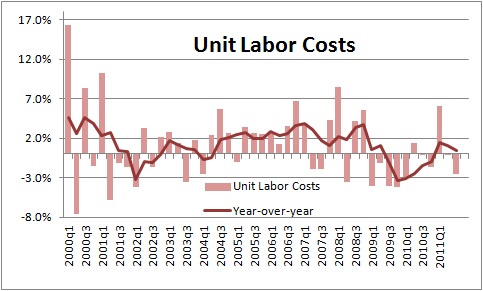
The most important factor in determining the inflation rate in the U.S. is labor costs because they represent about two-thirds of a firm’s total cost. If they rise, there is a tendency for prices to climb as the higher wages are pushed forward to the consumer. Over the past year, hourly compensation has risen a by a modest 1.4%. But even this overstates the case. If firms pay workers 1.4% more money but they are 1.4% more productive, they really don’t care because they are getting 1.4% more output. Indeed, they can pay them 10% more money and it will not be inflationary because they are getting 10% more output. What determines the upward pressure on prices is not the change in hourly compensation, but compensation adjusted for the change in productivity, which is what economists like to call “unit labor costs”.
Currently, higher compensation costs (1.4%) are being largely offset by an increase in productivity (1.0%). As a result, unit labor costs over the past year have risen by just 0.4%. However, as GDP growth accelerates in 2012, jobs growth begins to rise by more than 200 thousand per month, and the unemployment rate declines to 7.6% by this time next year, there is likely to be modest upward pressure on unit labor costs – and inflation — as the year develops. This should not be a problem as it will likely be offset elsewhere.
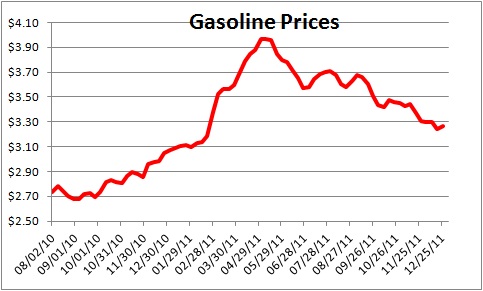
In addition to labor costs, the cost of materials matters is important in determining the rate of inflation. Most economists split these costs between energy and non-energy materials because, as we learned most vividly this past year, energy prices are quite volatile and political events can push them sharply in either direction.
Oil prices rose sharply in the early part of 2011 as the result of the political unrest in many North African and Mideast countries. As a consequence, GDP growth slowed to a snail’s pace. Oil prices have since fallen as the political situation in Tunisia, Europe, and Iraq has quieted down to some extent, and, as one might expect, the pace of economic activity has rebounded.
Non-energy prices, industrial commodity prices in particular (which include agricultural commodities such as cotton, wool and lumber, and various metals such as copper, aluminum, and iron ore) followed a similar pattern in 2011. Prices rose sharply early in the year, but subsequently retreated as concerns about a possible European recession in 2012, and slower growth in Asia, became more widespread. The IMF currently expects Euro area growth to slip from 1.6% in 2011 to 1.0% in 2012. And growth in what it calls “developing Asia”, which includes China and India, is expected to edge lower from 8.2% to 8.0%.
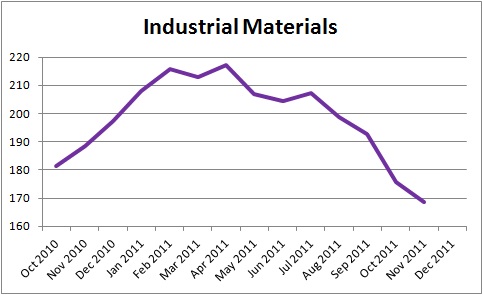
Combining the lack of upward pressure on labor costs (unit labor costs in particular), and downward pressure on all commodities (both oil and nonoil), we conclude that the CPI should behave relatively well in 2012. As noted earlier, the overall CPI and the so-called “core” rate of inflation are expected to rise by 2.4% in 2012. In some sense, the faster pace of GDP growth in the U.S. will be largely countered by slower growth elsewhere, with the net result being that inflation will remain stable.
Stephen Slifer
NumberNomics
Charleston, SC
Follow Me