
October 9, 2026
The Federal Reserve raised the funds rate by 0.25% last month with another 0.25% increase expected in December. The total increase of 0.5% would boost the funds rate to 4.1% by yearend. The recent increase in long-term interest rates, however, has been eye-popping. At the beginning of the year the rate on the Treasury’s 10-year note was 4.25%. Today it is 5.25%. What is going on there? Does the increase represent an upward adjustment to the market’s expected rate of inflation? No. Is the relentless addition to Treasury debt in conjunction with the additional need for funding by the private sector to finance the AI buildout beginning to take a toll? Yes. And, more importantly, do the higher levels of short- and long-term interest rates run the risk of significantly weakening the U.S. economy? No. Here is our spin on why the economy will largely shrug off these higher interest rates.
Let’s start with short rates. With the second 0.25% increase in the funds rate in December the level of the funds rate will be 4.1%. The question is, how does that rate compare to a so-called “neutral” level. For years the Fed believed that a neutral level was 3.0%. Prior to the September increase the funds rate was 3.6%. That means that Fed policy was apparently mildly restrictive. But if that is the case, why is the stock market at a record high level? Why is the economy continuing to chug along at a relatively robust 2.5% pace? And why is inflation stuck close to the 3.0% mark rather than continuing to slow gradually to the desired 2.0% pace? Clearly, a neutral level for the funds rate is not even close to the 3.0% rate that the Fed believes. It also is not neutral at the 3.6% level. We have suggested that a neutral level for the funds rate is around 4.0%. If the funds rate reaches 4.1% by yearend it will be roughly neutral and close to where it probably should have been for the past year. A funds rate of 4.1% would not threaten the economy.
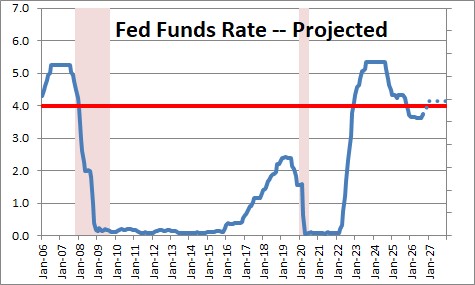
For what it is worth, at the last FOMC gathering, 6 of 18 Fed officials 6 believed the funds rate was neutral at 3.0%. One had it at 2.75%. And 11 pegged the neutral rate somewhere between 3.0-4.0% with 7 of the 11 believing it was between 3.5-4.0%. the Fed’s view of a neutral level for the funds rate seems to be edging its way higher.
The increase in longer-term interest rates has been far more dramatic. In January the rate on the 10-year was 4.25%, Today it is 5.25%.
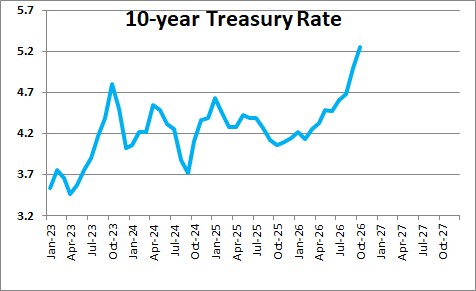
Long rates reflect two parts, an expected rate of inflation over that period of time and a real rate premium. Given the stickiness of inflation around the 3.0% mark and sharply higher oil prices, one could argue that some of the increase in the 10-year rate reflects an upward adjustment to the expected rate of inflation. Not so. The difference between the nominal rate on the 10-year and its inflation-adjusted equivalent represents the implied rate of inflation during that 10-year period. That rate has been rock steady at 2.4%.
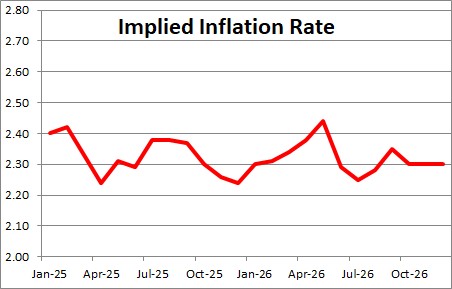
The market apparently believes that the recent increase in inflation caused by higher oil prices will be temporary. But it also reflects an expectation that the Fed is not going to reduce inflation to its targeted 2.0% pace any time soon. If Fed Chair Warsh and his colleagues are successful in reducing inflation this component of the yield on the 10-year could decline.
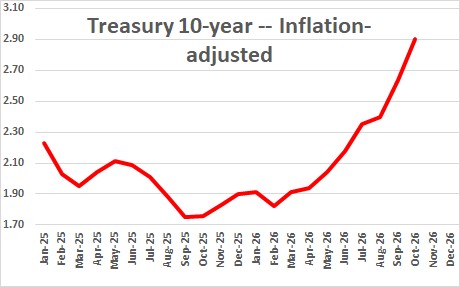
If inflation expectations have not changed, than the increase in the nominal 10-year must be attributable to the inflation adjusted component, i.e. the amount a holder will be paid above the actual inflation rate. And, indeed, that is the case. The 10-year TIPS rate has jumped by 1.0% from 1.9% at the beginning of the year to 2.9%. Our sense is that the sharp increase reflects the combination of the U.S. Treasury’s continuing need for $2.0 trillion of funds annually to finance its annual budget deficit, combined with another $1.0 trillion of funds required in the next year or so to finance the AI buildout.
The budget deficit for the fiscal year that just ended in September was $2.0 trillion with $2.0+ trillion deficits expected every year for at least the next decade.
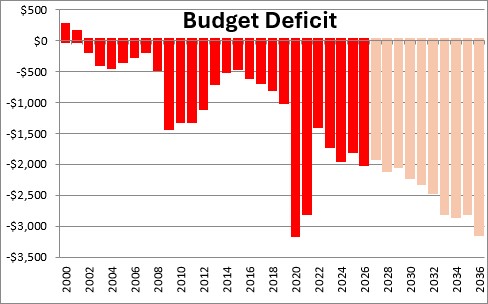
Every year that the U.S. Treasury runs a deficit of $2.0 trillion it must issue $2.0 trillion of debt to pay its bills. Thus, debt outstanding is going to continue to climb quickly every year for the foreseeable future. The problem is that debt as a percent of GDP is already high at 100% and poised to climb to 120% a decade from now.
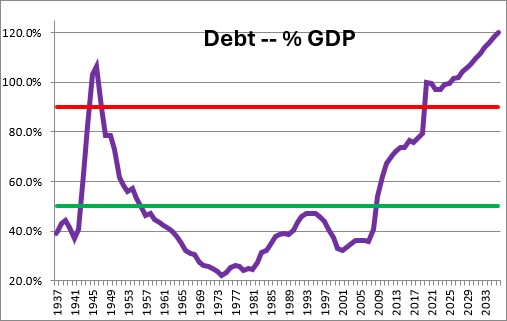
To put that in context, the debt to GDP ratio set a record after World War II at 106%. When the war ended war-related spending declined sharply and the ratio plunged quickly. That will not be the case this time. Sixty percent of every dollar our government spends is on some kind of a transfer payment — Social Security, Medicare, Medicaid, welfare benefits, veterans benefits. These are payments to individuals to supplement their income. Politicians are unwilling to cut those benefits because they will reduce the income of many voters in their district. Those benefits have often been viewed as the “third rail” of politics. Touch them and your career as a politician will come to a screeching halt.
Compound this problem with the fact that the Social Security Trust Fund will be depleted in 2032 and the Medicare Hospital Insurance Trust Fund one year later. Against this background it is understandable that investors are demanding a higher real rate premium.
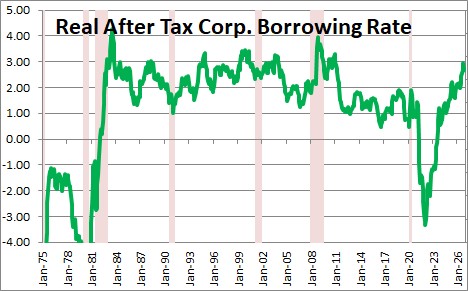
Could these higher real rates choke off growth in the economy? We doubt it. It is important to remember that corporate borrowers pay a nominal rate for the amount they borrow, but they currently get to write off 21% of that against their taxes, and pay it back with cheaper dollars because of inflation. The relevant rate to assess their borrowing decision is the real, after-tax corporate borrowing rate. Today that rate is 2.7%. But that rate pales in comparison to the expected real rate of return on an investment in AI. It is hard to see how the recent increase in long rates is going to negatively impact corporate borrowing and growth in the economy any time in the near future.
The increase in long rates this year has been disquieting. It has apparently been triggered by the Treasury’s incessant borrowing need to finance the budget deficit and now by the seemingly insatiable demand for money to finance the AI buildout. While these borrowing needs are unlikely to diminish any time soon the real rates are, hopefully, attractive enough for investors to consider longer-dated fixed income securities.
Stephen Slifer
NumberNomics
Charleston, S.C.
Follow Me