
April 19, 2013
For the first time an official of the Federal Reserve, St. Louis Federal Reserve Bank President James Bullard, suggested that the current inflation rate was too low, and that if it slowed further he would consider boosting the pace of bond purchases to pull price pressure up to the targeted pace. This idea surfaced at the exact same time that other Fed officials toyed with the notion of slowing their pace of asset purchases. What gives? Is the Fed going to ease? Or begin to tighten?
The Fed has an inflation target of 2.0%. Its preferred measure is the personal consumption expenditures deflator excluding the often volatile food and energy categories. Over the course of the past year that index has risen 1.3% which is, indeed, slower than the desired pace. How should the Fed respond to that shortfall?
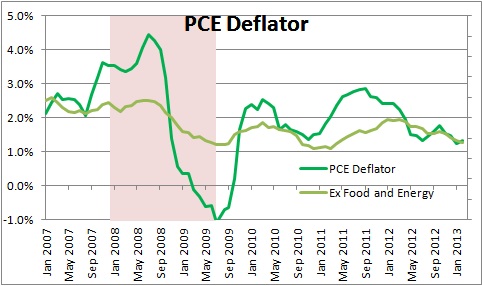
First, it is important to recognize that there are a variety of different inflation measures. Each provides part of the overall picture, each has its own strengths and drawbacks, and they typically do not tell exactly the same story.
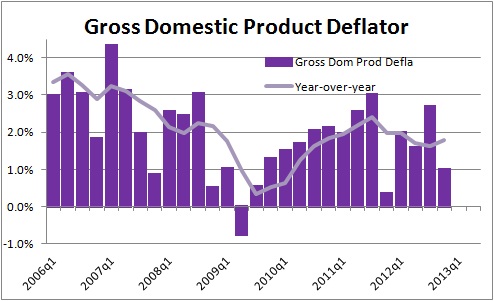
One of those alternative inflation measures is the GDP deflator. It is the broadest measure of inflation and includes over 5,000 items which is good. In addition to the prices of consumer goods and services, it also includes the prices of different types of capital equipment. But it is a measure of price changes for domestically produced goods and services. Prices of imported products are not included. Given that about 15% of the goods and services we buy are imported, it could provide a somewhat misleading picture of inflation at times when the dollar is rapidly changing in value. Currently the GDP deflator has been increasing at a 1.8% pace. The “core” GDP deflator has risen 1.7%. If that were the preferred inflation measure and the target was 2.0%, the Fed would claim victory.
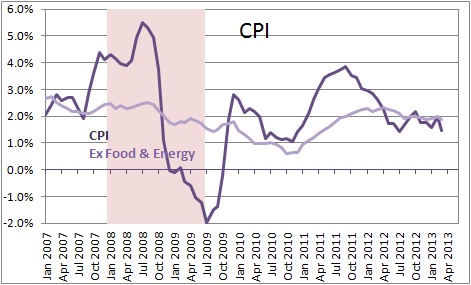
Then there is the consumer price index, or the CPI. It is the most well-known measure of inflation but it is also the narrowest gauge and includes just 364 items. Given its name it is a measure of goods and services that consumers buy. No capital equipment is included. Its advantage is that it is the only measure of inflation that includes imported goods. For this reason the CPI is our preferred measure of inflation. In the past twelve months the CPI has risen 1.5% overall and 1.9% excluding the volatile food and energy categories. Thus, several inflation barometers are much closer to the Fed’s 2.0% inflation target than the personal consumption expenditures deflator described earlier.
Why is the Fed concerned about a low rate of inflation? Its fear is that low inflation could turn into a deflationary spiral during which prices actually decline. That is essentially the situation that Japan has faced since the early 1990’s. When prices fall, people do not want to purchase something today because it will be cheaper tomorrow. Thus, the savings rate is high and consumer spending is greatly reduced from what it would be in a rising price environment. Once that mentality is firmly entrenched it is difficult to lure consumers out of their shell and entice them to buy.
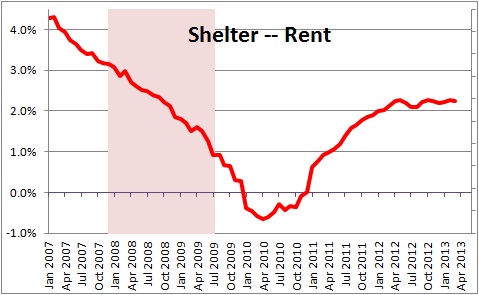
Is the U.S. close to a deflationary environment? No way. First, housing accounts for 38% of the CPI. Currently shelter is climbing at a 2.2% rate. With shortages of homes available to buy and the rental vacancy rate at a 10-year low, there is likely to be upward pressure on rents in the months and quarters to come.
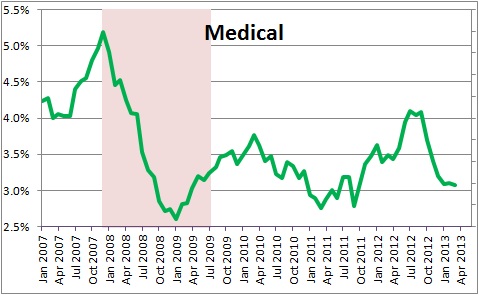
Medical prices are also rising. That is another 7% of the index. While the rate of inflation in this sector has slowed, it is still rising at a 3.1% pace, and it is hard to envision it dipping below 2.5% in 2013. Between these two sectors, which combined account for 45% of the overall CPI, it is impossible to envision a deflationary environment.
For the Fed to seriously consider stepping up its pace of purchase of asset purchases when only a single measure of inflation is significantly below its targeted rate, when the economy continues to be expanding at a moderate pace, when the degree of slack in the labor market gets smaller with each passing month, and when a significant portion of the CPI is more likely to accelerate than subside in the months ahead, would be totally inappropriate. Our sense is that the next Fed move will be to slow its pace of asset purchases, but that is unlikely to occur prior to yearend.
Stephen Slifer
NumberNomics
Charleston, SC
Follow Me