
January 15, 2016
Stock markets around the globe are in turmoil. We believe this is a short-lived phenomenon that will not significantly alter the economic outlook for 2016. However, we would be remiss in not considering alternative scenarios. We would like to review the reasons why we think this is little more than an ugly, nerve-wracking stock market correction, but also note indicators that could tell us we are wrong.
The global angst is largely attributable to a perception that the Chinese economy is far weaker than expected. That idea seems to have been triggered by the decline in the Shanghai Composite Stock Index. It has now fallen 43% from its peak in early June of last year. The pessimists note that Chinese stocks have now entered a “bear market”. However, that same index rose 135% in the nine months prior to June, and is currently 31% higher than it was 15 months ago. A stock market that rises 31% in a 15-month time span is not indicative of an economy on the verge of collapse.
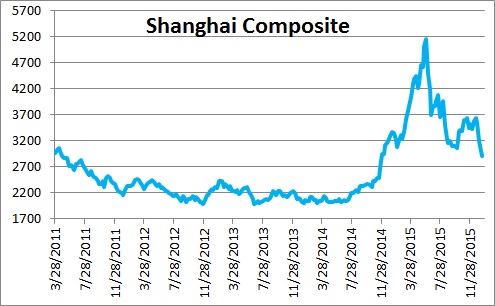
In addition, the IMF expects GDP growth in China to slow from 6.9% last year to 6.5% in 2016. Between 2005 and 2010 China was growing at a double-digit pace. Thus we believe that the bulk of the slowdown in the Chinese economy has already occurred and that the further slowdown will be modest in magnitude.
Finally, in mid-November e-commerce retail giant Alibaba reported $14.3 billion of sales in a single day. That is more than double e-commerce sales in the U.S. from Thanksgiving, Black Friday, and Cyber Monday combined. Somehow that does not seem consistent with extreme economic weakness.
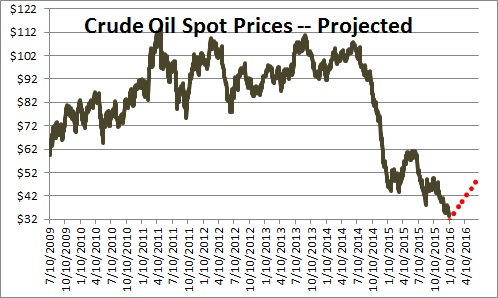
There also seems to be a perception that falling oil prices are indicative of global economic weakness. We disagree. The problem is attributable to the dramatic increase in oil production in the U.S. combined with no output cut by OPEC. Thus, prices are falling because of an increase in the supply of oil, not because of weakness in demand.
It is also important to recognize that falling oil prices are a positive factor for GDP growth in the U.S., not a negative one. While firms in the oil industry will be hit hard as prices decline, the bulk of the U.S. economy will benefit. Consumers pay less to fill their cars with gas and heat their homes with fuel oil. Truckers and airlines benefit because oil prices are such a large portion of their overall costs. We continue to believe that oil prices are near their bottom because of a strong seasonal pattern whereby prices invariably rise in the first half of the year and decline in the second half.
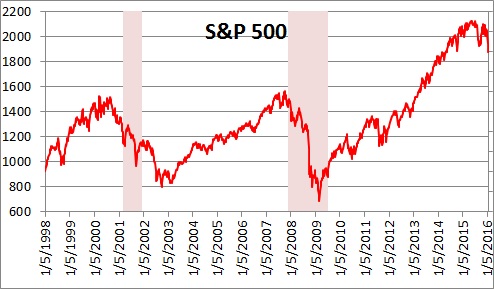
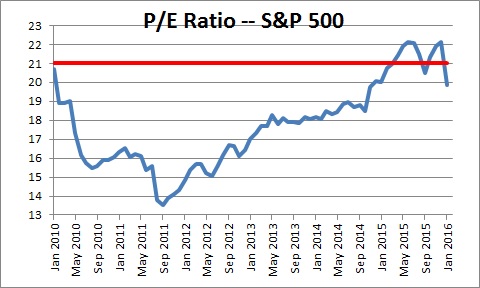
Having said all of this, the perception of extreme economic weakness in China combined with the notion that falling oil prices reflect economic weakness has caused the S&P 500 index to fall 10% for its second “correction” in three months. Our sense is that at its current level (as evidenced by the price-earnings ratio) the S&P is undervalued and a bottom in stock prices is not too far distant.
But what if we are wrong? How will we know? Despite impeccable logic, could this be one of those times when the economy simply does not cooperate? Could it be that two stock market corrections in the course of a few months unnerves investors who suddenly lose the faith? It is possible, but consumer sentiment for the first half of January does not suggest that is the case. The index actually increased 0.7 point in January to 93.3 which is close to the highest level thus far in the business sector. Consumers do not seem worried.
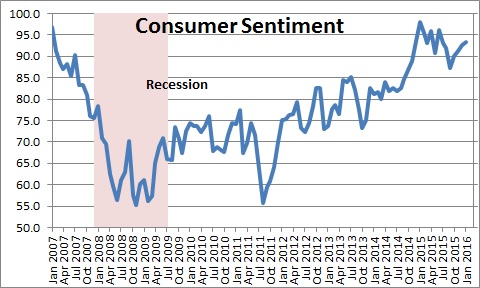
Suppose oil prices continue to drop to $20 per barrel? Given the perception that falling oil prices are indicative of economic weakness that would most likely be interpreted negatively by the stock market but, as noted above, lower oil prices actually provide economic stimulus.
In the end, we feel fairly confident that we are on the right track that GDP growth will be moderate in 2016 at about 2.5%, but we readily confess that recent market volatility is disquieting and makes us think about factors that could cause us to change our mind.
Stephen Slifer
NumberNomics
Charleston, SC


Stephen, Thank you for your interpretation of what is going on with the Stock market. A drop of somewhere in the range of 2,000 points does seem a bit much and does make for concern. Your interpretation seems sensible as always and do appreciate hearing from someone beyond “the sky is falling” folks.
Do you see the current political climate in the U.S. having anything to do with this drop as well? It looks like we most likely will end up with two presidential candidates, one on the extreme right and another definitely on the left. Just wondering how that works into the economic mix, from your point of view.
Have a great 2016. Darrel
Hi Darrel,
As nearly as I can tell the beginning of the year stock market rout was caused by a combo of China fears and oil We just learned this morning that GDP growth in China last year was 6.8% which was in line with what the IMF and others were expecting. But the headlines came across as the slowest growth rate in 25 years which, while true, is not the point. The fear is that right now Chinese growth is collapsing and that does not appear to be thee case. The IMF expects growth next year of 6.3%. Thus, almost everybody expect GDP growth in that country to slow a bit farther. But that is not news. I actually went back and looked at the IMF’s forecast for GDP growth in China. In April they had it pegged at 6.76%. In October at 6.81%. And it turned out to be 6.8%. Personally, I think this is much ado about nothing.
And I always have a hard time figuring out the market’s reaction to oil. Lower oil prices are good both for the U.S.and the global economy. Consumers benefit from lower gas prices (and natural gas prices I might add). The airlines benefit. Anybody in the transportation industry like truckers benefit. Not to mention the fact that around the globe all oil importing countries benefit. That includes the U.S., virtually every country in Europe, and Japan. Indeed every country in the G-7 benefits except Canada. But the markets want to focus on the impact on firms in the oil industry which will, in fact, be worse off. But, on balance, lower oil prices will stimulate global GDP growth — although not uniformly so.
And with respect to the election I don’t think this early year reaction was in response to that. As I see it, we just keep getting more of the same. The biggest problem is that corporations are frozen and unwilling to commit money to investment (even though they are sitting on a pile of cash) because they don’t know what future tax rates are going to be. They can’t figure out how much how much health care is going to cost them. They are tired of trying to weave their way through the needlessly complicated conglomeration of government regulation. But none of this is new. Corporations have been sitting on their cash and not investing for 15 months now.
In any event, thanks as always for your comments. Talk to you later.
Steve