October 23, 2026
The unemployment rate stands at 4.2%. The Fed believes that the “full employment” threshold for the unemployment rate is also 4.2%. That is the lowest level for the unemployment rate that the economy can sustain without causing inflation to rise. Thus, the Fed believes that it has achieved its labor market target and should not be trying to stimulate the economy to push the unemployment rate lower. But that full employment level is hard to measure and can vary over time depending upon business conditions, demographics, and regulatory changes. Could it be lower?
Even at full employment not everyone has a job. There are still 7.1 million workers or 4.2% of the labor force who remain unemployed but are actively seeking employment. The unemployment rate will never reach 0.0%. There is always frictional unemployment as workers transition between jobs or are trying to enter the labor force once they leave school or raise their kids. Furthermore, the economy today is experiencing major changes that are affecting the labor market. For example, AI is spreading rapidly and has made some jobs obsolete but it has created new ones. In effort to slash the size of the federal government the administration laid off about 300 thousand workers in 2025 or 10% of its entire payroll. And between tariffs, higher inflation, and the war with Iran business leaders today are reluctant to hire or fire workers. The question is whether the full employment threshold is still 4.2%. Could it be lower? 3.5% perhaps? Possibly.
To those 7.1 million workers who are currently unemployed it is very personal. Undoubtedly many are struggling. One person we met recently was laid off from a federal government job 18 months ago and has been unable to find a new position. One sympathizes with that person’s dilemma. But we do not know a lot of things. What kind of government job did that person have? Did it have a skill that is useful to a firm in the private sector? How much money does that person expect? It is difficult to swallow a big pay cut, but sometimes it is a necessary part of the transition to a new job.
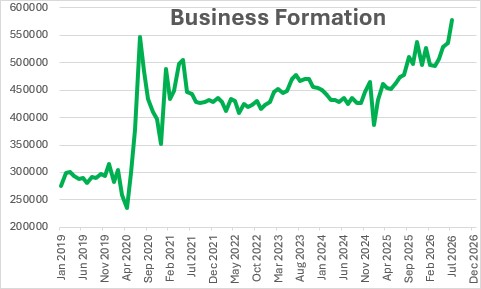
Many economists expected the spread of AI to bring with it a dramatic increase in the unemployment rate. That has not happened. At 4.2% the unemployment rate is probably close to full employment. Most people whose job has been eliminated by AI have been able to find a new position. Some of them appear to have joined forces with other workers whose jobs were eliminated by AI and have started a new firm. New business formation today is at a record high level. As a result, the unemployment rate has been surprisingly steady.
The monthly ISM report for both manufacturing and service sector firms indicates that for many firms their biggest challenge continues to be a severe shortage of workers. Furthermore, when we walk the streets of Charleston virtually every restaurant, fast food establishment, and retail shop has a sign in the window indicating that they are hiring. Jobs seem to be available. So what’s the problem?
Employment agencies that assist both firms and unemployed workers connect have interesting stories to tell. Many of the individuals who come to them only want to work from home. Others have no interest in working a 40-hour workweek. They really only want part time employment. One person wanted to know whether they could bring their dog to work. We question the work ethic for at least some of these individuals.
Some recent college grads simply do not have the skills required for the job they are seeking. In some cases they picked an extremely narrow major that is useful only to a very limited number of firms. Somewhere along the line that person, their high school guidance counselor, their parents, or their advisor in college should have warned them that this particular major was not going to land them a job. We have been a big advocate of technical colleges. The person can pick whatever field seems exciting to them and go to a technical college for 2 years with minimal tuition. While enrolled they will more than likely have an apprenticeship which will give them valuable work experience. And they will almost certainly have a job waiting for them when they graduate. If they choose they can then transfer to the same college or university that they wanted to attend initially, and receive the same degree they would have received had they been at that school for the full four years. In the process they have saved tens of thousands of tuition dollars and graduated with a far smaller amount of student debt.
Then there is the ghosting phenomenon. Many of these people may have a real, live job interview scheduled but never show. In one extreme example, the person had been offered and accepted a full time position, but never bothered to show up for their first day on the job.
Employers in today’s world routinely receive 500 or more applications for each available position. It is understandable that they need the help of AI in narrowing down the field of applicants. Job seekers, on the other hand, claim that the hiring process has become impersonal which is undoubtedly true. It appears to us that the instructions given to AI to sort through these applicants is flawed. People apply but never get a response. AI will tell them that they do not have the skills required for that particular position when often that does not seem to be true. There is no way to talk to a human being to plead their case. We suggest that all firms review their AI training models to refine exactly what the job requirements are for that position and what qualifications they are seeking in the person to fill that role.
Age discrimination seems to be another frequent complaint from job seekers. But that is not new. It has been going on for decades. The days of working for a firm for 30 years and getting a gold watch upon retirement are long gone. Firms will often encourage older, well paid workers to retire and replace them with someone one-half their age and pay them a fraction of what the more experienced worker was earning. We would suggest that all older employees give some thought to what they might do in that situation. Retire? Start their own business? Go back to school? Beat the bushes trying to find some other firm willing to hire an older worker?
The bottom line is that the economy is dynamic and changes constantly. Sometimes the pace of change, like today, can be lightning quick. Some workers will get laid off. New positions will arise. We have often said that with the unemployment rate at 4.2% the labor market is at full employment and that everybody who wants a job has one. But that is a macroeconomic view. The statement is not true for the remaining 4.2% of workers that remain unemployed but are actively seeking a job. To them it is very personal. They still have to pay the rent or mortgage, feed the family, and fill the car with gas. To say it is a stressful situation is an understatement. Over time the situation will improve but it will not improve quickly. AI will get better. One hopes that younger people today give some serious thought to what they want to do as an adult and seek guidance from others about what career paths might provide them with a lifetime of employment.
Stephen Slifer
NumberNomics
Charleston, S.C.
Follow Me