
September 21, 2012
Last week the Fed told us it intends to buy $40 billion of mortgage-backed securities every month until the unemployment rate falls to a more acceptable level. They also pledged not to raise rates until at least mid-2015. A look at their forecasts for GDP growth, the unemployment rate, and inflation shows why they think they can keep the fed funds rate at a low level for another three years.
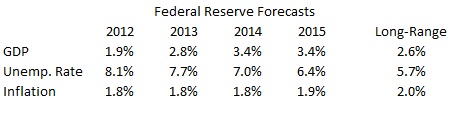
In the Fed’s world, GDP growth will be somewhat faster in 2013 at 2.8% than this year’s 1.9% pace. As the housing sector recovery gathers momentum, the negative impact from cutbacks in government spending is reduced, and growth in Europe and Asia rebounds, GDP growth in 2014 and 2015 is expected to quicken to 3.4%.
Given this forecast of growth in the economy, the unemployment rate falls moderately to 7.7% by the end of next year, and then more quickly to 7.0% and 6.4% in 2014 and 2015.
Throughout this period of time the inflation rate is steady at about 2.0%.
The reason the Fed can pledge to keep rates low for so long is because it believes that the unemployment rate can safely fall to 5.7% without generating inflation (right-hand column). At that level everyone who wants a job has one. If as the Fed expects the unemployment rate in 2015 is 6.4%, there should be enough competition amongst unemployed workers for the available jobs that there will be no upward pressure on wages. And because wages are by far the biggest cost item for an employer, no upward pressure on wages implies no reason for firms to raise prices – hence, no increase in the inflation rate.
But what if the full employment threshold is no longer 5.7% but something higher, say 6.0-6.5%? If that is the case and the unemployment rate in 2015 falls to 6.4%, there is likely to be some upward pressure on the inflation rate as workers begin to demand higher wages.
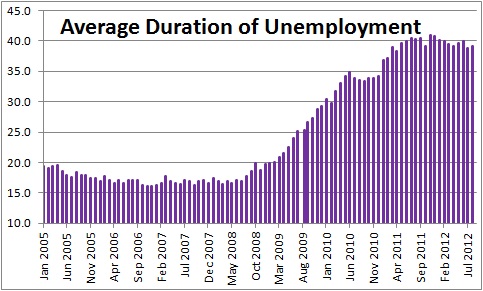
Why might the full employment threshold be higher than what the Fed thinks? Look at the average duration of unemployment. In the past three years the unemployment rate has declined from a peak of 10.0% in August 2009 to 8.1%. But yet the average duration of unemployment has continued to climb and is currently 39.2 weeks which is essentially the longest it has been since the Great Depression. Clearly, the people being hired are not coming from the ranks of long-term unemployed workers. Why? Several thoughts come to mind. First, there may be some stigma attached to having been out of a job for an extended period of time. Employers may think twice about hiring someone who has been jobless for a year or more. Second, employers today want workers who are tech savvy. It is likely that many of long-term unemployed workers no longer have the job skills required for employment today. The longer they are unemployed, the greater the chance that they will become permanently unemployed. And in that case the full employment level for the unemployment rate may no longer be 5.7% as the Fed believes, but perhaps 6.0-6.5%. And in that situation the inflation rate should begin to climb by 2015.
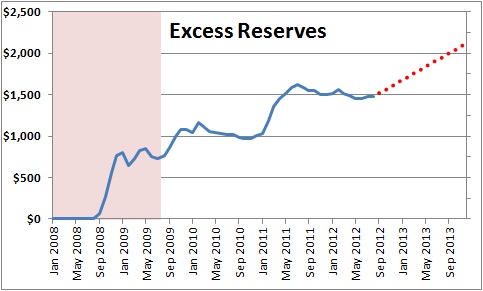
By purchasing $40 billion of mortgage securities every quarter the volume of surplus reserves in the banking system will have climbed to $2.5 trillion by 2015 which could fuel a highly inflationary spending spree. The Fed will quickly need to get its monetary policy stance back to “neutral”. What the Fed should do is raise the funds rate to its “neutral” level of about 4.25%, and reduce excess reserves from $2.5 trillion to about $2 billion by the time the unemployment rate has fallen to its so-called full employment level of 6.0-6.5%. But the Fed says it is not going to start changing its policy stance until the unemployment level has already declined to 6.4%. That may be too late to head off a pickup in inflation.
The point is that the labor market may have deteriorated to a greater extent than what the Fed believes and that it can no longer safely allow the unemployment to fall to 5.7%. Inflation may begin to set in at a much higher level of 6.0-6.5%. If so, the Fed needs to be changing gears and shifting back towards a neutral policy stance much sooner than mid-2015. But given its pledge to not raise rates, will the Fed actually do what it should be doing?
Stephen Slifer
NumberNomics
Charleston, SC
Follow Me