
September 20, 2010
It only took 15 months but the National Bureau of Economic Recession (NBER) today officially declared an end to the recession in June 2009. That is the date that almost every economist has been using for the past year, but now it is official.
As the NBER indicated in its press release, that makes this recent recession the longest one since the depression. For the record, the economy slipped into recession in December 2007, and 18 months later emerged from it. Previously the longest postwar recessions were those of 1973-75 and 1981-82, both of which lasted 16 months.
This means that we are now in the 15th month of the current expansion. But, not to worry, we are nowhere close to the end of this one. All previous recessions had an underlying problem – like the dot com bubble in the late 1990’s and early 2000’s, and more recently the housing explosion, but in every case the catalyst for the bursting of the bubble was the Fed.
Currently the Fed has the pedal to the metal with the funds rate at 0-0.25%. No economist expects the Fed to begin tightening sooner than the fourth quarter of next year. Once they start, how far might they go? Most economists believe that if the Fed wants the economy to grow at a 2.5% pace, and wants to keep inflation at about 2.0%, then a neutral funds rate in today’s world would be somewhere in the 4.0-5.0% range. If they follow past procedure and tighten in 25 basis point increments at each meeting – which are 6 weeks apart — it will take the Fed two years once they start tightening to get the funds rate back to neutral. Working through the arithmetic that means that it will be three years from now – the end of 2013 — before the Fed can even get monetary policy back into neutral mode, and even longer to push the funds rate into restrictive mode. So, as we see it, this expansion — at a minimum – will last four years.
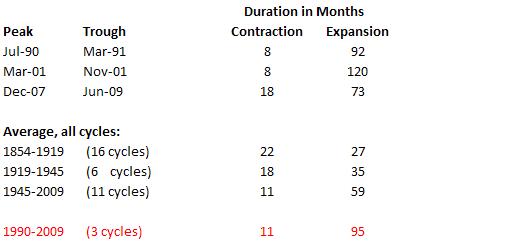
But by any recent historical standard that would be a very short expansion, indeed. As a test of economic trivia, take a look at the table below which is a shortened version of the business cycle table presented by the NBER. Recent business cycles are getting longer – much longer.
If we go back 100 years to about 1900, a business cycle consisted of roughly two years of expansion followed by two years of recession. Up two, down two, etc.
But over the past 100 years, as shown, expansions have been getting longer and recessions shorter. For example, since World War II, the average expansion has lasted five years, while the average recession lasts about one year.
Then look at the last three business cycles (shown in red on the table). Those business cycles have lasted eight years while the recessions averaged only about one year in duration. Yes, the most recent recession lasted longer than the average. But the point is that somehow or another our policy makers at the Fed and in Congress have gotten better at controlling the ups and downs of a business cycle. They are obviously not perfect, but they have clearly gotten better over the course of the last century. This expansion is still in its infancy.
Stephen Slifer
NumberNomics
Charleston, SC


Wow this is a great resource.. I’m enjoying it.. good article
I’ve recently started a blog, the information you provide on this site has helped me tremendously. Thank you for all of your time & work.