
August 27, 2010
Throughout this past week we have seen a string of surprisingly weak economic statistics. New and existing home sales plunged in July. Durable goods orders fell sharply. And then second quarter GDP growth was revised downward to a 1.6% rate from an initially-reported 2.4% pace. In response, the more bullish economists were busily revising downward their expected growth rates for the second half of the year and increasing their odds on the possibility of a double-dip scenario. And in the wake of such a string of data that is probably the prudent thing to do. I am perhaps being either stubborn or stupid, but I am not quite ready to go there. I have been anticipating third and fourth quarter GDP growth of about 3.0%, and I am sticking with that forecast because – to me – the economy simply does not feel all that weak for a variety of reasons. As we all know, in the forecasting business sometimes you are right and other times you are not. It can be a very humbling experience. In this case, I am hoping for the former. In either case, it is very important that you understand why I believe what I do, and then you can decide for yourselves whether that makes any sense. So here we go!
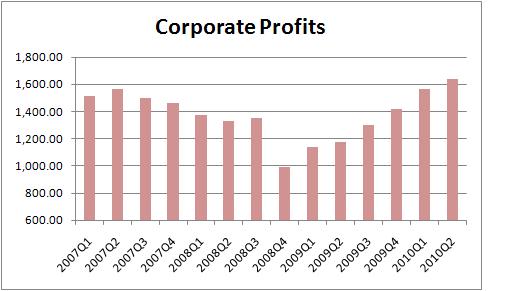
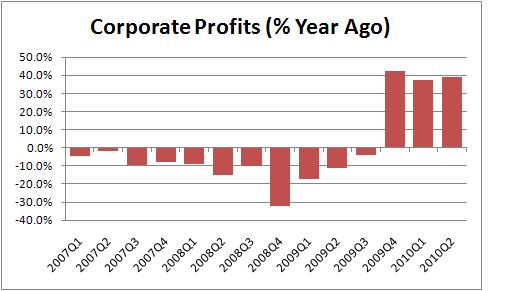
Last week we talked a lot about the corporate sector and I will give you a quick review. But before I do that, this week we got our first look at corporate profits for the second quarter, and they continue to be quite strong. Take a look at the following two charts. The first shows us the level of corporate profits. What you are supposed to notice is that corporate profits are higher now than they were prior to the onset of the recession. Then notice how quickly those profits have been rising. The second chart indicates that the corporate profits have been rising at a roughly 40% rate for the past several quarters and are showing no sign of slowing down.
So corporate America continues to make enormous profits. How did they do that? Well, here comes the review part from last week with two quick charts. Firms have been spending a ton of money on technology. Indeed, their pace of spending in the second quarter was revised upward slightly in the revision that was released on Friday.
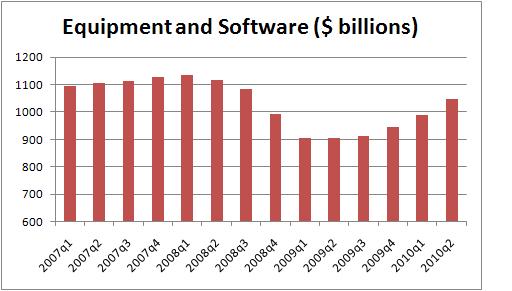
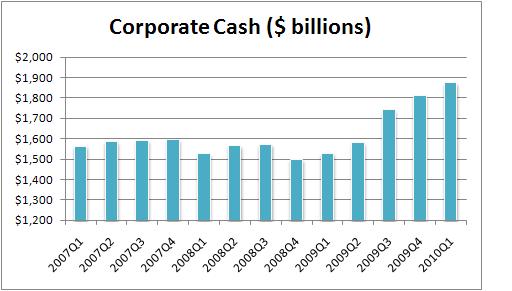
Such spending has resulted in a burst of productivity which has obviously enhanced corporate profits significantly. As a consequence of the growth in profits, corporations are now sitting on a mountain of cash which is, in turn, fueling merger activity.
However, corporations can continue to make money only if somewhere along the line there is a pickup in demand for their product. Cost cutting can only be carried so far. Which brings us to the second quarter GDP data. Some interpret the downward revision to second quarter GDP growth from 2.4% to 1.6% as evidence that the pace of economic activity was much slower than they thought previously and, as a consequence, the economy is now in danger of slipping back into recession. But be careful about jumping to that conclusion. The bulk of the downward revision to GDP came about because of a significantly slower pace of inventory accumulation. Final sales, which excludes the change in inventories from the GDP calculation revised downward, but only from 1.3% to 1.0%. But, you might say, that is still a very anemic pace and you would be correct. But remember that final sales measures the dollar value of sales on domestically produced (i.e., made in the U.S.) goods and services. There are times – and this is one of them – when a large portion of what we buy is imported. Take a look at the next chart which represents final sales by domestic purchasers. That represents our spending on both U.S. made goods and services as well as imports. The picture changes dramatically. Instead of growing at an anemic 1.0% rate, sales actually surged by 4.2% in the second quarter.
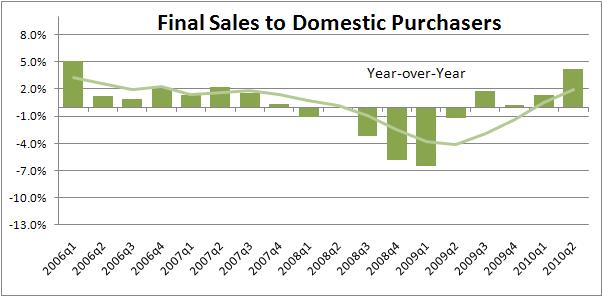
The good news is that we consumers and businesses were buying something at a relatively rapid rate in the second quarter. The bad news is that a large chunk of what we were buying was made overseas, and the benefits were accruing to the economies of our trading partners rather than to our own. But the point is that if people are looking at the downward revision to second quarter GDP growth as an indication that consumers and businesses have dramatically slowed their pace of spending and, therefore, the economy is in danger of slipping back into recession, they would be wrong.
Stephen Slifer
NumberNomics
Charleston, SC
Follow Me