
February 6, 2015
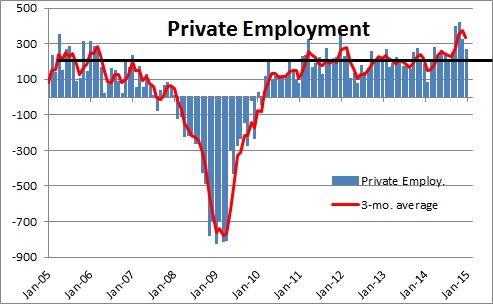
One of these days the boo-birds are going to give up on the notion that the labor market is soft. Jobs climbed by 267 thousand in January. Combining this with sharp upward revisions to November and December the average job gain in the past three months has surged to 334 thousand. That is the biggest 3-month increase in employment in 18 years! Meanwhile, the unemployment rate rose 0.1% in January to 5.7%. On the surface this seems a bit disappointing until one discovers that more than a million workers streamed into the labor force in that month and the economy provided jobs for three quarters of them. Given the above, it is abundantly clear that the U.S. economy is on a roll. These recent data will keep the Fed on track to initiate the first of a series of rate hikes sometime around the middle of this year. Robust employment gains will boost income which consumers will then spend on additional goods and services as a virtuous cycle gets underway.
The Bureau of Labor Statistics reported that private sector employment rose 267 thousand in January which, by itself, was stronger than been expected. But upward revisions to the previously reported increases for November and December were impressive. For example, November revised upwards from an increase of 325 thousand to an increase of 414 thousand. December revised upwards from 240 thousand to a gain of 320 thousand. The 3-month average increase in employment now stands at 334 thousand which is the biggest since April 1997! The job gains were widespread from high paying industries such as manufacturing, construction, and health care, to lower paying jobs in the retail trade and food and beverage industries. It is extremely rare for employment to rise by more than about 225 thousand per month. Climbing at a 334 thousand pace is impressive — but also unlikely to be sustained.
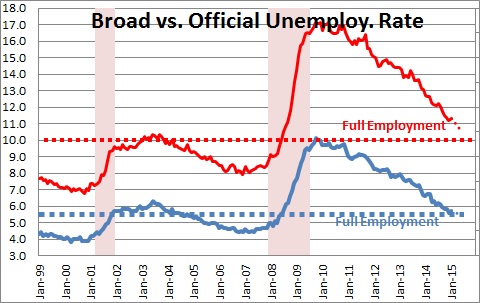
On the surface the modest 0.1% increase in the unemployment rate to 5.7% was disappointing. Upon further inspection one learns that more than one million workers surged back into the labor force in January. Civilian employment (which differs from the payroll employment data described above because it includes self-employed workers) climbed by 759 thousand. Thus, the economy was able to provide jobs for almost three-quarters of those new entrants. So while the number of unemployed workers rose by nearly 300 thousand and the unemployment rate rose 0.1% to 5.7%, the increase can hardly be characterized as disturbing. The broadest measure of unemployment also rose 0.1% to 11.3% largely for the same reason.
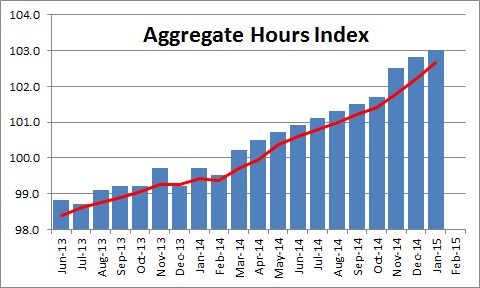
Not only is employment rising rapidly, the workweek is extremely long. If we know how many workers are on the job and how many hours they are working, we should be able to estimate how many goods they produced. That is exactly what GDP is trying to measure. The combination of employment and hours are captured in something called the aggregate hours index. It continued to climb in January after having risen sharply in both November and December. Thus, it appears that the U.S. economy is off to a good start. We continue to expect GDP growth this year to climb by 3.3%. So far, so good.
The labor market continues to impress not only all of us but it should impress Fed officials as well. The Fed has indicated that it does not intend to raise rates until such time as the economy reaches full employment and the inflation rate returns to the Fed’s targeted rate of 2.0%. Both of those conditions should be satisfied by the middle of this year. The official rate should have shrunk to 5.4% by June the broad rate to 10.5%. That puts both rates at or very close to their full employment thresholds.
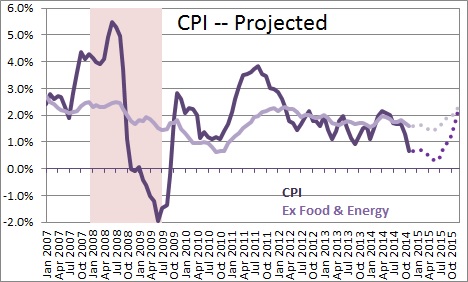
At the same time the CPI should be on the upswing for a variety of reasons. Building wages pressures caused by the relatively tight job market should translate into higher prices. Extreme shortages of homes available for sale and rental properties will continue to boost rents which are already climbing at a 3.0% pace. And, finally, oil prices seem likely to head higher. Just in the past week crude oil prices have jumped 13% from $45 per barrel to $51. Thus, the inflation rate by midyear should be close to the 2.0% pace the Fed would like to see. Against this background the Fed is increasingly likely to follow through with its pledge to raise rates sometime around midyear.
Stephen Slifer
NumberNomics
Charleston, SC


Stephen,
I have been so busy I did read this report until today. Wow! The Republicans are going to have to shut up on the weak economy soon. It is too bad that they hate Obama so much.
Thanks for the very upbeat report.
…Darrel