
December 21, 2009
About this time last year the economy was teetering on the brink and threatening to go into a death spiral not seen since the Great Depression. But thanks to the most aggressive combination of monetary and fiscal policy on record in this country, the economy is showing clear signs of recovery. And while the employment report for November still did not show any job creation, it was the most encouraging piece of economic evidence since the swoon started in the fourth quarter of 2007.
The first sector to get the word was, as is often the case, the stock market which caught fire and in the past nine months has now retraced about two-thirds of its earlier losses. Thanks to aggressive layoffs and other cost-cutting measures, corporate profits showed signs of improvement. At the same time the stock market gains caused consumers to regain some of their lost confidence. Then, with considerable help from government subsidized programs such as cash for clunkers and the tax credit for first time home buyers, the economy managed to produce positive GDP growth in the third quarter and, most likely, growth of roughly similar magnitude in the current quarter.
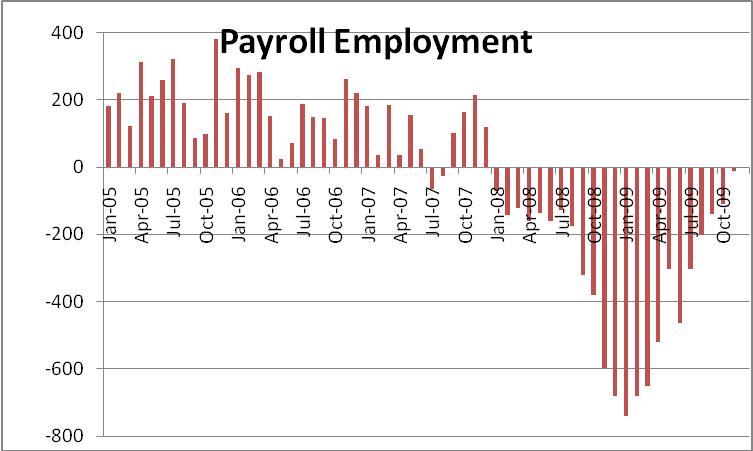
Throughout all this the missing ingredient has been jobs. Job losses were so severe early in the year it was clear it would take time for them to turn upwards. Last winter the economy was consistently losing about 700 thousand jobs a month as employers responded to the devastating economic news.
By the spring, however, there were early indications that the labor market was stabilizing. Prior to actually hiring someone, employers often take other measures which are precursors of employment.
The first piece of positive news came from the weekly figures on layoffs as firms began to anticipate the turnaround. Early in the year about 650 thousand people a week were being laid off. That figure slowly, but steadily, began to shrink and now stands at about 450 thousand. Typically, a figure of 400 thousand is consistent with modest job gains. So far so good.
Then in early summer there was some hiring of temp workers. If there is a need to boost production, businesses will initially use temps rather than make the long-lasting commitment to boost their payroll with its associated benefits. At first, just a few thousand temp workers were being hired. By November hiring had picked up to 44 thousand. Business confidence seems to be returning.
A third option available to employers faced with a need to ramp up production is to work their existing employees longer hours. In November the length of the workweek climbed twelve minutes from 33.0 to 33.2 hours. Another piece falls into place.
Given these developments it is not surprising that the monthly declines in payroll employment shown on the chart below have been getting progressively smaller. In November the employment drop was a miniscule 11 thousand. In each of the past five months the declines have been shrinking, and now the economy appears poised to register its first monthly employment gain since December 2007.
Having said all of this, it is important to remember that the economy must generate about 125 thousand jobs per month to prevent the unemployment rate from climbing. That is because every month the labor force increases – from population growth, graduation from college, and immigration.
Even though it currently stands at 10.0% the unemployment rate probably has not yet peaked. When the economy begins to improve many workers who have stopped looking for a job get their hopes up and begin to look again. Previously they were not counted as being unemployed because they were not seeking a job. The moment they begin to look again they are regarded as unemployed and the rate rises further.
The bottom line is that the labor market has come a long ways in the past year and the economy may soon begin to create jobs. But the likelihood of a moderate pace of economic activity this coming year means that the decline in the unemployment rate will be painfully slow. Most likely it will end 2010 at about the 9.5% mark. Ouch!
Follow Me