
September 27, 2013
Almost everybody bemoans the slow pace of jobs growth in this country, the quality of the jobs that are being created, and the elevated level of the unemployment rate. While the labor market is not robust, it is not as anemic as the pessimists would have us believe.
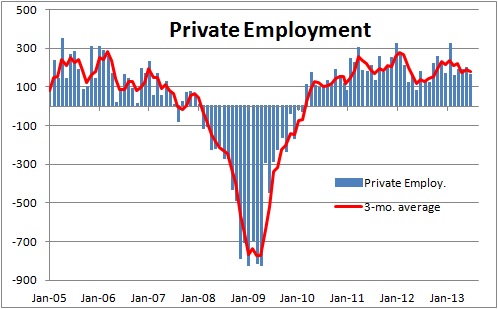
Private sector employment is currently rising by 160 thousand per month which is deemed to be a moderate pace. That figure is partially estimated. The Bureau of Labor Statistics collects monthly data from large firms, but must estimate the number of jobs created by small businesses. Once a year it gets a more accurate count of small business hiring from tax data collected by the IRS. This past week the BLS released its findings for the April 2012-March 2013 period. At the end of that period there were 333 thousand more private sector jobs than they had estimated, which works out to an additional 28 thousand jobs per month. Thus, private sector employment in recent months is probably climbing by 190 thousand per month rather than 160 thousand. How fast should it be rising?
Upon occasion employment spikes by 300 thousand in a particular month. But that is usually followed by a subdued employment gain in the subsequent month. Looking at three-month increments of time, as indicated by the red line in the chart below, private sector employment rarely rises by more than 250 thousand per month. Gains of 190 thousand are not all that anemic.
Each month the increase in employment consists of two parts –the number of people that find jobs less the number that lose them. Initial unemployment claims are a measure of layoffs — the second part of that equation. In the past month claims have shrunk to 308 thousand which is the smallest number of layoffs we have seen since July 2007. If fewer people are being laid off it stands to reason that the labor market is improving and we should reasonably expect to see monthly employment gains soon surpass the 200 thousand per month barrier.

However, the revised monthly employment data will not be released until the BLS does its annual benchmark revision in February of next year. While the additional job creation is quite real, we will not actually confirm the more robust pace of hiring for another four months. The markets will initially react to the less impressive monthly gains in employment, but eventually we will learn that all along hiring has been faster than we thought.
Other economists are distressed by the still high level of the unemployment rate. While it is true that the unemployment rate remains at an elevated level, it has also fallen faster than anybody had expected. At 7.3% the unemployment rate has declined to a level that most people did not believe would be achieved until the spring of next year. Why?
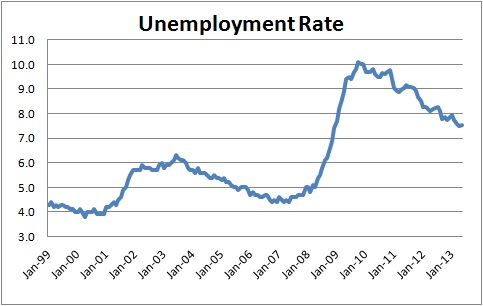
Probably the most important factor explaining the faster than expected decline in the unemployment rate is slower growth in the labor force. At the beginning of this year the labor force was growing at a 1.0% pace; its growth has since slipped to 0.3%. The naysayers suggest that the slow growth is attributable to people dropping out of the labor force because the labor market is so challenging that they have given up looking for a job. That is partially true. But a more important factor is that an increasing number of Americans have reached retirement age. As a result, they are no longer included in the labor force (which only includes people that are actively seeking employment). Consider the fact that the baby boomers were born between 1946 and 1964. If they retire at age 65, then the labor force should have begun to grow more slowly by 2011 – which it did — and should continue to expand at a subdued pace for a protracted period of time. This means that the unemployment rate can fall even though a smaller number of jobs are created each month.
The labor market is clearly not robust. The unemployment rate remains higher than it should be. Many employers currently have a propensity to work existing employees longer hours rather than hire new workers. And many firms have chosen to hire part-timers and temps to avoid paying health care benefits. But given the forthcoming upward revision to the employment data and the faster-than-expected decline in the unemployment rate, the labor market is not as anemic as some would have us believe.
Stephen Slifer
NumberNomics
Charleston, SC
Follow Me