
March 29, 2013
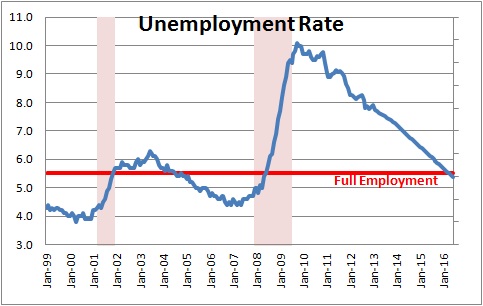
The unemployment rate currently is 7.7%. Assuming GDP growth averages about 2.5% during the next several years it will decline to its “full-employment” level of 5.5% by mid-2016. Presumably at that level everyone who wants a job has one. Unfortunately, that is not entirely accurate.
The reality is that the labor market is far weaker than the official statistics represent. In fact, the current situation is unprecedented. That is because in addition to the 12.0 million currently unemployed workers (in blue below), there are another 8.0 million workers who are working part time but would like to have a full time job (in red), and another 2.5 million workers who are currently not looking for work but want a job (in green). Both of these latter categories have exploded since the recession. This means that today there are 22.5 million workers who either need a job or, at the very least, a better job. Prior to the recession that number was 13.0 million.
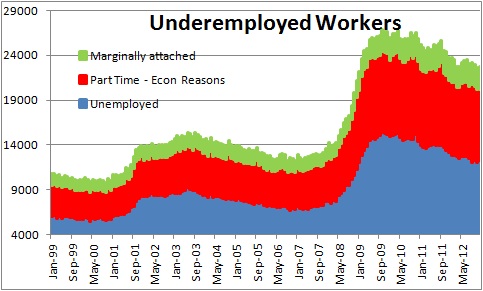
If one re-calculates the unemployment rate including these people who are currently not counted in the official statistics, the unemployment rate today is 14.3%. Prior to the recession it was 8.5%. As the “official” unemployment rate declines, this broader measure will do the same. But by 2016 when the official rate has fallen to 5.5% and is at its so-called “full employment” level, this broader measure will probably be in a range from 10-12% and there will still be a large number of workers in need of full time employment.

Fed Chairman Bernanke is trying his best to reduce the unemployment rate. But he has also said that the Fed will start raising interest rates once the official unemployment rate declines to 6.5%. If he is so concerned about creating jobs, why in the world would he start raising rates once the unemployment rate shrinks to 6.5% if the presumed full employment threshold is 5.5%? What’s the rush?
Part of the answer is that once the Fed begins to alter its policy stance it is not really “tightening”. Tightening implies a desire to slow the pace of economic activity. Rather, the Fed’s intent will be to shift from its current policy stance which is wildly stimulative to one that is more neutral. In some sense they will be taking their foot off the accelerator and letting the economy coast for a while.
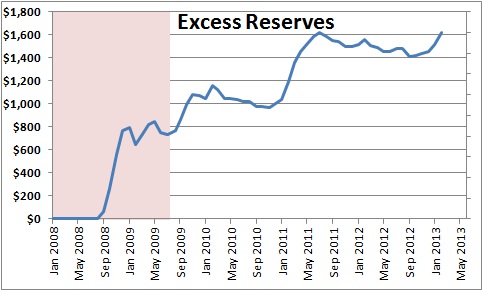
During the past couple of years, in an attempt to jump start the economy, the Fed has pushed short-term interest rates to 0% and flooded the banking system with reserves by purchasing record amounts of U.S. Treasury and mortgage-backed securities. In the old days (defined as pre-recession) it might have needed to absorb $1.5 billion of surplus reserves to shift back to a “neutral” policy stance. In today’s world the Fed will need to neutralize more than $1.5 trillion of reserves to get to the same place. That will take time and the Fed will proceed cautiously. The first thing it will do is stop buying, and eventually sell, some of its bond holdings. That will have the impact of gradually raising long-term interest rates.
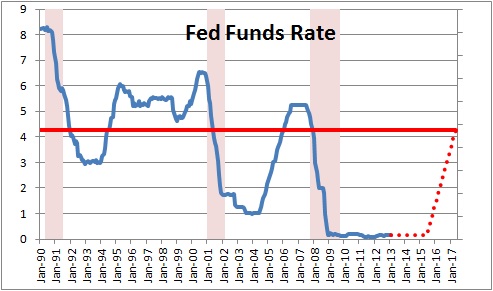
At some point it will also begin to raise short-term interest rates. The funds rate today is effectively at 0%. The Fed believes its policy stance is neutral when the funds rate is about 4.25%. Once it starts to raise short rates it will likely take two years to get the funds rate back to what it would regard as “neutral”. It is hard to imagine how it will get to that point prior to the middle of 2017. By that time, presumably, this broader measure of employment will be close to its pre-recession level of 8.5%.
The point is that the Fed is well aware that the labor market today is unlike any we have ever experienced with a large number of both unemployed and underemployed workers. It will do everything in its power to ensure that everyone in this country not only has a job, but is working to his or her full potential. And even though it may begin to adjust its policy stance a couple of years from now, this action should in no way impede the steady decline in both the official and broader measures of unemployment.
Stephen Slifer
NumberNomics
Charleston, SC
Follow Me