
July 11, 2014
While Janet Yellen and her colleagues at the Fed continue to fret about labor market weakness the game has changed. The unemployment rate has fallen quickly and labor shortages have begun to emerge. As we go forward over the next year labor shortages will become more apparent, wages will begin to climb, and the inflation rate will inch upwards. While the Fed has made it abundantly clear that it will not begin to raise the funds rate sooner than the middle of next year the reality is that it should start sooner.
Economic growth for the past several years has largely been a disappointment. But yet the unemployment rate has fallen faster than anyone expected. Why is that?
First, productivity growth has slowed dramatically in the past several years primarily because firms have been unwilling to invest. They have had to contend with considerable uncertainty — the fiscal cliff, tax increases, cuts in government spending, the implementation of Obamacare, and financial crises in Europe. Against this background their unwillingness to invest is understandable. As a result, productivity growth has slipped to one of the slowest rates ever for a non-recessionary period.

If firms are unwilling to invest and boost productivity they must hire additional workers. In the past three years GDP has grown at a 2.3% pace and productivity has risen 0.9%. The implication is that jobs needed to climb by the difference or 1.4%. That works out to about 160 thousand new jobs every month. Thus, one reason the unemployment rate has fallen so quickly is because firms have needed to hire many more workers than they would have if productivity growth had been more robust.
Second, the labor force has stopped growing because many of the baby boomers are retiring and thereby leaving the labor force. If the labor force is not growing and firms require 160 thousand new workers every month, where do they get them? From the ranks of the unemployed. If the labor force is unchanged and jobs climb by 160 thousand per month, the number of unemployed workers falls by 160 thousand and the unemployment rate declines.

Thus, the rapid decline in the unemployment rate in the past few years has been caused by a combination of slow growth in productivity and a lack of growth in the labor force as the baby boomers retire.
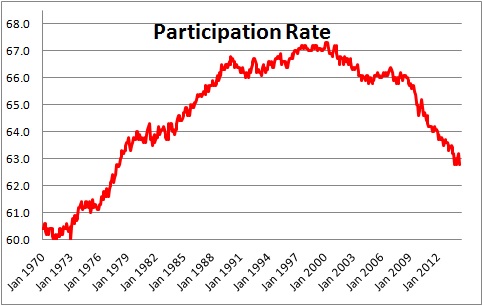
Given that the boomers were born between 1946 and 1963 they will retire between 2011 and 2028. If the population continues to grow but the labor force remains relatively steady because the boomers are retiring, the labor force participation rate will decline. It has already begun to fall and will continue to drop gradually for at least another decade. It is not falling because unemployed workers have become discouraged and given up looking for a job; it is declining primarily because of demographics.
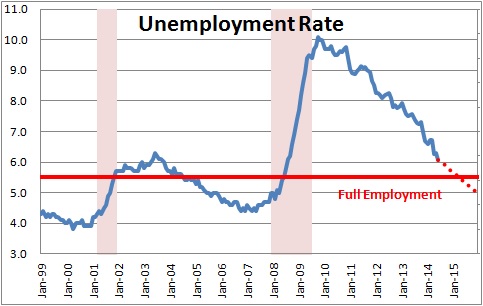
The problem is that the unemployment rate is quickly approaching its so-called full employment level of about 5.5%. It will reach that level by the spring of next year. As that occurs, shortages of qualified workers will become more widespread. Workers are already in short supply in the food and beverage industry, in construction, and in STEM jobs (science, technology, engineering, and math). The National Federation of Independent Businesses says that more than half of their business owners have tried to hire in the past three months and more than 80% of those that have been trying to hire reported few or no qualified applicants. Further, 26% of all owners reported job openings they could not easily fill. The point is that the labor market is a lot tighter than is generally perceived at the moment and will continue to tighten with each passing month.
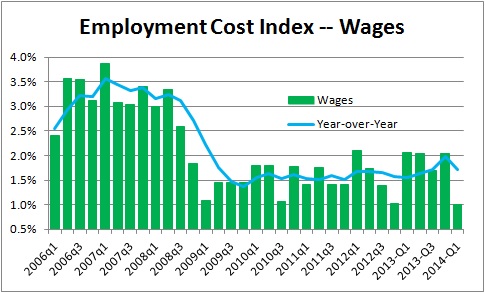
As the economy approaches full employment firms will soon have to bid up wages to attract qualified talent. At the moment wages are rising at slightly less than a 2.0% pace. But wages will not remain subdued for long. If wages begin to climb higher prices — and inflation – are sure to follow.
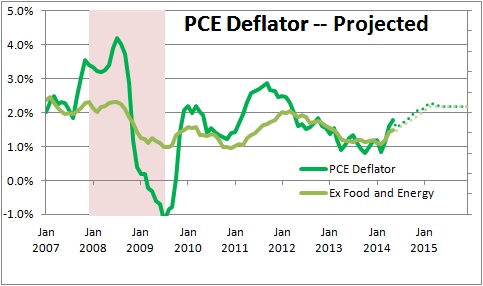
The pickup in inflation will be slow and gradual and there is no reason to panic. The core personal consumption expenditures deflator is currently climbing at 1.8% rate. By the middle of next year it should have climbed to 2.2%. That is above the Fed’s 2.0% inflation threshold.
The whole tenor of the discussion has shifted from a weak economy, a soft labor market, and subdued inflation to robust growth, a relatively tight labor market, and a gradual pickup in inflation. The need for low rates has come to an end.
Stephen Slifer
NumberNomics
Charleston, SC
Follow Me