
April 25, 2014
For months we have seen a steady diet of weak-looking economic indicators allegedly caused by the brutal winter weather conditions. Given the lag between when a month ends and when data are actually reported the bad news continued into April as March data were released. But spring has arrived. The string of bad news should end with the release of first quarter GDP data on Wednesday. And, indeed, the report will look anemic with a likely growth rate of 1.4% or so.
But if the weather story is really accurate, it is time for the second half of that story to unfold. It is our expectation that second quarter growth will rebound to 3.5%. Unfortunately, we will not learn the actual growth rate until the end of July. However, we will be able to hone in on it as we gather information about what happens in each of the months of the second quarter — starting with April.
The string of April statistics largely begins with the release of the employment report for that month. And this report should get the second quarter off to a roaring start. We expect to see payroll employment increase 225 thousand in April, and we expect the unemployment rate to decline 0.2% to 6.5%. While this particular report always contains the potential for a surprise, the expectation is not unreasonable based on hints we have received from some of the notoriously volatile weekly data.
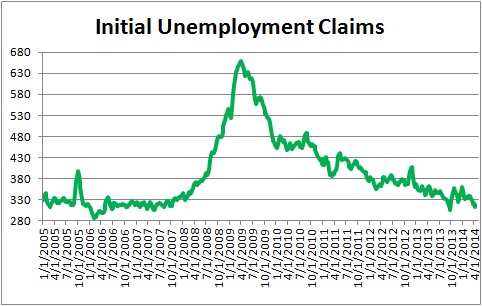
First of all, initial unemployment claims have been steadily declining in recent weeks. Claims are a measure of layoffs. Each month some people get laid off, others find jobs. The change in payroll employment is essentially the difference between the two. Not only have claims been dropping in recent weeks, they are about as low as they ever get. As shown below claims rarely fall below 315 thousand or so – even in the best of times like 2005 and 2006. You may not characterize 2014 as the best of times, but there are similarities.
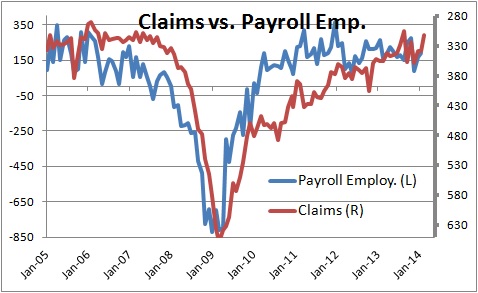
Second, it is not surprising to find that there is a reasonable correlation between layoffs and the monthly changes in employment. With claims at their current level we should expect employment gains to average about 225 thousand or so which is also about as good as it gets. People seem to think that the labor market is not “healthy” until we see monthly employment gains in excess of 300 thousand. That may happen occasionally, but monthly increases of 300 thousand simply cannot be sustained. As shown by the red line below employment simply does not average more than about 225 thousand per month – even in the best of times. If that is where we are at the moment that is not too shabby.
Third, if employment is rising by 225 thousand per month and the labor force is currently rising by about 100 thousand, employers have to find the additional workers they require from the ranks of either the unemployed or the underemployed. That, in turn, implies that the unemployment rate should fall. We expect to see a decline of 0.2% to 6.5%.

By Friday we may find that our expectation is totally off base. That can happen from time to time. However, let’s assume we are reasonably accurate with our forecasts of both the change in payroll employment and the drop in the unemployment rate. How will people respond? Our sense is that everybody will tend to disbelieve this seemingly good news. The press will almost certainly find the weakest part of the report and focus on that. Bad news attracts more attention from viewers/readers than good news. Republicans will clearly highlight the weak spots because they do not want to admit the economy is doing well prior to the November election. Democrats will focus on the bad parts of the report because they do not want anything that might de-rail their push for greater entitlements – like an extension of unemployment benefits and/or an increase in the minimum wage.
If people could just get over themselves and recognize that the economy is doing OK and adopt a slightly more positive attitude, I wonder how much better off the economy actually would be?
Stephen Slifer
NumberNomics
Charleston, SC
Follow Me