
May 3, 2013
Why is it so difficult to believe that the U.S. economy is producing a significant number of new jobs and has been for some time? Private sector employment in April rose 175 thousand. In the past three months the average gain in employment was 216 thousand. In the past six months it has been 215 thousand. And in the past year it was 180 thousand. Those gains have occurred despite strong headwinds. Employment suffered in the second half of last year as firms worried about the “fiscal cliff” and the possibility of a recession in the early part of this year. The economy weathered a 2% increase in the Social Security tax at the beginning of the year. It has blown off a reduction in government spending triggered by the sequester. Are economists just a dour group of people that always want to find the dark side? Is it political as the Republicans tried to talk down the economy in the hopes of scoring political gains? Probably some of each. Thus far the doom and bloom chatter has proven wrong. While we are not dealing with a robust economy, we are seeing one that is surprisingly resilient and continues to chug along at a moderate pace.
During the past three months employment has climbed on average 216 thousand per month. In the past six months the average gain has been 215 thousand. Thus the labor market has been producing a respectable number of new jobs for some time.
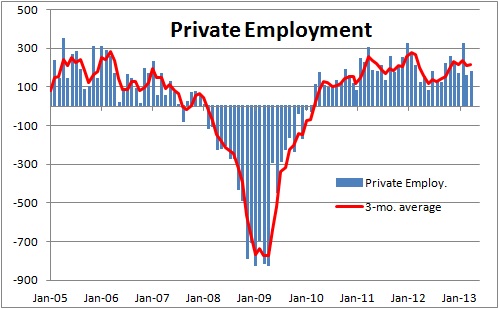
Some may argue that we need 300 thousand jobs per month, not 216 thousand. While that would be nice, it simply does not happen very often. As shown above, in the overheated 2005-2007 period, job gains rarely averaged more than 250 thousand. There is no reason to apologize for producing 216 thousand jobs per month.
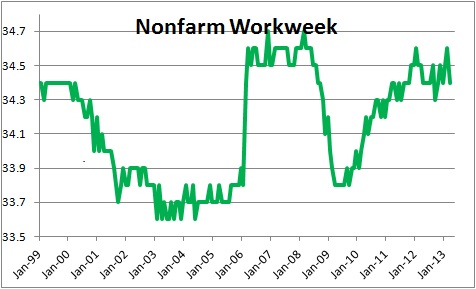
This should not have been a great surprise. The workweek has been steadily lengthening and has been as long as it was prior to the recession for some time. If firms do not have the ability to boost output by working existing employees longer hours, what do they do? They hire more bodies.
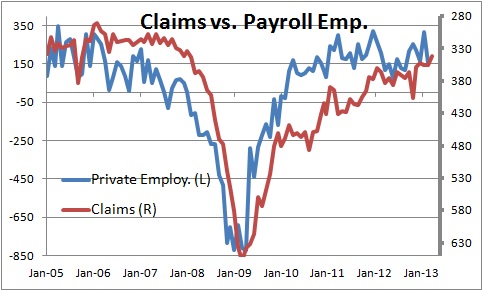
Also, when firms need to boost output they lay off fewer workers. Not surprisingly there is a reasonably tight correlation between layoffs and the monthly change in employment. With initial employment claims (layoffs) currently averaging 340 thousand per week, we should expect to see monthly employment gains of roughly 200 thousand. Once again, no great surprise.
Then there is the stock market. It continues to attain a new record high level every few days.

In the process of doing so it boosts net worth which has already recaptured everything that was lost during the recession. And now with the stock market continuing to climb and home prices having risen 8.6% in the past year and accelerating, there is no question that net worth will surpass its previous record high level. When wealth is rising rapidly, consumers are far more inclined to loosen their purse strings.
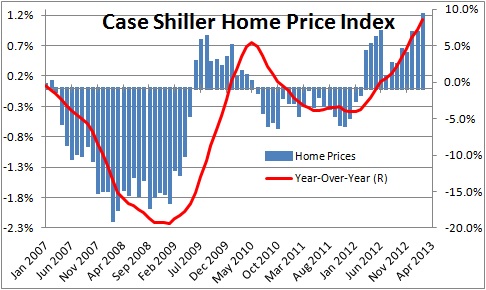
The strong stock market gains and rapidly rising home prices will also boost both consumer and business confidence which should further stimulate consumer spending and investment.
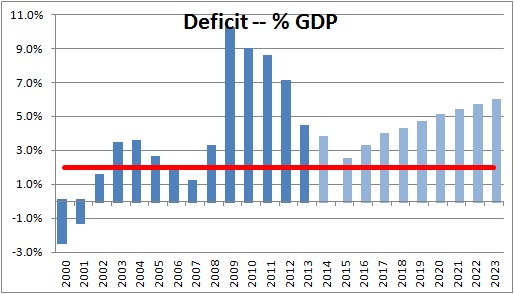
A side benefit of all the faster-than-expected pace of economic activity and reduced government spending is that the budget deficit is shrinking. The Congressional Budget Office said in February that the likely deficit for this year would be $845 billion. It now appears likely to be about $700 billion which compares to a deficit of $1.1 trillion last year. As a percent of nominal GDP that would shrink it to 4.4% in the current fiscal year and probably to 3.7% next year. That is still high, but it shows the power of what satisfactory economic growth (and reduced spending) can do to alter the budget outlook.
We are not suggesting that the economy has suddenly taken off. It hasn’t. Higher taxes, reduced government spending, and a continuing recession in Europe will keep growth in check. But the combination of steadily rising stock prices, a robust recovery in housing, and respectable employment gains will ensure that the economy registers GDP growth this year of roughly 2.7%.
Stephen Slifer
NumberNomics
Charleston, SC


Steve, The employment numbers are far below the 400,000 a month we need to be adding to reach back to the 2008 levels. Charlie