
March 16, 2012
Recent economic statistics have confirmed that the pace of economic activity has been steadily accelerating. The stock market continues to gain ground, jobs gains are increasing, the unemployment rate is steadily declining, the consumer is willing to spend, order books for manufacturers are rising, and production is climbing. We could not ask for much more. Against this background, the markets have suddenly come to the conclusion that the Fed will not be able to extend its bond buying program beyond its expiration date on June 30. As a result, the yield on 10-year Treasury securities has recently risen from 2.0% to 2.3%.
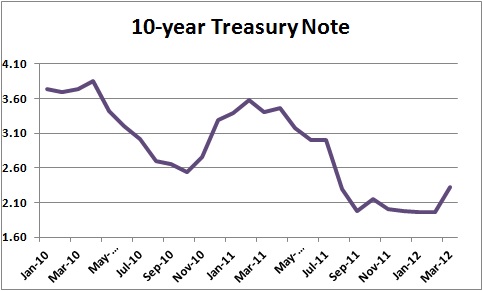
In September of last year the Fed indicated that it was going to engage in what has become known as “Operation Twist”. Its plan was to buy $400 billion of Treasury securities with maturities between 6- 30 years, and sell $400 billion of Treasury securities with maturities of 3 years or less. This swap arrangement would last through June 30. The idea was to push long-term interest rates lower and, hopefully, provide some support for the ailing housing sector.
In August of last year, prior to the Fed’s announcement, the yield on the Treasury 10-year note was 2.3%. It quickly declined to about 2.0% and stayed at about that same level until very recently.
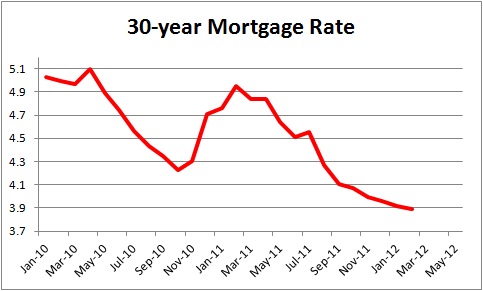
Similarly, the yield on conventional 30-year mortgages fell from about 4.25% in August to just below 4.0%. In that same period of time the housing market has shown clear signs of improvement. Existing home sales have perked up significantly, builder confidence has jump to its highest point in more than five years, housing starts have surged, and employment in the construction industry has begun to climb. In our view, the seeds for the pickup in housing occurred long before this recent Fed action. Consumers paid down enormous amounts of debt in the past three years, home prices fell by 30%, and mortgage rates had already declined to near-record low levels. This additional 0.25% decline in mortgage rates was almost certainly not the major catalyst for the turnaround in housing.
Meanwhile, Chairman Bernanke has consistently suggested that additional Fed easing steps might be forthcoming. His expectation is based on the notion that GDP growth this year will be modest at about 2.5% and, perhaps more importantly, the unemployment rate at yearend will be 8.3% — which just happens to be its current level. If the Fed is correct and the unemployment rate does not decline further as the year progresses, the Fed could attempt to further stimulate the economy.
However, recent data suggest that the Fed is being far too pessimistic. We expect the unemployment rate to be 7.6% by yearend. At the very least it will be well below the Fed’s current forecast. It appears that the markets have come to the conclusion that the Fed will not be able to continue its bond buying program beyond the June 30 expiration date. That change in expectation has pushed up the yield on the 10-year Treasury note by 0.25% to 2.3% which is likely to raise 30-year mortgage rates by a similar amount.
This modest backup in long-term rates is not the beginning an uptrend. The Fed is going to be on the sidelines for some time to come. While it may begin to tighten sooner than the latter part of 2014 that it currently expects, it will not begin sooner than mid-2013. Furthermore, the inflation rate remains benign. The CPI has been pushed upward slightly by the recent increase in gasoline prices, but the so called “core” rate of inflation, which is the CPI excluding the very volatile food and energy components, has been tracking steadily at 2.2%. This compares to a Fed targeted inflation rate of 2.0%. Thus, there is nothing in the pipeline that should boost Treasury bond yields or mortgage rates by any significant amount.
The only thing that has happened recently is that the market finally gave up on the notion that the Fed might try to ease further. It’s about time. The only thing left is for the Fed to reach the same conclusion. That may occur at the next FOMC gathering in late April.
Stephen Slifer
NumberNomics
Charleston, SC
Follow Me