
September 22, 2013
At its September 18 meeting the Federal Reserve was widely expected to reduce the pace of its monthly asset purchases and thereby begin the long process of reversing the course of monetary policy. Because Fed officials chose not to do so, economists were quick to blame the Fed for misleading them. Our sense is that, instead, most economists simply misread the Fed’s intentions.
The Fed is currently purchasing $85 billion of securities every month in an attempt to lower long-term interest rates — 30-year mortgage rates in particular — and stimulate the economy. That wildly stimulative monetary policy cannot continue forever. During his testimony before Congress in July, Chairman Bernanke presented guidelines for the eventual end of the asset purchase program.
At that time the Fed expected economic growth to pick up in the second half of the year. It also anticipated that, over time, inflation would move back toward its 2.0% objective. In that situation Bernanke said that it would be appropriate “to moderate the monthly pace of purchases later this year”. And if subsequent data confirmed the faster pace of expansion, the Fed’s asset purchases could end by the middle of next year. Neither he nor any other Fed official said anything about beginning the process in September.
Since July, economic data for the third quarter has been disappointing. We lowered our forecast for GDP growth in that quarter from 2.5% to 1.8%. Other economists and the Federal Reserve have done the same thing. While most of us expect growth to quicken in the quarters ahead, the reality is that at the moment consumer spending and business investment are not cooperating.
In addition, Congress is once again debating an increase in the debt limit. The battle is intensifying as House Republicans have voted to defund Obamacare. If unresolved many Federal government functions will come to a halt at the end of the fiscal year on September 30. While most political leaders do not expect that to happen, it is not exactly clear how a compromise will be achieved or what impact another episode of political gridlock will have on consumer and business confidence. A federal government shutdown would further reduce GDP growth.
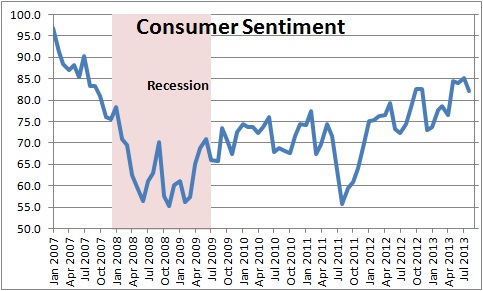
You may recall that the last time Congress tried to raise the debt ceiling was in August 2011. While it eventually found a solution (which, by the way, resulted in the government sequester of funds in March of this year), the debate raged until the last possible moment and the U.S. Treasury narrowly avoided default. As a consequence, consumer confidence plunged 16 points in July and August of that year to its lowest level since the recession, and third quarter GDP growth slowed markedly to 1.4%.
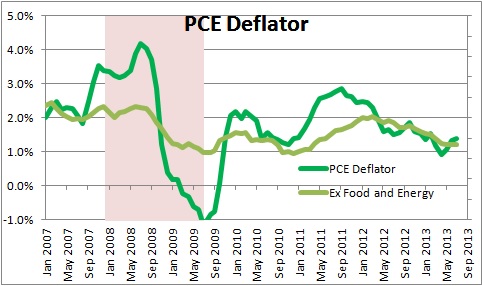
In addition to a slower pace of economic expansion, the Fed’s primary inflation measure — the personal consumption expenditures deflator excluding the volatile food and energy components — is expanding at a modest 1.2% rate which is far below the desired 2.0% pace.
So let’s see:
- Economic data suggest that contrary to everybody’s expectation third quarter GDP growth is not accelerating. Instead, it should continue at a disappointing 1.8% pace.
- A bitterly partisan debate in Congress about increasing the debt limit could negatively impact consumer and business confidence, potentially trigger a federal government shutdown, and reduce GDP growth.
- Inflation is expanding at about one-half of the Fed’s desired 2.0% pace.
Why is everyone so surprised that the Fed chose not to reduce is asset purchases at its meeting in September? The current environment is simply inconsistent with the conditions Bernanke described for the Fed to moderate its pace of asset purchases.
If the economy does, in fact, show more clear-cut evidence of gathering momentum in the next few months as almost everybody expects, and if Congress gets its act together and passes an increase in the debt ceiling in a relatively timely manner, there is plenty of time for the Fed to taper its asset purchases later this year and phase out the program entirely by the middle of next year.
While the Fed may have an expectation that the pace of economic activity will accelerate, they need more solid evidence before deciding to alter the direction of monetary policy for the first time in seven years.
Stephen Slifer
NumberNomics
Charleston, SC
Follow Me