
December 5, 2014
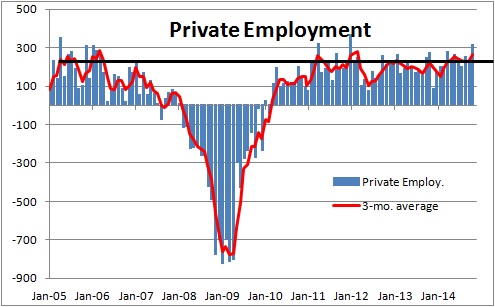
With each passing month the labor market keeps getting stronger which implies that the economy is also gathering momentum. The jobs report for November was a jaw-dropper. Private employment surged by 314 thousand. The gains were widespread across virtually all sectors. Previously reported increases for September and October were revised upwards. Firms also lengthened the workweek to produce enough output to satisfy demand. Average hourly earnings jumped the most since June of last year. Something is happening. If hiring is rising rapidly and those workers are working longer hours, they are presumably producing something – which is what GDP is all about. As a result, we are raising our projected fourth quarter GDP growth rate from 3.3% to 4.0%. A virtuous cycle of faster spending, more jobs, and higher income, leading to still faster spending, is seemingly underway.
Private sector employment climbed by 314 thousand in November, and upward revisions to September and October added another 32 thousand jobs. Over the past three months job gains have averaged 266 thousand. It just does not get any better than that. It is hard to argue that these successive increases are some sort of statistical fluke because they were widespread across virtually the entire spectrum of industries – manufacturing, construction, retail trade, health care, food services, professional and business services. That diversity by itself is evidence of significant underlying strength.
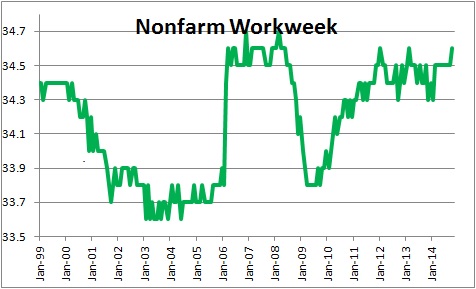
In addition to hiring 314 thousand new workers, firms had to lengthen the workweek by 0.1 hour to 34.6 hours to ramp up production enough to keep pace with demand. They had to pay more overtime. Monthly Job gains do not get any bigger, and hours worked and overtime hours simply do not get any longer, than they are currently.
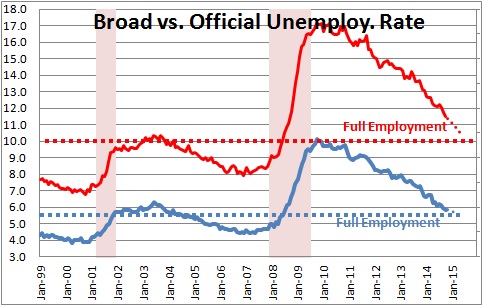
While the official unemployment rate held steady at 5.8% in November, the broad rate preferred by Fed Chairman Yellen fell 0.1% to 11.4%. With each passing month both rates are closing in on their so-called “full employment” levels. At full employment all workers who want a job presumably have one. We would suggest full employment will be attained for all measures of unemployment by the middle of next year. Once that occurs firms can no longer get the bodies they need from the ranks of either unemployed or underemployed workers. So where do firms get the workers that they need? They poach them from other firms by offering higher wages and/or more attractive benefits packages.
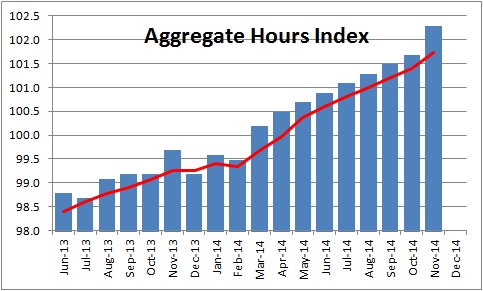
This combination of employment gains and hours worked can be captured by something called the “aggregate hours index”. If we know how many people are working and how long they worked, we should have some idea of how many goods they produced – which just happens to be what GDP is all about! Given the big increase in hiring and the longer workweek, the aggregate hours index jumped 0.6% in November. While we still do not know the index level for December, what we know from the available data for October and November suggests that the index should climb by 3.2% or so in the fourth quarter. If workers are even slightly more productive then GDP growth this quarter should be at least 4.0%. For this reason we are raising our estimate of fourth quarter GDP from 3.3% to 4.0%. If that forecast is accurate it would be the third quarter in a row of 4.0% GDP growth. Not bad!
The biggest reason why the Fed has not yet initiated a move to higher short-term interest rates is because of perceived weakness in the labor market. But the combination of faster jobs growth, longer hours, rising wages, and a surprisingly rapid decline in the unemployment rate, should convince the Fed that the time has come to wean the economy off of 0% interest rates. It no longer needs that kind of support.
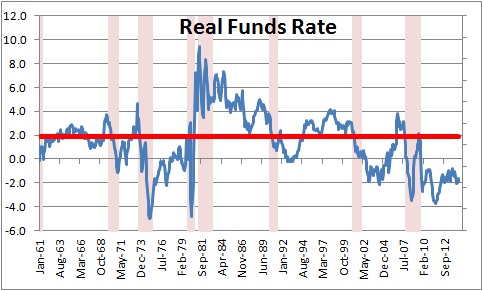
Over the past 50 years or so the fed funds rate has averaged 2.0% higher than the inflation rate. That is to say, the “real” (or inflation-adjusted) funds rate has averaged 2.0%. That is generally regarded as a neutral rate for the economy. With the funds rate today at 0% and the inflation rate at 1.8%, the funds rate is -1.8%. There was a time when the economy needed that degree of stimulus. That is no longer the case. The time for 0% interest rates is past. Stop stalling. Get on with it.
Stephen Slifer
NumberNomics
Charleston, SC
Follow Me