
January 22, 2016
Interpreting economic indicators is always tricky business. Each report provides a wealth of information. Unfortunately, economists can pick and choose whichever tidbits support their case. The object should be to provide an unbiased commentary so that the reader can be better informed and draw their own conclusions. However, in recent years — perhaps in an effort to attract viewers and readers or perhaps because of a political bias — the press seems to focus on the negative part of any given report. Bad news sells. Since the beginning of this year, in our view, biased reporting has contributed to investors’ fear and enhanced the market decline. A couple of examples.
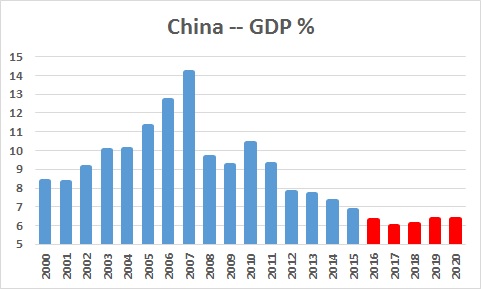
“Growth in China has faltered, slowing to 6.8% last year the slowest pace in a quarter century. The slowdown has rattled economies on every continent.” The statement is true, but hardly news. Indeed, GDP growth in China has been slowing for the past eight years. Furthermore, nothing that has happened recently has altered the outlook for China. For example, in April of last year the IMF projected growth in China for 2015 of 6.7%. In October it revised that forecast to 6.8%. What did it turn out to be? 6.8%. The IMF expects GDP growth in China in 2016 to slip to 6.3% and then level off at about that pace in later years. Like the 2015 forecast those projected growth rates have been essentially unchanged for a year. Olivier Blanchard, the former chief economist of the IMF, said “A collapse of growth in China would be a world-changing event. But there is just no evidence of such a collapse.”
A second example. “The International Monetary Fund it cut its global growth forecast (for 2016) by 0.2% from 3.4% to 3.2%.” That is true. But that would still mark a slight increase from 3.1% growth in 2015. The idea that GDP growth around the globe is on the verge of collapse is founded on fear – not fact.
“And then there is oil, which fell below $27 a barrel in New York just two days after settling below $30 for the first time in 12 years. Cheaper oil can be good news, signaling lower costs across the economy. But it may indicate slower demand from the factories, truckers and car buyers that use petroleum products around the world.” GDP growth in China has slowed which has produced some softening in the demand for oil. But the precipitous slide in oil prices is without a doubt primarily the result of an enormous increase in the global supply of oil. Oil production in the U.S. has doubled in the past 7 years as a result of hydraulic fracturing and horizontal drilling.
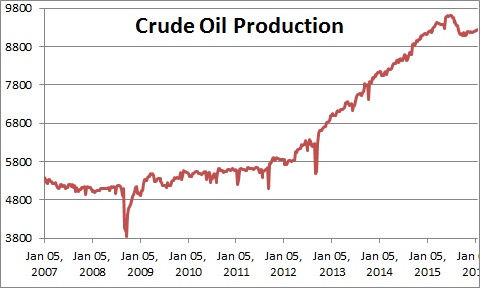
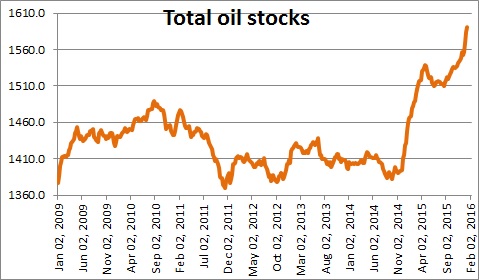
The doubling in output has caused oil inventory levels to climb to a record high level both in the U.S. and around the globe.
U.S. production continues apace. OPEC refuses to blink and is maintaining output in an effort to protect market share. And now as economic sanctions are being lifted Iran is poised to boost production which will exacerbate the global oil glut. Against this background, how can anyone seriously argue that falling oil prices are the result of reduced demand? That makes little sense, but the misplaced notion of a significant falloff in demand fuels market fear.
And why is it that nobody bothers to point out that falling oil prices stimulate global GDP growth? To be sure the results are uneven. Not all countries are better off. The winners are oil-importing countries. The top oil importers around the world are the European Union, the U.S., China, Japan, South Korea, and Japan. That group accounts for 73% of global GDP. The losers are oil-exporting countries. The top oil exporters are Saudi Arabia, Russia, Kuwait, Iran Iraq, Nigeria, the United Arab Emirates, Angola, Venezuela, Canada, and Mexico. That group of countries accounts for just 8% of global GDP. It should be obvious that falling oil prices will stimulate global growth. But, for now, that is not the way markets have chosen to view falling oil prices. They have focused exclusively on the negative impact on oil producers, but chosen to ignore the stimulative impact on consumers and any company in the transportation industry – airlines and truckers in particular.
The problem is that fear can become reality. Should the global equity rout continue – justified or not – there is bound to be a point at which consumers and employers anticipate slower growth. Consumers spend more slowly. Employers are reluctant to hire. In the past such a slowdown has never turned into a recession. But misplaced fear can trim a few tenths of a percentage point off of expected GDP growth for the year.
As this commentary is being written oil prices have rebounded above $30 per barrel and stock markets around the globe are rallying vigorously. Our hope is that the market has finally touched bottom and its early year behavior represents nothing more than a short-lived correction which will not significantly alter expected GDP growth for the year. In our view the recent selloff would have been less troublesome had the news services done a better job of providing more balanced reporting. Unfortunately, that is not going to change.
We continue to anticipate U.S. GDP growth for 2016 of 2.5%.
Stephen Slifer
NumberNomics
Charleston, SC


Stephen, thank you for your insight into the negativity generated by the media when they explain what is going on. As I get older, I have to convince myself not to become totally cynical about what I read and hear in the media. Thank you for your commentary, which almost always turns out to be right on track. …Darrel