
December 30, 2016
As the Fed flooded the banking system with excess reserves from late 2008 through the end of 2014, it created the potential for a future bank lending spree that could re-ignite inflation. For years those surplus reserves sat idle. That is no longer the case and the Fed needs to pay attention.
Beginning with the collapse of Lehman Brothers in September 2008 the Fed flooded the banking system with reserves visa its bond-buying program. Its goal was to pull the economy out of recession and boost GDP onto an acceptable growth track.
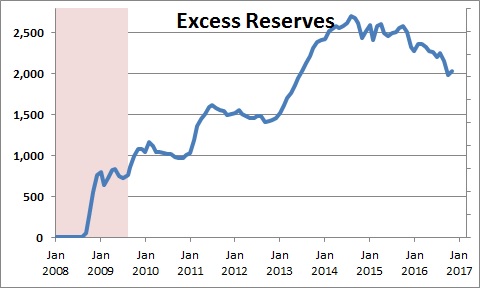
When the Fed purchases securities it buys them from a bank and places the proceeds in that bank’s “reserves” account which can be viewed as the equivalent of a checking account. As a result, excess reserves climbed from $2 billion to $2.5 trillion. Excess reserves represent the banking system’s ability to make loans. Because those assets earn essentially no interest there is an incentive for banks to make loans. The Fed provided the reserves but for years they sat idle. Why?

First, for banks to lend somebody has to be willing to borrow. Both consumers and businesses were grossly overextended going into the recession. Consumer debt in relation to income was at record high level.

Businesses were in a similar situation. Thus, consumers and firms needed several years to bring debt into closer alignment with income.
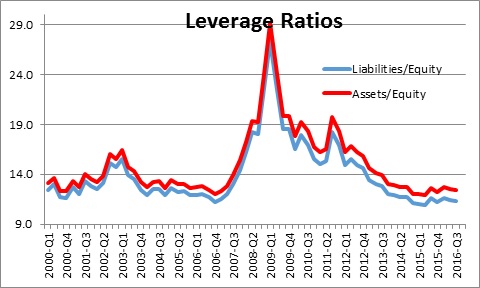
At the same time the Dodd-Frank Act imposed sharply higher capital requirements on banks and a stiff new regulatory environment. So between a need for consumers and businesses to re-structure their balance sheets, and an inability of banks to lend in the wake of Dodd-Frank, excess reserves at the Fed went unused for years.
But in the past year that has begun to change. First, consumers and businesses have paid down enormous amounts of debt and their debt in relation to income is the lowest in years. Second, the longer the expansion lasts the more confident businesses and consumers become which makes them more willing to borrow. As a result, total loan growth has quickened to a 7.5% pace.

Banks have used some of their excess reserves to make those loans so excess reserves have gradually declined from $2.5 trillion at the end of 2015 to about $2.0 trillion.
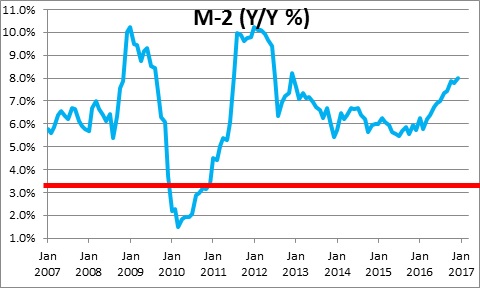
When the Fed provides excess reserves to the banking system and banks use to make loans, money supply growth accelerates. That did not happen for a number of years but since the beginning of 2016 faster loan growth has boosted growth in the money supply from 5.5% to 8.0%.
Finally, President-elect Trump has promised cuts in individual and corporate income tax rates and a sharp reduction in the regulatory burden. As consumer and business confidence continues to climb, and banks are freed up from the stifling regulatory environment imposed by Dodd Frank, loan growth and money supply growth could become even more rapid. Banks still have $2.0 trillion of surplus reserves.
With the explosion in excess reserves there has always been a risk that the lending process at some point could spiral out of control and trigger a worrisome increase in the inflation rate. That risk has always been there but now it seems a bit more worrisome. However, the Fed still has a couple of tools in its war chest to prevent that from happening.
First, as the Fed raises the Federal Funds rate it will simultaneously increase the interest rate it pays to banks on their holdings of excess reserves. That rate is currently 0.75%. As that rate rises it will provide an increasingly attractive, risk-free rate of return for banks which will increase the incentive for them to hold excess reserves at the Fed rather than lend them to consumers and firms with the commensurate risk of non-repayment.
Second, the Fed has indicated that it will not sell securities outright, but it will at some point shrink its portfolio by allowing security holdings it mature and not be replaced. Given the average duration of the Fed’s portfolio this process will take years for its security holdings to shrink to the point where excess reserves have been eliminated.

During the recession the Fed flooded the banking system with reserves and created a potential inflation problem at some later date. Given renewed confidence by consumers and businesses, increased willingness to borrow and lend, tax cuts and a less onerous regulatory environment, the Fed will need to pay close attention to excess reserves and money supply growth as it evaluates the path towards higher interest rates.
Stephen Slifer
NumberNomics
Charleston, S.C.
Follow Me