
December 10, 2010
Anyone who has taken Econ 101 knows that there is a relationship between growth in the money supply and the rate of growth in the economy, and they probably also recall that it is the job of the Federal Reserve to regulate the pace of money growth. So what is that relationship and why does it matter?
Without wanting to oversimplify the matter, the bottom line is that the rate of growth in the money supply tends to foreshadow growth in the economy six to nine months later. If the Federal Reserve can somehow cause the money supply to grow at a desired pace, then it has a good chance of getting the economy to grow at an acceptable rate.
Fed Chairman Bernanke and his colleagues at the Fed have told us that they believe that in the long run the economy can grow at roughly a 3.0% pace, and that they want to keep the inflation rate at about 2.0%. If we add those two numbers together, they are implicitly saying that they would like to see “nominal” GDP growth of 5.0%. Fed policy is designed to influence that “nominal” rate of growth in the economy. It cannot determine the split between growth in the economy and inflation, but it can influence “nominal” growth. If the Fed could somehow produce 5% nominal growth forever, they would likely end up with the desired “real” GDP growth rate of about 3.0%, and the desired inflation target of 2.0% or less.
If the Fed wants “nominal” GDP of 5.0%, how much money growth should it allow? The short answer is that it should allow the money supply to grow at about that same 5.0% pace. If money grows more rapidly than that for a long enough period of time, the Fed will almost certainly cause the inflation rate to accelerate. If money growth is too slow, the economy will not expand as quickly as they would like.
So what has been happening to money growth over the past couple of years? The chart below shows money growth following the dramatic easing by the Fed in late 2008. The Fed began buying securities of all types in an effort to pull the economy out of its slump and money growth accelerated. Money growth had been chugging along between 6.0-7.0%, but suddenly jumped to 10.0% by December 2008. Note three things:
- Money supply growth of 10% was far in excess of the 5% pace that would be required if the economy were on an even keel. The Fed effectively put the pedal to the metal.
- The economy responded and came out of recession in June 2009 which was much sooner than what most economists expected.
- The acceleration in money growth led the economy by 6-9 months.
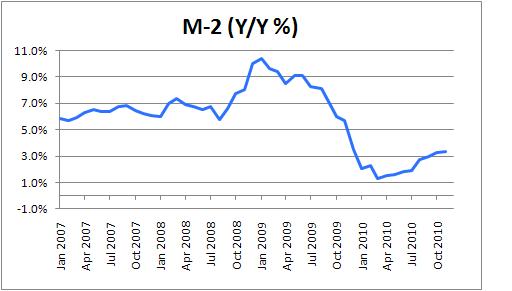
Then notice that money growth slowed dramatically in 2009 and by January 2010 was down to about 2.0%, much less than the 5% pace required over the longer term. That was followed by slower growth in the economy beginning in the second quarter of this year. This time a slower rate of money growth foreshadowed a slower pace of GDP expansion.
And now for the coupe de grace. Money growth has recently begun to accelerate. The year-over-year growth rate is now 3.4%, but more recent growth has been even faster. In the last six months, for example, money growth has been 5.3%, and in the most recent 3-month period it has been even more rapid at a hefty 7.0% pace. This faster rate of money growth is quite clearly telling us that the economy is going to gather momentum as we move into the spring which is consistent with our expectation that GDP growth in 2011 will accelerate to a 4.0% rate.
When trying to anayzle the economy, money growth matters. No single economic indicator is infallible, but when the acceleration in money growth is combined with a signficant reduction in consumer debt, rapid growth in weekly earnings, a noticeably faster pace of consumer spending in recent months, a significant drop in layoffs, and corporations sitting on a mountain of cash, the conclusion is inescapable — The economy is on the cusp of an impressive acceleration of GDP growth in 2011.
Stephen Slifer
NumberNomics
Charleston, SC
Follow Me