
June 8, 2012
In the wake of the recent stock market decline and signs that the pace of global economic activity may have ratcheted downwards, will the Fed ride to the rescue with another round of easing? What form might it take? Will it be successful?
For the Fed to take further action, they need to see evidence that the economy is expanding at a pace slower than the 2.4-2.9% range they projected in April. Given recent data they may marginally trim that forecast. In April they expected the unemployment rate to end the year in a range from 7.8-8.0%. There is no reason for that projection to change. So while the Fed may tinker around the edges, they will not significantly downgrade their economic outlook. Why not?
First, the stock market, while volatile, has declined only about 7% from its early April peak which is less than one-half of the drop registered in the spring of last year.

Second, consumer confidence measures are mixed with the University of Michigan series showing no sign of decay, while the Conference Board index has declined modestly. Last year, you will recall, in response to a variety of factors confidence plunged to levels last seen during the recession.

Finally, layoffs have risen only marginally, factory orders have slowed but are not declining, oil prices have fallen sharply and will be providing a tailwind for the economy in the second half of the year, and the housing sector is steadily improving.

Against this background, it is hard to imagine that a majority of Fed officials are going to significantly downgrade their economic outlook, but it could be nudged lower. This will almost certainly initiate a discussion of whether further policy action is required.
Typically when the Fed decides to ease it lowers short-term interest rates. But given that short rates have been at zero for more than three years that option is off the table.

A second option would be to add reserves to the banking system. Ordinarily when the Fed provides reserves it pushes short-term interest rates lower. Given that such rates are already at zero that cannot happen. What happens instead is that the additional reserves provide more ammo for the banking system to make loans to consumers and business people. In two earlier rounds of easing, known as QE1 and QE2, the Fed has provided $1.5 trillion more reserves than are currently being used. If the current volume of reserves is sitting idle, throwing more fuel on the fire is not going to help the economy. Indeed, it will only complicate the issue at that point in time when the economy strengthens and the Fed needs to tighten. It must then eliminate that overabundance of reserves. Strike this option as well. It makes no sense.

There is a third choice for the Fed. They own lots of government securities. If they sell some of their holdings of Treasury bills and short notes, and buy an equal amount of longer-term notes and bonds, they will not add more reserves to the system and they might be able to push long-term interest rates lower. Indeed, in September of last year they decided to do $400 million of these swaps by the end of June 2012. Beteween then and now the yield on the 10-year Treasury note has fallen from 2.0% to its current level of 1.65%.

Thirty year mortgages rates declined by a roughly comparable amount from 4.1% to 3.7%. If the Fed is concerned about some softening in the pace of economic activity, their only real choice is to extend the swaps program by another $400 or so between now and yearend. Doing so might lower long-term interest rates by 0.3-0.4%.
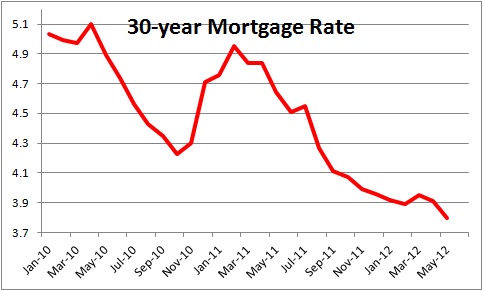
The extent to which such action might help is debatable. Our sense is that the economy will gather momentum on its own without any such Fed action and that lower rates will not help much. But that is irrelevant. For Fed officials, any softening of the economy from what they anticipated in April will mean that the unemployment rate will remain elevated for an even longer period of time. That is unacceptable. They will probably choose Option #3 and extend their swap program. While lower long-term interest rates may not help much, the really important point is that they will not hurt. There is no downside.
Stephen Slifer
NumberNomics
Charleston, SC


Hi Steve…In option #3…don’t the Chinese own a lot of these gov securities? What effect might that option have on their option to sell or keep them? Massive quantities I understand are owned by them…
Hi Randy. You are right that the Chinese own a lot of our debt. Here are a few facts. First, as of March 2012 we had $10.3 trillion of debt owned by the public. Of that amount $5.1 trillion, or almost 50%, was owned by foreigners. And of the amount owned by foreigners China held $1.2 trillion while Japan was close behind at $1.1 trillion. So each of those countries own about 10% of the total amount of our debt outstanding. Interestingly, however, they have not really been buyers of Treasury securities for more than a year. Take a look at this table published by the Treasury:
http://www.treasury.gov/resource-center/data-chart-center/tic/Documents/mfh.txt
But what if they decide to dump them? Clearly we have a problem. But if they decide to dump them what are they going to buy? Euros? Not very likely given what is going on now. Yen? First of all, the Japanese do not issue enough yen-denominated debt to make that possible. And even if they did, given the current state of the Japanese economy is that where you want to go? I doubt it. The reality is that when people get scared (like right now) they buy Treasuries.