
December 31, 2010
As we close out 2010 and look ahead to next year, the economy is clearly gathering momentum. GDP growth for the fourth quarter should approach 5.0%. GDP growth for 2011 is expected to be 4.0%. The economy should soon crank out a considerable number of new jobs so that by yearend 2011 the unemployment rate should decline to 8.7% from its current level of 9.8%. Part of the reason for the expected growth acceleration is that consumers and corporations in America have spent the past two years actively paying down debt. However, not all sectors of the economy are following suit. Federal government debt has skyrocketed in the past three years. While this debt deluge will not harm the economy for the next several years, it does present a major threat to the economy in the second half of the upcoming decade.

The most rapid de-leveraging in the past couple of years has occurred in the financial sector (the olive green line on the chart above). That is no great surprise given the rapid debt accumulation by financial firms in the first seven years of this past decade, and the extreme pain inflicted on the banking and investment banking community following the collapse of Lehman Brothers in September 2008.
Non-financial firms in America have behaved in a similar manner. By investing heavily in productivity-enhancing technology and equipment, corporate profits have soared. Those profits are being used to both reduce debt and accumulate unprecedented amounts of cash.

In the early years of this past decade consumers were accumulating debt almost as rapidly as financial firms. They, too, have felt a compelling need to retrench in the past three years, as shown by the red line on the earlier chart. As a result, their debt burden has shrunk almost to its historical norm. This means that during 2011 consumers will not need to pay down debt as aggressively as they did in the past couple of years, which will leave them with more money to spend.

This debt reduction by financial and nonfinancial businesses and by consumers is a major reason why the economy should expand at a significantly more rapid rate in 2011.
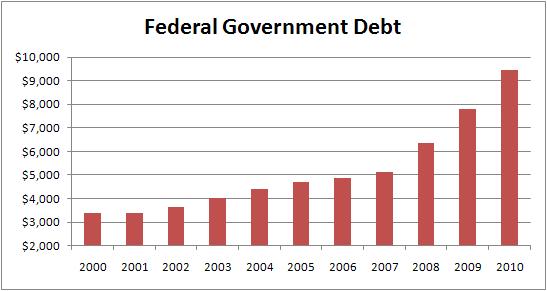
However, there is one sector of the economy that over the past three years has gone in absolutely the opposite direction and added significantly more debt – the Federal government – as shown by the blue line on the earlier chart. Indeed, government debt has grown at annual rates in excess of 20% in each of the past three years, and the amount outstanding has doubled in that period of time.
Rapidly rising government debt has offset most of the combined debt reduction by consumers and businesses. As a result, the debt to income ratio for the economy as a whole is still way out of whack with where it ought to be. Over the last 140 years of our history, debt outstanding has been about 1.5 times income. There have only been two exceptions – the 1920’s and 1980-2008. The first episode was in the 1920’s. By 1929 this ratio had climbed to 3.0 times income. Then the stock market crashed, debt became a huge problem, and suddenly the U.S. was in a depression. This ratio then declined for a decade until it stabilized following the outbreak of World War II. It stayed low for the next 40 years until it began to rise again in the early 1980’s as credit became readily available. It finally peaked anew in 2009 at 3.7 times income. If history is any guide this ratio is likely to fall for a decade as burned consumers and businesses become debt shy.

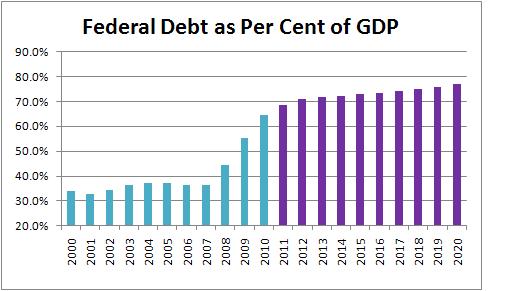
The Federal government debt explosion, however, has become a major issue. Federal debt outstanding has climbed from about 35% of GDP for most of the early part of this decade to 64.4% in 2010. Using the President’s February 2010 budget forecast that percentage will climb to 77.2% by 2020. But so what?
Three factors are worth noting.
1. The comparable federal debt/GDP percentage for Ireland in 2010 was 55.2% vs. 64.4% for the U.S. The European community is already expressing concern about Ireland’s ability to repay its debt, which is pushing interest rates significantly higher. If the U.S. does not soon get its fiscal house in order those same credit issues could well spread here.
2. The IMF outlook for the U.S. is not as rosy as the President’s. Its forecasts only go out as far as 2015 at which time they anticipate that the debt ratio will have climbed to 84.7% versus 73.6% for the Administration. No one knows what truth will be, but the IMF outlook suggests that the likely direction of error is for the ratio to be higher than the Administration expects which, in turn, increases the likelihood of a European-type debt problem eventually emerging in the United States.
3. The most recent recession ended in June 2009. The longest expansion on record lasted exactly 10 years (from March 1991 to March 2001), but most have been shorter. The three most recent ones have averaged about 8 years. Thus, it is likely that a recession will emerge sometime in the second half of this coming decade. If the debt/GDP ratio is, say, 75% going into the recession, what will it be coming out?
The bottom line is that the near-term outlook for the economy is quite positive, especially for 2011. By 2012 the Fed will begin a relatively slow, but steady, tightening initiative that might take two years. Thus, the economic outlook for the 2012-2014 period is still good, but not quite as rosy as for 2011. Any time the Fed enters the picture and starts tightening, the forecast becomes just a bit dicier. That Fed tightening initiative could easily set the stage for a recession sometime in the 2015-2018 period. The U.S. simply cannot go into the next recession with the federal debt/GDP ratio close to the 75.0% mark. If it does, those debt woes could bring back unpleasant memories of the U.S. economy in 2008 or the European economy in 2010. It is imperative that President Obama and the new Congress devise a plan to significantly reduce budget deficits in the medium term. We can no longer afford to kick the can down the road and postpone the day of reckoning. And make no mistake, there will be pain associated with any plan they can devise. Be prepared. Taxes are going up, and government spending of all types is going to get slashed well beyond where it is today.
Stephen Slifer
NumberNomics
Charleston, SC


This is a very clear, concise and understandable picture of the “good news/bad news” road ahead. I think the biggest concern continues to be the inability of both the American people and their elected leaders to come to grips with the reality of the ballooning federal deficit and its consequences. No one wants to raise taxes, and we’ll have to. No one wants to adjust benefit programs, and we’ll have to do that too.
If I had a choice, I wouldn’t place any substantial financial bets on the prospects for seriously addressing the deficit in the next five years, but unfortunately we’re all placing this bet whether we want to or not.
Thanks for your comments, Bill. Unfortunately, our politicians are not very good at responding to anything unless there is a crisis. Then things seem to happen in a hurry. As maddening as that process may seem, it has somehow worked pretty well over the past couple hundred years.
Also, as I traveled the cocktail circuit during the Christmas holidays nobody came up to me and wanted to talk about the impending budget problem. Well, maybe it is not the time of year to address such serious issues. But they all know I am an economist and frequently want to know what I think. But not about the budget. They want to know when we are going to create some jobs. Or they want to know how high the stock market will go. Or when we are going to have an inflation problem. But I can’t tell you the last time anybody has expressed any genuine concern about the budget. Perhaps it has been talked about for so long that people simply do not believe it is a legitimate problem. If we don’t care, why should our politicians?
Steve