
March 1, 2013
Every six months the Congressional Budget Office (CBO) revises its budget forecasts. Unfortunately, the outlook is worse now than it was in August of last year. In fact, projected debt outstanding in 2023 is $4.0 trillion higher now than it was six months ago primarily because of the American Taxpayer Relief Act passed at the end of last year. This legislation made the Bush tax cuts permanent for all but a small group of wealthy taxpayers. The associated reduction in tax revenue increases both the annual budget deficits and debt outstanding. The need for budget cuts today is more pressing than ever.
Under current law the CBO predicts that the debt ten years from now will be 77% of GDP. Prior to the recession it was 35% of GDP. In the past five years it has climbed to 75% as the economy shrank and lawmakers tried to jump start it. Thus, 10 years from now the debt to GDP ratio is little different from what it is today.
But that forecast incorporates spending cuts and tax increases that may not occur. For example, Medicare physician payments are scheduled to be cut 25% in 2014. But lawmakers have overridden these cuts in the past and are likely to do so again. Some of the “sequestration” cuts may also be overridden. The CBO also provides an alternative forecast using less favorable assumptions which most economists believe is a far more realistic scenario. In that event the debt to GDP ratio will climb to 87% by 2023 which is dangerously close to the generally regarded 90% danger level.
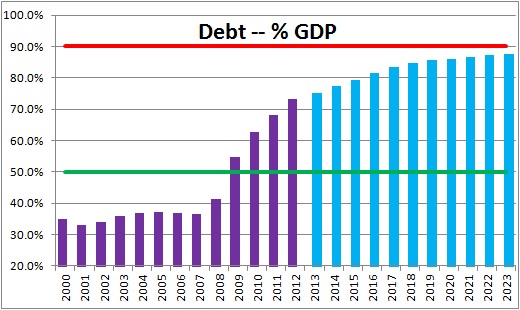
Unfortunately, that is just the tip of the iceberg. Beyond 2023 the debt to GDP ratio climbs rapidly and by 2038 will approach 200% unless action is taken to alter that course. To put that in context, Greece today has a debt to GDP ratio of 186%.
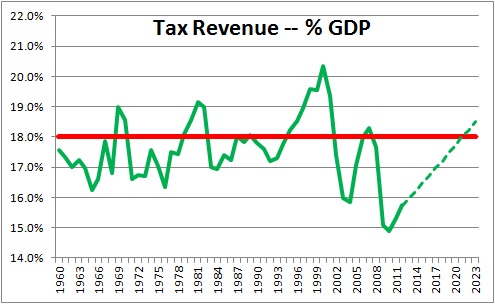
The problem is not on the revenue side. The CBO suggests that in 10-years time revenues will climb to 18.5% of GDP which is slightly above the long-term average of 18.0%. The revenue increase is partly attributable to the 2% increase in the payroll tax that occurred at the beginning of the year, but also to the tax increase on high income taxpayers that was passed earlier this year, and tax hikes enacted in 2010 to fund the expanded health care coverage sometimes known as Obamacare.
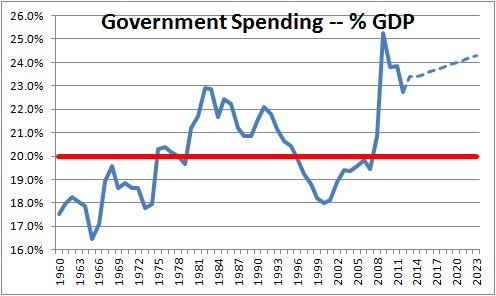
The problem is that government spending is out of control. Spending climbed to a postwar high of 25.2% of GDP in 2009 as policymakers attempted to stimulate the economy. It has come down slightly in the past few years, but will resume growing faster than GDP in the second half of this decade and exceed the 24.0% mark in 2023 compared to its long term average of 20%. CBO suggests that by 2038 — 25-years from now — spending could climb to 35% of GDP. Unless spending is reduced, Americans will be subject to unprecedented levels of taxation, a vast increase in indebtedness, or some combination of the two.
Why does spending climb so rapidly? Largely because the baby boomers will be retiring. They were born between 1946 and 1964, which means that they will retire between 2011 and 2029. As they retire they collect Social Security benefits. They become eligible for Medicare. Indeed, the projected growth in spending is entirely attributable to Social Security, Medicare, Medicaid, and the new expanded health care coverage.
The projected high and rising debt burden could have serious negative consequences. As interest rates rise to more normal levels, spending on interest payments will increase substantially. Policy makers will have less flexibility to use tax cuts and increased government spending to respond to unexpected difficulties. The risk of a fiscal crisis similar to what several European countries are currently experiencing will increase if investors lose confidence in our government’s ability to manage its budget.
The demographics associated with an aging population exacerbate the problem, but solutions such as those outlined by the Erskine-Bowles commission are available. The commission recommended a sensible combination of significantly lower tax rates, elimination of most tax deductions, and sharp cuts in both defense and nondefense spending. What is lacking is the political will to embrace these policy changes. Over the course of the next month our lawmakers will, hopefully, find the courage to do what is necessary. They owe it to our children and grandchildren.
Stephen Slifer
NumberNomics
Charleston, S.C.
Follow Me