
July 20, 2012
This past week we got June retail sales data which were surprisingly weak. Any way we slice and dice the data they were still anemic. As a consequence, we lowered our GDP forecast for the second quarter from 2.0% to 1.5%. That figure will be released on Friday, July 27. Every other economist appears to have done the same thing. This means that first quarter GDP growth was a modest 1.9%, and now, presumably, second quarter growth is 1.5%. So what gives? Are the pessimists right and we are on the cusp of dipping back into recession? Or is this a temporary phenomenon which will give way to faster growth in the second half of the year?
Even though we (grudgingly) lowered our second quarter GDP estimate to 1.5%, and are forced to acknowledge that first half growth was less than what we had expected, we are still in the camp that believes this is a growth pause which will be soon be reversed.
Are consumers and business people perhaps worried about the “fiscal cliff” that is currently scheduled to occur at the end of this year? On December 31 the Bush tax cuts will expire, the alternative minimum tax will ensnare a much larger number of tax payers, payroll taxes will climb and thereby reduce take home pay, defense spending will be slashed, unemployment benefits will be curtailed. The Congressional Budget Office estimates that GDP could grow 1.7% in the first half of next year, but if the tax increases and spending cuts are fully implemented GDP would decline 1.3%.
But that is not going to happen. No one is going to deliberately push the economy over the edge into recession. The American people would justifiably blame them all – the President, Congress, Republicans, and Democrats. Unfortunately, this situation is remarkably similar to the debilitating debt limit debate last summer which pushed the Treasury to the brink of default. Almost certainly nothing will be resolved until the deadline is imminent. But, in the end, we believe that almost all of the tax increases and spending cuts will be postponed.
Having said that, people may well worry about its possible consequences for the next five months. Could retail sales be a sign that consumers are becoming nervous? Probably not. Too many other indicators suggest that the economy is chugging along at a moderate pace and not on the brink of something more ominous.
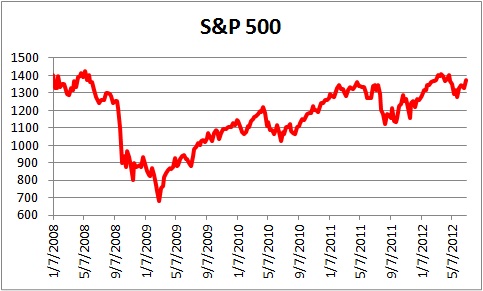
If investors are worried about the “fiscal cliff” and concerned that the economy might fall back into recession next year, why is the stock market within 2.5% of its high for the cycle?
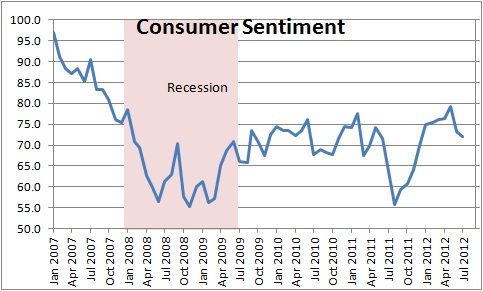
If consumers are so worried, why isn’t consumer sentiment lower? Consumer sentiment fell sharply in the summer of last year. Shouldn’t it be at least as low today if there is a realistic chance that the economy could slip back into recession in the early part of next year?
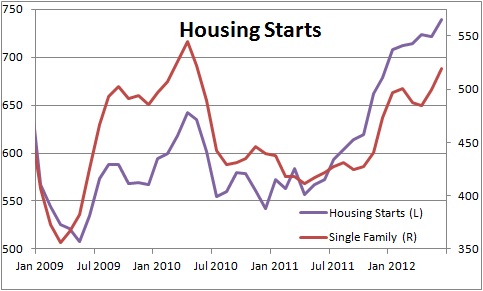
If consumers are pulling back on their spending and buying fewer “goods” as evidenced by the softness in retail sales, why are home sales and car sales – their two biggest purchases – so robust? It is difficult to reconcile their willingness to spend on these two big ticket items with the slower pace of sales on other goods. Most likely the recent retail sales weakness will give way to a faster pace of spending in the months ahead.


If firms are so worried, why are builders feeling the best they have since the pre-recession days of 2007? Why are housing starts soaring? It is hard to make a case that builders are worried.
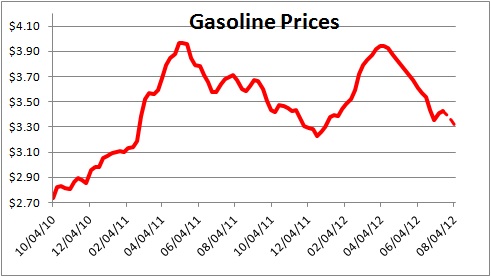
Finally, won’t gasoline prices have a positive impact on GDP growth in the second half of the year as consumers have money left over to spend on other goods and services?
The bottom line is that we do not have a good explanation for the June weakness in retail sales. We fully expected something a bit more robust. And we are disappointed by the softness in GDP in the first half of the year. But so many pieces simply do not fit with the notion that the economy is teetering on the brink of a recession, and/or that consumers and business people are pulling back on spending because they are worried about the “fiscal cliff” that might occur at yearend. While people talk a lot about it, few actually believe it will happen. Don’t panic. Things will look better soon.
Stephen Slifer
NumberNomics
Charleston, SC
Follow Me